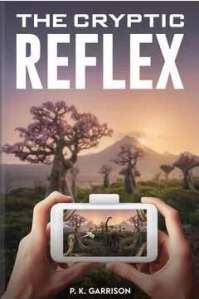
 The Cryptic Reflex (Broken Spine Books, 454 pages) by P. K. Garrison is an adventure novel or “novel of the road,” along the way of which the explorers debate major social, scientific, and philosophical questions.
Putting characters in an extreme and exotic environment is a good technique for triggering such discussions. People don’t usually conduct deep explorations of the human condition in a coffee shop during a regular work day lunch. That would seem artificial. A fiction writer either has to create some trauma for his characters to justify the soul searching or put them in a strange world that makes them question their assumptions.
Garrison found the perfect setting and goal for his characters to tell this kind of story. Five men and one woman (Kendal who is the narrator) travel to Socotra, an island off the coast of Yemen, where the Dragon Trees and electric blue water provide an exotic otherworldly scene. As a woman in a Muslim country, Kendal is further alienated, made self-conscious of her sexual attractiveness, and she adapts uncomfortably to the custom of wearing a hijab. The group’s mission is to find a “cryptic,” that is, an animal that most zoologists consider to be mere legend.
The novel touches on many issues, but the dominate theme concerns the need to open one’s mind to consider the previously impossible. The characters each has something in their personal histories that made them become the kind of open-minded person willing to make this journey. For Kendal, it was her father’s attitude. He read her stories from the Bible as fiction, but when she asked if there were any truth to the stories, he told her “that anything is possible.”
The objective of their trip is to document a new species, a black and gold snake that, according to legend, guards frankincense trees on Socotra. The professor leading the team of biologists/zoologists is an off-beat character who has been ejected from respectable scientific community due to his interest in cryptic species. In the opening chapters of the book, the depiction of Professor Roop as a zany man (with an even zanier sometimes naked wife suffering from dementia) reminded me of a character in a Thomas Pynchon novel. But Roop develops from this initial caricature into respectable, if still eccentric, researcher whose craziness is ultimately explained/justified as part of the plot.
Garrison’s characters discuss several novel scientific hypothesis and anomalies, that sound like fantasy but, in fact, are not merely fictional: the Heck brothers, who sought to “switch evolution into reverse gear and breed back to extinct animals”; crypto-amnesia, when a person under hypnosis seems to remember details from a past life but is actually remembering something, such as a foreign language, that he/she learned subconsciously; and the remote possibility that not all dinosaurs went extinct.
Garrison handles the heady conversations in dialogue in a natural way. Although the two Russian photographers on the trip never break out of their roles as clowns due to a language barrier, the other characters are interestingly fleshed-out. Owiti the African secular-Muslim translator, who speaks Russian, English, Arabic and the native dialect of Socotara, is a complex person who teaches Kendal not to oversimplifying Islamic culture. Koz, the ugly zoologist who befriends Kendal, teaches Kendal to have more empathy. Roop becomes both a father figure to Kendal and a damaged child that Kendal mothers.
After the climax of the plot, the professor sums up the point of their trip for his “students”:
“The cruelty of traditional science,” Roop said, “is that it seeks not to understand but to objectify, codify, pin down, pickle in formaldehyde—in essence destroy—the objects of its study; but the funny thing about science’s evolution, its tragedy and its triumph, is that the more ‘sophisticated’ and esoteric it becomes, the greater it distances itself from its objects until, in the end, it does away with these objects altogether, giving itself away for all it ever was and ever could be: the wrinkled face of the lonely old savant staring into the cracked mirror he’d intended to hold up to the elusive real. Cut to a most insidious, hilarious scene, to a chorus of clever technicians in off-white coats mimicking the chatter of a counterfeit universe. But never fear, oh obstinate defenders of never-ending progress, for, presto chango, there suddenly sounds a roar of celebration from within the hallowed halls of learning; for, whether by mistake or on purpose, they have engineered a trick more amazing than even the greatest of magician could muster. This is what they have hoped and prayed for all along: a cold, hard autonomy, unsusceptible to all experimentation and mutability. Now forever untouchable, science has cut itself loose from the viscous and preposterous business of objective investigation, dispensed with all the briny corpses stinking up the laboratories—oh, those corpses, those inglorious specimens, are still there, of course, but only for the sake of the dumbstruck masses, only for gruesome show. Yes, science has finally risen to the Olympian heights to which all charlatans and flimflam artists aspire. They have become immortal, taken their seats in the majestic and fraudulent pantheon. They’ve cheated death, but only at the cost of an authentic life.”
Kendal, playing the part of the critical reader, thinks in response, “I wasn’t entirely certain what the professor was talking about, but his disdain for purely speculative science was clear enough. What I couldn’t gage was the degree to which he himself still believed in reality, whether he lamenting its loss or its premature eulogy.”
Garrison road novel of ideas is tolerant of different perspectives, religions and cultures. The Cryptic Reflex works on many levels to expand a reader’s horizons.
If I may append a final note, I was delighted to be introduced to the Yemeni island and its culture. It is a strangely beautiful country with a much longer, richer Arab culture that the faux Gulf States that have been propped up since WWII. Somewhat auspiciously, the novel touches lightly upon the US empire’s invasion into this ancient culture, which has only recently become a flash point in the opening moves of WWIII. The novel is worth reading just to be introduced to this strange and beautiful place.
–V. N. Alexander, author of The Girlie Playhouse, 2026

