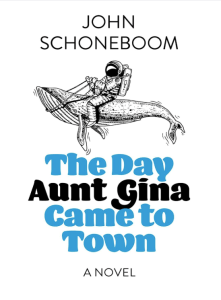
 The Day Aunt Gina Came to Town (Round Fire Press, 200 pages) is not about the day Aunt Gina came to town; she only arrives on the last page. The story is about the fun that novelists have making things up, specifically inventing the backstories for characters and providing commentary on the thoughts that make characters seem interesting—even though their lives are in fact dull. The playful omniscient narrator makes this novel more than interesting. It’s fascinating, hysterical, and witty.
The narrative focuses on an ordinary suburban family of four who have no real meaningful interactions and instead appear to imagine all manner of impossibly exciting lives for themselves. The patriarch Bapa Jim is an advertising executive who either dreams of being or is secretly a propagandist who starts wars and puts a stop to all would-be wonderful social programs and policies around the world. His wife Matalulu wants to be a cabaret singer who gets embroiled with the mob over gambling debts. It is Matalulu who invents(?) Gina as an excuse to get out of the house. Their son Saho, once a promising young man, is now a food/drug addict. Their wallflower daughter Bahena rises to the top of a corporation whose clients are space aliens, who can communicate only with Bahena and who really get her.
A passage that shows off that narrator’s wit is this ironic close third-person account of Saho, whose character channels Martin Amis’ self-deprecating dwarf hero in Dead Babies — except Saho is not capable of the self awareness; that’s the narrator thinking for him.
Saho crept into the kitchen looking for a snack. Why creep? Why not walk boldly forth? Indeed, why not sashay? Because Saho was not proud of his trip to the kitchen. The whole way there from his room he felt worse and worse and had to keep attacking the idea of turning around, of not going into the kitchen, he had to punch and kick that idea until it was all smashed and made him sick. He felt it as sure as he felt the ground under his feet, felt self-loathing, a self-loathing that poked him over and over again whenever he did something that he loathed about himself, poked him without pause, right in the forehead, mercilessly, like an insane child-devil from the sort of movie he couldn’t even watch anymore.
On the whole, Shoneboom’s novel reminds me of David Foster Wallace’s Infinite Jest, only it’s much shorter (200 pages) and consistently funny throughout. Although DFW (the writer not the airport) begins his novel with a spectacularly humorous scene, the humor is not sustained. The cast of characters seem similar to DFW’s as well, foreign spies, mafia bosses, cabaret dancers, political leaders, suburban families, and drug addicts.
Schoneboom makes up innumerable backstories for the various femme fatales who might be, according to different scholars, the Aunt Gina for whom we wait. Almost all of them are cabaret performers who marry military men. Most take after Mata Hari in one way or other. One of the many possible character backstories ends this way: “There’s no tragic ending here. She went on to publish two novellas about the demimonde, now sadly out of print, and an instructional manual about how to speak a song [this Gina was known for her “patter songs,” think Leonard Cohen]. In her declining years she ran a school for girls.”
I love the last line in particular; in my own novels I have cooked up such details, as startling asides slipped in smoothly between commas, and felt very clever in doing so. Of course, no author can top the most famous parenthetical backstory in literary history, that is Vladimir Nabokov providing the information about how Humbert’s mother died young as, “(picnic, lightning)” but Schoneboom comes close sometimes: various persons named Gina in history have owned or worked at cabarets, one such business shifted “its focus from dancing to being a blackmail-oriented Satanist gambling sex club for mob-connected politicians working for the intelligence agencies.”
Schoneboom even makes up a cultural movement, the Finnish Cabaret Scene, packed by bourgeoisie audiences, that savagely satirizes the bourgeoisie.
A writer may be at liberty to just make things up, but an infinite number of background details have to be eliminated, not told about the character, in order to do characterization properly. Schoneboom playful demonstrates what he could have written about Aunt Gina and decided not to. He reveals details that could have turned an imaginary literary persona into a real human being with a soul that every reader could relate to, but this magician performs with the lights up, showing you the trick.
Here’s how it didn’t happen. Whoever Aunt Gina may or may not have been, she hadn’t taken the train out to the beach during the off season, even though, presuming she is real in the ordinary sense, she would know that the coast is lovely at any time of year, even when it’s cold, windy, and overcast, maybe even especially lovely, evoking the sublime feeling of simultaneous joy and desolation, life and death, now and forever, which simple blue skies and unquestioning warm rays can never convey.
Schoneboom takes this game, imagining various persons that may or may not be Gina, to it’s limit when imagines a man working in a complaints department reading letters from consumers, one letter of which might be signed by a Gina, although the signature is illegible. This very sensitively drawn man gets an entire chapter, and all of it is hilarious.
Because the various Ginas have stage names, any cabaret dancer could be Gina. One dancer named Mata Gula stands in for all dancers in this clever passage that I—as author of a novel which satirizes public appreciation/rejection of the art form—found spot on:
The astonishing effect of her work was not to lower her social standing but rather to elevate the art of erotic dance into respectability. She mingled on equal or superior terms with the wealthy and became the long-term mistress of a millionaire industrialist: she was the toast of Paris. The worshipful press called her majestically tragic and wonderfully strange and compared her entrancing gracefulness to that of a wild animal.
Mata Gula’s heyday as a dancer endured for about five years before myriad imitators diluted her brand. She found herself emblematic of a genre now populated by dancers who relied on straightforwardly cheap exhibitionism, not bothering with the sensual or the mysterious or the enveloping mist of mythic narrative. These newcomers had otherness, but it was the wrong kind, so that the enterprise as a whole suffered reputational damage. Critics began to complain that exotic dancing lacked artistic merit after all. When one expositor from a serious cultural institution called out Mata Gula specifically for being a dancer who could not dance, her career began an unmistakable decline. … She ended her dancing career with a final performance that brought out a sentimental audience that treated her one last time as the star she had been, bidding farewell with tears, love, and a standing ovation.
The hyper metafictional The Day Aunt Gina Came to Town is a novel for novelists. It’s for readers who know that willingly suspending disbelief is for amateurs.
V. N. Alexander, author of The Girlie Playhouse, 2026

