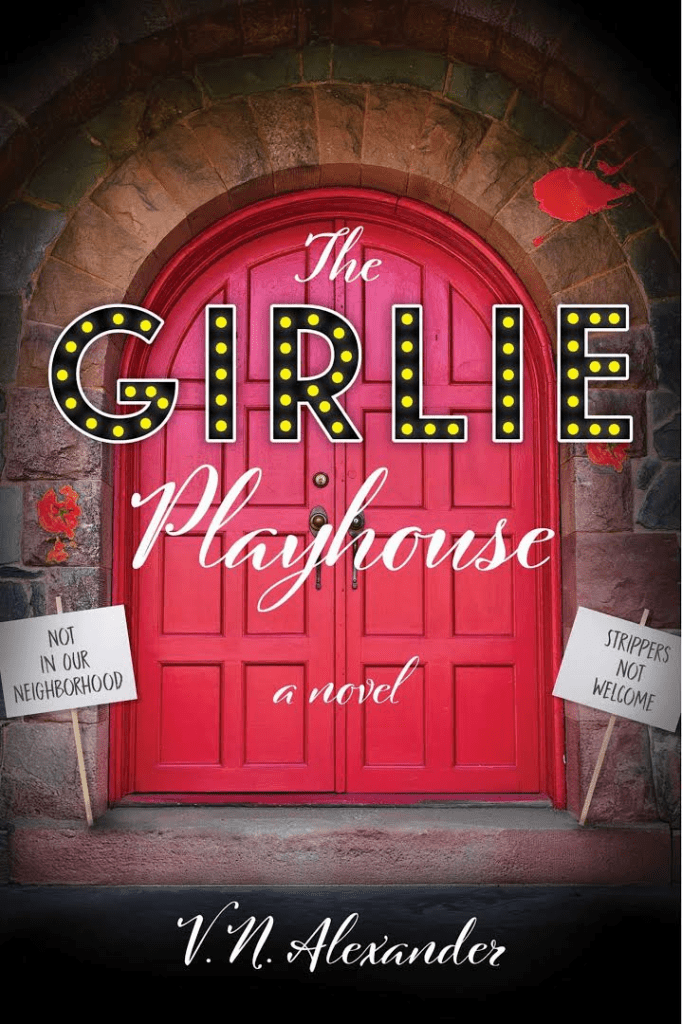
V.N. Alexander, The Girlie Playhouse: A Novel, N.Y.: Heresy Press (Skyhorse Publishing), 2025, 239 pp.
Mothers and Daughters
We begin with the dedication page: “To Tricia, my mother.” This would be not a particularly noteworthy dedication except for the main theme of the book. For this novel is not one more Fathers and Sons; but it is one more Mothers and Daughters. The main character is the narrator, known only as Pixie; we never learn her real name. Pixie’s personality has been molded almost in toto by one central event: the murder of her mother when Pixie was only four years old. “Ever since the day Mother died, I have been dancing, always naked, usually alone, even on the days I don’t go into the cabaret . . . Dancing works on me like a favorite perfume: when I smell the Iris 99 Mother wore on that day—so vivid, so compelling—the whole episode is replayed . . . I dance as if no one were watching, as if I were completely alone and nothing mattered, nothing at all . . .” Mad dancer as narrator. Will this narrator prove somewhat unreliable? You guessed it.
Where are we and when? This we never learn, since all the place names in the book are fictitious and the time frame hazy. The action takes place largely in a big city, somewhere on the eastern seaboard. A fictional New York? DC? Could be. The only photo that Pixie has of her obscure father dates to 1959, a grand opening picture of members of the Capitol Cabaret, where “he must have been a regular patron.” Let’s guess that he was, say, thirty years old then; if so he was born about 1930. Pixie herself—we learn this only late in the novel—is thirty years old at the time of the present action. Would she have been born about 1960? Which puts us in the 1990s for the novel’s time frame. A lot of guesswork here, maybe faulty. At any rate, the narrative does not have the feel of the twenty-first century; somehow it feels more like the twentieth.
“I was born in a small town actually named Gunsmoke City. But for the thin photo album labeled “Gunsmoke Years” and Mom’s incomplete diary, I would have few dim, balmy memories of her. With the help of these dear photos and notes, I have nursed the half-forgotten past into a very real, complex recollection, featuring Mom in an Easter hat and sunshades holding infant me. The camera clicks; she gives me another feathery kiss on my powdered belly. My feet fidget in helpless joy. My father is the broad-shouldered shadow who snapped the shutter with the sun behind him. He owned a lake resort in the middle of nowhere, near Gunsmoke, called Runaway Stay.”
The father remains in the shadows, while the bright lights of Pixie’s whole existence shine on the mother, who made her living as a dancer in strip joints. “That August I was conceived [in a wild strawberry patch, we later learn]. Mother, who never married Dad, ended up renting a cabin year-round in Gunsmoke on East River Lake. She was shot in the stomach on a Sunday as we walked home from the general store. She bled to death under the noonday sun on dusty, lime-coated Farm Road 7 while mad swarms of cicadas screamed in the old gnarled oaks.
“Well after midnight I was found naked on a dirt driveway, about a mile from the scene, with a grimy face, a blood-smeared belly, and a half-eaten package of sugar taffy in my hand. I was dancing frantically and deliberately to some distant music. The sheriff’s headlights turned on me and were reflected in my eyes. I froze like an ill-fated deer.” The name of her father’s resort, Runaway Stay, is telling. Pixie spends the entire rest of her life somehow running away from this traumatic event, while remaining ever with it. Since she, at age four, has so few memories of her mother, she embellishes on what she knows, making things up. First and foremost, she decides to do what mother did: dance naked. Dancing naked becomes the central focus of her whole existence. At the time we meet her, as narrator of this book, she has graduated from college (ten years ago), she is telling us a story, but the only thing she really cares about doing is dancing naked.
The Murder
The defining event in Pixie’s life, that murder, is described at several different points in the novel. We learn halfway through the book that “my mother [the stripper] only became known to the general public when she was shot in the stomach and died leaving a ruthless murderer at large for two years (they finally caught the moron—his name was ‘Ned’—working at a bait-and-tackle shop . . .” Later, in Chapter 20, events leading up to the murder are described. Mother and daughter go for a swim at “the lake near Runaway Stay.” Mother seems to enjoy the catcalls and whistles when she struts about in her swimsuit. After swimming she not only undresses her daughter in public; she herself also changes clothing, “kicking up her bottoms and catching them with her hand, a stunt that I was anxious to copy.” Dancing naked. As if rehearsing for her act at the strip club.
Among spectators is “a fussy man, early fifties, with a pencil mustache, who had been sitting near us eating warm egg-salad sandwiches.” This man, so it turns out, is embarrassed when teenaged boys and girls remove the beach ball in his lap, exposing the erection in his bathing suit. As mother and daughter walk home from the beach it is this man who confronts them with a pistol. The implication is that Mom must die for her brazen, wanton behavior. “Everybody in the town knew Mom danced at a city cabaret, and they regarded her with a mixture of public scorn and private envy; mental revulsion and uncurling, stiffening, trigger-squeezing desire. According to everything Gunsmoke held dear, she should have been really depraved and gauche, but she wasn’t, much to their frustration.” At the end of Chapter 32 Pixie still has the murderer on her mind: “And Ned, oh Ned, I know it was inappropriate that your penis swelled and stiffened to the point that its cap-headed form could be distinguished through your bathing trunks and people laughed at you, but oh, Ned, my Ned, my murderer Ned, why is it so wrong that my mother aroused a moral man?” Note that “my murderer,” which implies that not only Mother died that day; daughter Pixie did as well, at least in spirit. The whole book describes how badly scarred our narrator/character is.
Elsewhere in the book Pixie dreams about her mother, and the dreams suggest that, at least in the eyes of the world at large, the way her mother lived her life was morally repugnant. “I was walking down Farm Road 7. At the crossroads I came to Mother’s grave, marked only by a pile of white stones. The authorities had suggested her death was suicide. The deacon at the local House of God gave her a burial suited to her crime, buried on unconsecrated ground with a stake through her body. Hot, dry wind. A pile of white stones. Anthill. Sugar taffy in my hair. I woke with a start.” In another dream (end of Ch.15) mother is depicted as a prostitute, copulating with several men in turn. On the same page the extent of Pixie’s mother-obsession is described: “Actually, I am a worm that has eaten its way through Mother’s coffin; I’m so full of her death that I have no life of my own.”
Pixie/Trixie and the Plotline of the Novel
In the first chapter, in the first few pages of the book, the whole plot is summarized. A strip joint known as The Girlie Playhouse is under siege. Feminists including “Gideon Angels” and “City University students from the Oppression Studies Department” are picketing the place, holding banners and posters: “A Woman Is Not a Plaything.” Is this to be a novel with a feminist slant? Yes, but only in a weirdly inside-out way. Tabloids have taken an interest in the cabaret, especially since one of its clients, a man named Maximillian Roquefort Price, owner of a Mazda dealership called Price Mazdatown, has won seven million dollars in the lottery, then left his wife and squandered the cash, buying each of seven strippers a red sports car.
The picketing, the lottery, the wronged wife, etc., all this part of the story is ancillary for its narrator, our mother-obsessed Pixie. On the very first page she introduces the person who, for her, plays a central role in the tale. This is Beatrice Nichols, better known as Trixie, another dancer at the cabaret. “She was once my partner: pale, waifish, with long limp black hair and navy eyes. Trixie still skips through my sphincter-clenching dreams. Onstage, her skin reflected blue light; mine reflects pink. She liked sequins; I like feathers, and we danced sometimes in sync . . . I loved the girl, so I can understand why just the idea of her keeps the Gideon Angels up at night, keeps their confusion tickly and keen. She was attractive, absolutely, but with a trace of tawdriness about her that—irritatingly, unreasonably—made her all the more fascinating.” More on the tawdriness later, since the word tawdry cannot escape being salient in a book about a strip joint.
We also learn by page three that Trixie, the main character (in Pixie’s view) is dead, has in fact been killed. The narrator (see beginning of Ch. 6) is “assembling some version of Trixie’s past, selecting facts, choosing this one, tossing that one aside, discovering a similarity in pattern here, a strange coincidence there.” Pixie believes that “there is a phenomenal pattern in the hazy chaos of events,” that there must be some reason why “two ‘chance’ catastrophes have so indelibly marked my life.” The narrator searches constantly for similarities between Trixie and Mom, patterns that may be obvious only to herself.
We spend the rest of the book working our way back through the intricacies of plot to the day when this second “killing” occurred. The narrator Pixie dismisses the subplots as “common,” but explains that “Trixie’s story, on the other hand, is gorgeously uncommon. My aim in telling it is to be kind, but above all, thorough; to be truthful, but more than that, poetic—after that farce on TV [the sensationalist treatment of Trixie’s death and the whole cabaret fiasco]. I’d always thought Trixie was inexplicable, not easily reduced to a type. But they managed it. Yes, indeed. My own method is to complicate the issue rather than to clarify.” So we have a narrator who is telling us a story, but deliberately making it “poetic,” and, what’s more, “complicated.” Hmm.
Pixie, who has been to college (as has Trixie) goes on to relate a very complicated tale, announcing at the onset, “Now, I, like a whore, unpack my heart with words.” This citation, for the uninitiated, comes from Shakespeare’s Hamlet, Act Two, Scene Two, the soliloquy in which Hamlet berates himself, calls himself “a dull and muddy-mettled rascal,” who, “prompted to my revenge by heaven and hell,” fails to take action, even after learning of his father’s murder by his uncle. It is especially appropriate here, since Pixie’s profession (striptease dancer) makes her, in the eyes of the world, “like a whore” and because her narration of this story, along with her obsessive dancing naked, is, in a way, an act of revenge against the puritans who murdered her mother and who, as Pixie sees it, are also complicit in the death of her lover Trixie.
Who, so it turns out, was not really her lover. Here we run into the intricate complexities of Pixie’s character. For in the plotline of the story Trix—never depicted as anything other than heterosexual—becomes the lover of Max the Mazda dealer. While repeatedly professing her love for Trix, Pix seems to approve wholeheartedly of this affair with Max. Trix is, at least in an ancillary way, responsible for breaking up Max’s marriage to Rosamund, who is portrayed as the bête noire of Ardent Feminism: the bourgeois wifey-wife type with no redeeming virtues. In writing her book, Pixie hopes to dispute the version of the tale told by the tabloid Inside Story, and to prove that “Trix was not merely a tramp who trapped gullible husbands . . .”
Pixie concludes Chapter One with more professions of her “love for girls with meretricious charms,” and her love for stripping and strip joints. “Yes, I was wholly enamored of Trixie; that’s indisputable. Never let it be said that I admired merely the idea of her or the symbol for which she stood. I loved her. I loved her thin arms, her automatic laugh, and her brutal temerity. I loved her more thoroughly and intimately than anyone before or since. But she wasn’t the first.
“When I was very young, I loved another famous stripper who met a bad end for her terrible pride. So when Trix came along, I was equipped with a kind of horrible hindsight. This precursor of Trixie’s, this slain starlet, was my own mother.” Okay, here at the end of the first chapter we encounter the mother-obsession. If not here, then at least later on we come to the realization that Pixie’s love for Trixie is a substitute for the mother love and has nothing whatsoever to do with homosexuality. This is not a book about lesbian love.
The Untawdry Cabaret
What does the reader expect from the description of a strip joint? Tawdriness, of course. Think of recent depictions of strip joints in film. In “The Sopranos,” e.g., in “Anora.” Low-class and sordid, dark establishments, reeking in lewdness. The dancers working there are underclass, lascivious, as are the people running the place: base, disreputable, sleazy. My personal experience with strip joints is limited. I was once sitting at the bar in a strip joint; this was in Panama City, Florida. I overheard the conversation, i.e., negotiations between one of the dancers and a customer. She was saying to him, “Well, do you want to screw, or don’t you?” I guess he couldn’t decide. Or the price was not right.
My nephew was a U.S. Army Ranger, then joined a biker gang, then ended up in prison. During his Ranger days he frequented a strip joint in Savannah, Georgia. He married one of the strippers who worked there. Guess how that turned out. Tawdriness.
How does the more-than-unreliable narrator of this novel, Pixie, describe her workplace, The Girlie Playhouse? As not tawdry. Pixie and her sort-of twin Trixie, to begin with, have both graduated from college and live respectable middle-class lives. Not the norm for a strip joint dancer. Trixie has been a ballet dancer. She has a degree in performing arts, becomes a teacher, gets a job teaching dance therapy. Later she works with children at a Community Center. At age twenty-one Pixie finished her university education and went out looking for a job. Where? In a strip joint, of course. Why? See above, the mother obsession.
An agent, named incidentally “Dick Peters,” who knew her mother, gives Pixie the addresses of three cabarets. One, Le Mirage, doesn’t seem to exist anymore. Two others, Some Chorus Line and Happy’s, are what the reader might expect from a strip joint. Happy’s is described as “a dingy hole of unequaled despair and degradation.” Next, Pixie stumbles upon The Girlie Playhouse, which—at least according to the descriptions Pixie gives us—is just different. The clientele is different, the regular customers. Three of them, the so-called “beta males,” Dan, Percival and Bartholomew, are featured throughout the novel, each of them something of an innocent nerd, but all of them good guys.
The management is different. The main boss Umberto, sometimes addressed as Um, or Um-Um, may have his literary origins in Nabokov’s Humbert Humbert (from Lolita), but he has none of Humbert’s perversity. Hum is a pedophile, while Um is a good guy who loves the girls who work for him and does his best for them. The bouncer Calvin is, you guessed it, another good guy, described as “gorgeous and bald.” He makes a play for Pixie at one point (more on this later), but ends up quitting his job because of her (he wants her to quit hers and she won’t). Calvin is respectable. As for the other girls who dance at the cabaret, they present a stylistic problem: I’ve got all of these characters; how do I make them all come alive on the page? There are too many of them to present as rounded characters, but Pixie gives it a good try. By the time of the present writing of her narrative, only two of the original dancers are left at the Playhouse. For a number of reasons the ambience at The Girlie Playhouse has deteriorated over the course of the novel. But at the beginning sleaze and tawdriness are not preponderant among the dancers at The Playhouse or in the smoky air of the place.
How do the dancers talk to each other in the dressing room? They use “a combination of false bravado, reserve, and denial.” Okay, that makes sense. But their language is stripped bare of profanity. Let’s compare the conversation of the girls of “Anora,” a film that for some ungodly reason won best picture at the Academy Awards in March, 2025. In “Anora” every other word is “fuck.” When a fight breaks out at the cabaret in “Anora,” they can’t just yell joyously, “Hey, there’s a fight!” They yell, “Hey, there’s a fucking fight!” Sleaze, sleaze, and lots of “fucking” tawdriness. But that’s not the way the Playhouse dancers act and talk.
The Playhouse features a private room. What goes on there? “Percival offered a hundred dollars to take me into the infamous champagne room.” When they get there she and Percival listen to opera on his headphones. The “prematurely gray attorney” takes Pixie into the same room. For lap dancing? Nope. Lap dancing appears to be practically nonexistent at The Girlie Playhouse. The attorney does ask her to take off her top, which she does. Then he requests “a ‘peek’ at a particular part of my anatomy.” Pixie declines. The dancers of “Anora” or “The Sopranos” would be truly perplexed if they found themselves in The Girlie Playhouse. They would be thinking, “Where the fuck is the fucking tawdriness in this fucking place?”
There is one scene in which Trixie and Max, her love interest, go together to the champagne room. Aroused Max mentions that they “do lap-dancing in champagne rooms” and Trixie replies, “‘Do they?’ in hushed, high-pitched surprise.” Here we have the naïve and innocent stripper, who is apparently unaware that men have phalluses. Then, in one of the strangest episodes of the book, Max and Trix copulate, while two observers, Calvin and Pixie, observe them through sheer curtains. I’m reminded for some reason here of the Peter Sellers weirdo Chance—in the film Being There. Chance “likes to watch.” As they watch Calvin makes his first move on Pixie, another basically non-copulating female. “‘Got your interest, huh?’ whispered Calvin . . . ‘Aren’t you interested in anyone but that girl? You are all the time watching her.’” After that he tells Pixie, “You’re my favorite . . . Because you’re nuts; you love it here, and you like everybody.” I defy any reader to explain this bizarre scene, in which a potential heterosexual lover, Calvin, makes his move on a woman by stressing her regard for another woman. Of course, Calvin apparently knows nothing about Pixie’s pathological obsession with her dead mother, which explains her obsession with Trixie.
Max and Trix and Calvin and Pix
We have what appear to be two heterosexual hook-ups in the novel, but the heterosexuality is always counterbalanced by something else. The primary male character, Maximillian Roquefort Price, scion of an old Southern family, is the proprietor of a business, Price Mazdatown. We are told that he has an interest in lofty pursuits, philosophy, aesthetics, but practically nothing that he does or says in the book supports that claim.
Like Rabbit of John Updike’s Rabbit tetralogy, Max has come into his car dealership by way of marriage. He is so devoted to his wife Rosamund that when he begins coming to the Playhouse the dancers there call him Mr. Rosamund. As the plotline goes, we see Max gradually succumbing to Trixie’s charms. Although she is somewhat reluctant at first, he eventually wins her over and abandons his wife. A subplot involves Max’s winning the lottery, then going whole-hog for Trixie and the whole Girlie Playhouse.
Somewhat burdened by the narrative point of view, the reader never does get a firm fix on the character of Trixie. How does she feel about Max? We can only determine this by what the narrator Pixie tells us, and Pixie is obsessed with Trixie from the get-go. “I realized, feeling my face redden, how like my mother she was. My eyes traveled up and down her long sinewy arms and legs and lingered on her wonderfully fleshy, perfectly formed butt. She had a tight, compact little torso, like chiseled ivory, a shallow navel—a mere dent—the breasts of an athletic boy. Her hair, deep black, not shiny, fell to her waist. Her skin was very pale, thin, almost bluish. Her eyes, a strange dark blue. Her nose long and straight. She held herself like a real dancer, swayed back and head high.”
Since she apparently cannot get enough of being around Trixie, Pixie joins the Community Center where Trix works and goes there to work out. Then she provides another long description. “A tour around the center found pretty, high-shouldered Trixie leading a gaggle of girls and boys. She sported a clingy black costume of cotton, which was beautifully faithful to the rungs on her ribcage, her delicately defined areolae, and even the dimples on each side of her coccyx. Her thong panties, which she wore over opaque back leggings, imitated, in an athletic theme, her costumes at the Playhouse. Her fine, hip-length hair was restrained by a nylon tie, though a few strands had won their freedom and hung from her temples or dangled down her nape.”
Given these sensuous descriptions of female flesh and Pixie’s utter obsession with her fellow dancer, we are surprised to discover that she has nothing against the Max-Trix pairing. In fact, at two points she observes Max and Trix as they copulate and feels not even a twinge of jealousy. The second time, when all the dancers are taking a holiday at the beach, Pixie and Audrey intrude upon the lovers and “see more of Max than he had ever seen of us. ‘Oh, my,’ I said respectfully.” Odd stuff, this. Here’s a telling detail (end of Ch. 6): “Ever since she [Trixie] was a skinny kid, she had always considered herself rather asexual.” At least the way Pixie tells it, one other salient detail about Trixie is all-important: her love for dancing naked, and her almost compulsive need to work as a stripper.
As the asexuality goes, Pixie is even more into it than her twin Trixie. Calvin the bouncer makes a play for her but quickly strikes out. Our unreliable narrator Pixie describes this episode as follows: “He took me by the arm and I was swept ahead of him into Umberto’s office. Within minutes we were, after falling into a large easy chair and sliding to the hardwood floor, consummate lovers.
“And there was a buzz from my chest to my groin. Calvin’s open mouth rested heavily against my cheek. I remember looking over his shoulder, seeing that remarkable vista before me, Calvin’s rashness, his sense of immediacy, his uncouth strength and intelligent eyes. I delayed that first spoken sound that would end that moment and begin the next one, the start of the long and arduous process of love. I waited, in that sparse ill-lit office, amid crated liquor, behind the locked door that muffled the voices of Audrey and Sid, for him to speak first. But we were disturbed by a rap on the door . . . Our ‘romantic’ beginning was bungled and interrupted, an awkward fledgling that flopped about and fell and never did take wing.” So much for “consummate love.” Calvin gets the picture. On the next page he gives up on Pixie and quits his job at the Playhouse.
Note here as well the literary metaphor of the awkward fledgling. A sub-sub plot of the book features Pixie as creator, the pride she takes in her literary style. We are reminded once again of Nabokov’s fine-tuned but perverted stylists, Humbert in Lolita and Kinbote in Pale Fire. Other examples: (1) “I held my trembling window-struck sparrow in cupped hands” (59); (2) at the Community Center where Trixie works, “the indoor swimming pool lapped upon ceramic shores” (75).
When Max and the girls take their vacation at the beach Calvin does not come along. “I didn’t invite him, did I? No, for some reason, I had not. I had long since been in the habit of holding the world at arm’s length, of stiffening under the threat of embrace. I had tried to squirm my way out of my mother’s arms that day as she tried to keep me safe. Even then I vehemently defended my independence.” At the beach she overhears Trixie say to Max, “She doesn’t have anybody.” The non-copulatory female, Pixie has no interest in heterosexual love or lesbian love or any kind of love attachment. She just wants to dance naked. In utter loneliness.
But Trixie’s newfound love is not long for this world either. Max notices at the hotel by the beach an alarm clock “with a chain attached to its back,” a grim reminder that his minutes and hours with Trixie are chained to Time and will soon expire. For deep at heart Trixie, another obsessive naked dancer, is another asexual non-copulator. Calvin shows up for one more scene with Pixie, in which he repeats, in slightly different words, the same request that all of the male characters make of the strippers in this book. “What’s a nice girl like you doing in a place like this? Quit your job and let me make you a wifey.” Max’s final words to Trixie: “It’s an ugly place [the Playhouse], and those are ugly people in there.” Pix’s father has the same message for her mother: quit dancing naked—come be my wife. Pix and Trix and Mom don’t see any ugliness. For them a cabaret is a place to do the only thing they want to do in life: dance naked.
In another ancillary scene Pixie goes to a gynecologist and finds out that she has problems with her “personal fertility.” She cannot have babies, but this is certainly no great loss for her, since she never expresses the least desire for marriage and children. Making babies, in fact, seems to have no appeal for any of the females in this novel. Not even Max’s traditional wifey character Rosamund has any children. There is one exception. Sammy the Hispanic dancer, a secondary or tertiary character, is pregnant; near the end of the book she quits her job to prepare for having her baby. Among the dancers in the dressing room of the Playhouse, the conversation never even once turns to making babies and having children.
Demi-Vierges and Non-Fornicatrices
Of all the dancers at The Girlie Playhouse only Pixie—and by extension, in Pixie’s mind, Trixie—approach the trade of stripper with lofty motivations. The others are just trying to make a living. This becomes even more obvious as the place enters into a sort of decline. New dancers show up late in the novel, clearly meretricious types named Cookie and Stacey Smart. What’s even worse, Umberto—in an attempt to take advantage of the publicity generated by Inside Story— decides to hire big star strippers to come in for one-night stands on the main stage: women with names like Betty Boobs and Mandy Mountains and Julie Juggs. How are Pix and Trix different from the others? Here’s one of Pixie’s jeremiads.
“I might confess now and be done with it. No better explanation for a stripper’s inclination is needed. Even without my mother’s death, I would be here anyway. I need bystanders in order to feel alive (they have a word for my condition; it starts with an ‘e’ and ends in an ‘ism’) [exhibitionism]. Every day I look for someone to wander into the cabaret, a vicious businessman, who has no anticipation of any real talent or intensity in a place called the Girlie Playhouse; someone who possibly has a few hours to kill or is lonely and will settle for the company of a stripper; someone who has previously only witnessed striptease with the glaring unloveliness of the everyday or the confounded veneer of camp. All I want to do is show this semi-hostile customer, when he glances up from his watch, that I am real. I want him to muse and clear his throat, to come back the next afternoon, jinxed with an unreachable itch. I want him to like me, to know me, to want to be me.” That’s asking a lot. Way too much, in fact.
Much later in the novel Trixie is portrayed as a tragic child star manipulated by her mother, and a child psychologist diagnoses her condition as exhibitionism. So what we appear to have here are two exhibitionists in Pix and Trix, but what they represent in the book goes deeper than this. The main point, as I see it, may be this: Pixie, and to a lesser extent Trixie, embody a kind of ultimate feminist view that disdains not only the bourgeois woman housewife (Max’s wifey Rosamund), but also the Ardent Feminist bra-burner who argues that “a woman is not a plaything.” The most ardent of feminists assert that they don’t need men at all and strive to learn how to pee standing up. Their main objective is taking power away from men. At least in the U.S. since the early seventies of the twentieth century, when the feminist movement first burgeoned, they have indeed succeeded in taking a lot of power.
Pixie/Trixie, on the other hand, are interested not largely in grasping power. They see themselves as artists whose performance is on a loftier plane that transcends the mere power game. “Max and Trixie disagreed as to whether art can be affected negatively by its audience/environment or if the integrity of the artist’s intent transcends the philistine and ugly thoughts of stupid viewers. Trixie took the latter position.” As for the business of power, the only thing Pix and Trix want from men around them is the relinquishment of those men’s insistence that they quit dancing naked. But not a single male in the book is willing to stop insisting. Why? Because the men cannot view these dancers’ “art” as detached from the prurient eyes of the audience.
In the waning pages of the book Pixie herself, a pathological naked dancer, admits that “what we do is obscene.” In other words, she acknowledges that the one thing Pix-Trix cannot do without, shamelessly dancing naked, is indelibly blended with prurience. The un-tawdry cabaret is tawdry after all, and always has been.
What both Pixie and Trixie are in this book recalls the image of the demi-vierge in Decadent literature at the beginning of the twentieth century. First popularized by the French writer Marcel Prévost in his novel, Les demi-vierges (1894), the “semi-virgin” is “an unmarried young woman who is lewd in thought and speech but not in act” (dictionary definition). She is associated with “a fin-de-siècle obsession with ambiguous sexuality, blending innocence with corruption, which acts as a perverse counterpoint to the banality and stagnation of provincial life”(online citation).
In Russian literature the best example of a demi-vierge is Lyudmila Rutilova in a famous novel by the Decadent/Symbolist poet Fyodor Sologub, The Petty Demon (published in 1907). Although Lyudmila’s behavior could initially be viewed as the book’s positive counter to the stagnant and vile character of Peredonov, the book’s main protagonist, a closer look at what she does reveals how she is a kind of female version of Humbert Humbert in Lolita, a corrupter of the morals of a young boy. Nabokov had read Sologub, and makes veiled allusions to Sologub’s works in his own fiction.
The two main characters of The Girlie Playhouse, Trixie and Pixie, may be something like inside-out demi-vierges. They are each portrayed as ambiguous in their sexuality. Each of them has much of the asexual about her, though both are mired in sexuality—through their lewd dancing. Before she meets her lover Max, Trixie appears to have had no, or few sexual relations with other men. She becomes, briefly, Trix the Fornicatrix, but her obsession with dancing above all else leads the reader to suspect that—even if she were not killed off late in the book—her liaison with Max would be of short duration. Both Trix and Pix indulge in activities generally viewed as obscene and prurient, while maintaining what they see as their chastity and innocence.
As for Pixie, whose real name is never revealed, she in her pathology sees herself as less a real woman than a kind of fairy or elf (“pixy”). See another telling citation: “my idea of pixie, that entity that no one has ever seen or caressed or tasted.” Note also the entry on “pixy” in The Standard Dictionary of Folklore, Mythology and Legend, p. 873, where pixies are described as spirits or fairies of SW England whom “many people believed to be the souls of unbaptized infants.” Further on, “pixies typically dance by moonlight to the music of crickets and frogs.”
A brief dalliance with Calvin reveals that Pixie prefers to do without males as sex partners altogether, although (see above) her obsession with Trixie has no overtones of lesbian fleshy love. She is basically an asexual creature who dabbles in sexuality through naked dancing. This makes her resemble in some respects the genuine demi-vierge. Since neither Pixie nor Trixie has any interest in making babies, fertility magic, so important in worldwide folklore and mythology, plays no role in their motivations as obsessive naked dancers.
Conclusion
Although written most often in a spirit of lightness, The Girlie Playhouse has a dark message. The book accentuates an issue much in the news twenty-five years into the twenty-first century: the in-betweenness of everything, the no longer black-and-whiteness, the gray of it all. Asexuality and transsexuality are fashionable in our times. Women and men are at odds like, perhaps, never before in the history of the planet. The world is awash in a demographic crisis; practically nobody, it appears, wants to make babies anymore. While perhaps not treated always directly in the subject matter of The Girlie Playhouse, these issues hover beneath the surface of Pixie’s often confused narrative.
The novel ends with the death of Trixie, run over, killed accidentally by a stranger in a red sports car—not murdered, as the whole plotline has led us to expect. Its main character and narrator Pixie leaves the scene of the accident and heads inside the club to dance naked: “This is what I am, shedding my panties and shoes, dancing; I am a mad, bad, bad pixie.” The narrator is a tragic character, pathologically obsessed with her dead mother and determined—at age thirty, which is getting old for a cabaret dancer—to go on doing the one thing she must: dance. Of all the deceit that Pixie practices, most important, perhaps, is self-deceit. At the end of the book she is still pretending to herself that she needs something from Calvin, that he will soon return to her, although deep down she certainly realizes that if he returned she would reject him again.
In the final passage of the book The Girlie Playhouse is closed, while Pixie still dances (at least in her dreams) “down the center of a long winding dark country road, headlights rushing by on either side,” defying all the traffic, waiting for the “hard-driving pair of lights” that will run her down and finish her off.
U.R. Bowie, author of The Futile Search for a Living Soul: A New Reading of Gogol’s “Dead Souls”
 Dactyl Review