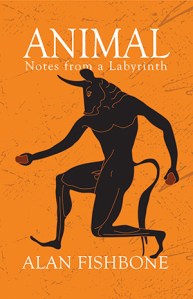
 Although Animal: Notes from a Labyrinth by Alan Fishbone (Heresy Press, 111 pages) observes many of the conventions of the novel—representing life thematically, describing characters in Dickensian detail, and drawing upon classic literature as a guide to interpretation—it is, properly speaking, a diary. The reader must grant the writer the leeway to record unresolved episodic events and to introduce characters who never cross paths and to allow some jotted down thoughts to stand alone as chapters.
Because no man’s life is organized according to an argument, whatever the diarist decides to omit and record shapes reality into some kind of art form. The organizing theme here is the idea that the narrator acts like an animal sometimes. He is a boozer and is sexually promiscuous (even attempts to have sex with a man in a drunken state). He is given to inappropriate violence when faced with cognitive dissonance, such as when he watches the Twin Towers explode on 9/11 and then randomly trashes his own apartment. But the powerful idea at the center of this really quite amazing little book is about the urge to procreate, not merely to have sex, but to make a baby with the woman the author has dedicated all his energies toward.
It’s a love story that ends tragically.
In addition to being a drunk much of the time, the narrator is also a classical Latin scholar who leans upon Catullus, in whose tragic obsession with Lesbia that narrator sees parallels with his own experiences.
“…in everything there’s always the script, or a role which the moment presents you to play. You can surrender yourself to play it or not. I secretly enjoyed the tragedy of abandonment you played me. You created textbook conditions for the spurned lover-poet, locked out and grieving, spinning his pain into self-indulgent lines. I think Catullus enjoyed it too…,”
I cannot think of other examples of literature that describe that powerful urge to make a love child. Not everyone experiences it, I suppose. Women are often represented in literature as pursuing a husband and family in order to conform to the expectations of society, but I can’t think of any stories that describe so vividly the animal procreative urge.
“That last night, I was overcome by a desire to make you pregnant. I hadn’t seen that coming at all: it exploded on me. Was I trying to keep you by tying you down with a child? Or was it simple animal love, a pheromone or some mysterious confluence of testosterone and dopamine finally throwing the breeding switch in my nature? How does one ever know these things? You’re probably not supposed to ask the question, but even that ‘supposed’ implies some teleology: supposed by whom? Anyway, I tried. We made love so hard I thought we might hurt each other. I imagined my seed flowing into you like magma, saw it glowing over and wrapping your ovules. I felt sure you would become pregnant. And you knew what I was thinking, though neither of us said anything. When we lay back next to each other in that pant-and-stare-at-the-ceiling afterglow, I was dazed at the emotion blowing through the room, like a wind coming into the window, as if you were a tree and I were your rustling leaves or we weren’t even there at all. Just life, pure and impersonal. I put my head on your chest and listened to the thud of your heartbeat and thought ‘this.’ This was what I was waiting for without even knowing. It’s a paradox: you made me believe in the soul by turning me into an animal. The next day you left…,”
Animal focuses on two men, the diarist Alan (I’m Alan is an anagram of Animal, we are told; the author likes wordplay) and an artist named Dieter who approaches Alan in a bar in Berlin and asks to paint his portrait. While Alan is sitting, Dieter tells his story about his animal urge to procreate with the love of his life, a story that ends in miscarriage and suicide.
The opening chapter captures the reader with its comic wit, describing the narrator attempting to use an espresso maker that explodes and covers the kitchen in what looks like nasty diarrhea. The author admits,
“I’d have to deduce that my parents were a bit too relaxed, because I’ve definitely turned out as an expulsive. I’m unkempt and thoughtless. My life is a mess. I can’t seem to hold on to money, and I hate being told what to do. Even my name is an anagram of anal, as if it were written into my destiny. In a way this whole book is kind of an anal expulsion, without much structure or purpose, just trying to entertain with some of a life’s digested residues. A necessary self-indulgence masquerading as a gift.”
Animal is unforgettable. It captures common human experiences so intimate that only a master with language could dare express them.
-V. N. Alexander, author of The Girlie Playhouse, 2026

