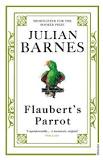
 Julian Barnes’ Flaubert’s Parrot (Picador 2002, 190 pages) is the story of one man’s quest, his “project” to find the writer outside his writings, despite Flaubert’s insistence that the books should be enough, the writer should disappear and be left alone. Geoffrey Braithwaite, this amusing novel’s British protagonist, is a medical doctor about sixty. He pursues museums, letters, literary works, criticism, and Flaubert the person in a long quest as unofficial biographer and tireless seeker. Continue reading →
Tales of Barranco Lagarto by Steven C. Levi
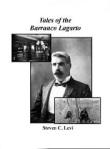 According to a note on the title page Tales of Barranco Lagarto (277 pages, Kindle) is a collection of stories which first appeared in The Coachella Post Gazette. The tales were handed down by one Horatio Shackleton, who died in 1925, and eventually assembled into a single collection by his grandson, Horatio Shackleton III. These characters are based on actual persons. Grandson Horatio is the mask which the “editor”—author Steven C. Levi—utilizes for his satirical tribute to a time gone by. The book concentrates on American culture in the southwest in the late 19th and early 20th centuries. It is not so much an intellectual history as a whimsical foray into a forgotten past, with the narrator’s twinkling eye always at the ready. Continue reading →
The Plague by Albert Camus
 Composed in 1948, Albert Camus’ The Plague (Vintage International, 308 pages) is a study of human habit and frailty in a time of widespread destruction and crisis. A plague appears in a modern city called Oran in Algeria, afflicting the community for most of a year, then as abruptly lifts. Residents celebrate, much in the way of celebrations for the ending of world wars, with renewed energy for humanity’s “humble yet formidable love” (301). It is this love, an adult’s understanding of love in the view of protagonist Dr. Rieux, that Camus highlights toward the ending of the novel—that is, love as desire to join with another, whether adult son with mother, father with child, doctor with patients, wife with husband, or “true healers” who seek peace (254). Continue reading →
Mechanic of Fortune by Peter Bollington
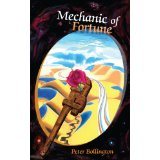 In the ‘bad old days’ when there were a dozen publishing power houses in New York that controlled the industry, everyone knew what a genre books was. If it was a mystery, it started with a murder. If it was romance, it was boy-meets-girl-loses-girl-gets-girl-back. It was all very simple and quite generic, the root of the term genre. But all of that has changed. The industry has outsized and now books that would not have gotten so much as a nod a decade ago are in print. Continue reading →
Dismantle the Sun by Jim Snowden
 Dismantle the Sun (Booktrope, 324 pages) is literary, but if you are looking for a novel of bright sunshine, lollipops along with skittles and beer, this is not the book for you. It reeks pathos; “wrenches” is the term used on the back cover of the book, and the work lives up to that term. It is an uncomfortable read because you are being dragged into the intimate, excruciating dynamics of a couple where the wife is dying and the husband is struggling with that reality.
Continue reading →
The Darling by Russell Banks
 “[M]erely the story of an American darling,” Banks’ 2004 novel The Darling (Harper Perennial, 393 pages) ends on September 10, 2001, one day before “a new history” in America begins. The words “merely” and “darling” are strongly ironic, suggesting the “new history,” beginning on the next day, will be even more ominous and horrible than the one recounted by Hannah Musgrave, the novel’s protagonist. She is also known as Dawn Carrington, her adopted pseudonym due to youthful foolishness in abetting the Weathermen revolutionary group in America during the late 1960’s into the 1970’s. Hannah is essentially still on the run, although she will manage to marry a Liberian minister close to President Samuel Doe, plus later be exploited by the CIA in arranging the escape from prison of Charles Taylor. She has been a self-necessitating fugitive, obliging herself with a life of running and hiding, and unaware of herself as also a political tool easily exploited. Continue reading →
Milligan and Murphy by Jim Murdoch
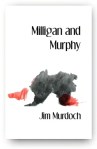 Opening a novel with a quote, particularly one from a writer as universally celebrated as Samuel Beckett, risks much. A reader is apt to spend a good deal of the novel comparing the works of the writer before him to those of the great master, fall into a reverie about how great was the work of the great master, and lose track of what the book in hand is going on about. Jim Murdoch, the author of Milligan and Murphy (Fandango Virtual, 180 pages), assumes that risk. Continue reading →
If a Man be Mad by Harold Maine
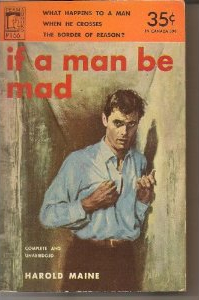 As cruel as the world itself.
If a Man be Mad (Permabooks, 156 pages)…there couldn’t have been a more appropriate title for this gem hidden amidst the American literature. Walker Winslow, writing as Harold Maine, had written this fascinating book while living in Big Sur, at a time when other great writers, such as Henry Miller resided nearby. Whether it was Winslow’s gift or the proximity of some of the greatest in modern American literature, Mr. Winslow has achieved what only but a few writers are capable of. He shook my world. Continue reading →
The Miraculous Journey of Edward Tulane by Kate DiCamillo
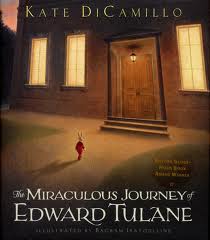 Edward Tulane is a china rabbit…
The bulk of my reviews deal with serious fiction and not with children’s literature. Therefore, you may ask yourself, “What does a china rabbit have to do with literary fiction?” Well, to answer that question honestly, I must say: “Nothing…nothing at all.”
There is no question that a children’s book about a china rabbit is an unlikely contestant to end up in my `favorite books’ pile. After all, this book is not about a character contemplating the murderous attitude of the world. Nevertheless, the book is about a character – a china rabbit Continue reading →
Pnin by Vladimir Nabokov

He is not a very nice person but he is fun – Nabokov describing the character of Pnin in a letter to his editor at The New Yorker
Readers of my third novel, The More Things Change, who at the current moment in time comprise a not entirely significant two, my current wife and my only daughter (though not a daughter to my current wife despite the fact she treats her like a second daughter), will recall – Continue reading →
 Dactyl Review