Stripped: A Collection of Anonymous Flash Fiction edited by Nicole Monaghan

The premise here is interesting: an anthology of flash fiction with the bylines removed so that the reader can’t know the identity of the author. According to Nicole Monaghan, editor of this collection, the purpose is to question a reader’s assumptions about gender.

As an experiment, Stripped: A Collection of Anonymous Flash Fiction (PS Books, 102 pages) recalls I.A. Richards’ Practical Criticism and his withholding authors’ identities from his Cambridge students in the 1920s in order to come to grips with their literary values. It was a step forward in reading awareness. We live in a very different world now, to put it mildly—gender was not on Richards’ radar—but some of the same questions of reception persist. Continue reading →
Frog City Updike by Arthur Graham

Frog City Updike never would’ve been without Brautigan’s Trout Fishing in America, the book that showed me just how loose I could get with form. — Arthur Graham, Big Al’s Books and Pals

One of the words I use too often in reviews is “interesting,” but I never really make it clear whether a particular word piques my interest or holds it. It’s the same with “nice,” which I also overuse; nice can have negative connotations; the last thing your wife wants to hear when she walks in wearing a new outfit is, “You look nice, Dear.” Even more confusing I would expect is when something gets referred to as “nice and interesting.” Frog City Updike–the place, not the book–sounds like a nice, interesting place. I’m not sure I’d want to live there but if I did I can see myself running across interesting things and saying, “Oh, that’s nice,” or vice versa. Continue reading →

Editorial by Arthur Graham

The following is my editorial of Arthur Graham’s Editorial (Bizarro Press Edition,  149 pages).
The following (edited) definitions of editorial are from Dictionary.com:

noun — an article presenting the opinion of the editor.

Whoever the editor is–the unnamed narrator, a young orphan who remembers “days of reading and masturbating in my room” but doesn’t remember, at the time of telling, what his age was (17 or 28)–is dumped by auntie and uncle into the cruel sea of the outside world with his heavy burden, a suitcase filled with dirty magazines. The narrator assumes that the reader is surprised: Continue reading →

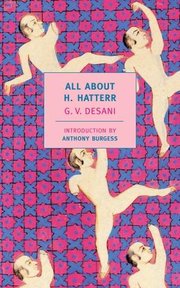
All About H. Hatterr by G.V. Desani

Warning!!

Warning!!

Better heed those first warnings, and all those !!!!! This – fellers! femmes! — this book – is mad. Like a hatter?

Ostensibly an “autobiographical,” All About H. Hatterr, by Govinas Vishnoodas Desani (New York Review Books, 318 pages) was first published in 1948. Desani explains,

…Though I was attending a world war, the first row, I worked….It seemed I’d be stuck for years; the post-Cease Fire ones too…well meaning people kept butting in, demanding that I stop breathing the bracing air of war-time England with my windows shut. I do anything for peace…the windows open, work would be impossible…

Continue reading →

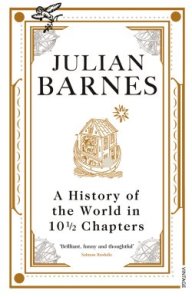
A History of the World in 10 1/2 Chapters by Julian Barnes

God’s all-time bestseller, The Book, might be described (I wish to offend no one) as metafiction; it was written, divinely, by its main character, Who appears in various forms, at crucial cliff-hanger moments, as Himself. Unfortunately, so the story goes, God’s sixth-day creation, us — or more accurately our ancestors — made a muddle of His work, so God recruited Noah & Sons to cruise.

Mr. Julian Barnes launches A History of the World in 10½ Chapters (Knopf, 307 pages) with his own mock-knowing version of history, as reported by a wiseacre, truth-telling woodworm (baby termite?) stowaway, one of several who survived the trip. Why the need to sneak? Woodworms were not one of God’s chosen species, which leads Continue reading →

Alien Autopsy: Stories by Pedro Ponce

Pedro Ponce offers eighteen very short stories in this slender volume (Cow Heavy Books, 55 pages). Within the brief space Ponce delegates for himself not much can happen, but these vignettes do manage to develop vigorous fabula-like themes. In each short piece, a subject is opened, then skillfully closed. Continue reading →
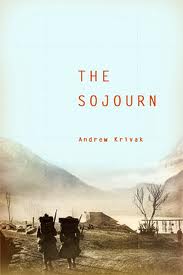
The Sojourn by Andrew Krivak

There will, unfortunately, always be a need for books about war, and this need takes many forms. In The Sojourn (Bellevue Literary Press, 191 pages), Andrew Krivak successfully defends the parish of the novel. Although the harsh imperatives of history require much sifting of facts, places and victims—synthesis and hindsight are essential, as part of our troubled species’ perverse CV—the novel, with its relentless subjectivity and its bloody-minded insistence on the plight of individuals, brings its own kind of necessary testimony. Continue reading →

The Beach Beneath the Pavement by Roland Denning

Bernard Hawkes is a cynical, disillusioned journalist who finds himself in a spot of trouble when someone starts enacting the theoretical terrorist plots described in his satirical newspaper column. So begins this sardonic tale of conspiracies within conspiracies set in modern-day London.

With the sinister Tranquility Foundation (a New Age conglomerate promising “serenity with security”) on one side and the Primitive Front (a group bent on shaking people out of such complacency) on the other, Bernard’s previously humdrum existence suddenly becomes quite interesting as he is drawn ever deeper into the intrigue behind the bombings. Adding to his problems are Inspector Pitmarsh, the paradoxically chummy yet menacing police detective, a vivacious young revolutionary calling herself Animal, and Dillwyn, his alternatively rational and paranoid neighbor. Continue reading →

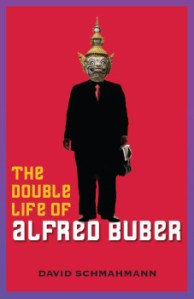
The Double Life of Alfred Buber by David Schmahmann

(Permanent, 197 pages) Who is Alfred Buber? In starkest terms, he is a respected Boston lawyer who falls in love with a Thai sex worker named Nok. Not surprisingly, they do not live happily ever after. This is not a book of neat resolutions.

But it is a story full of interesting ruminations, which are often amusing, sometimes provocative, and consistently engrossing. Narrated in the first person, the novel moves deftly between past and present and provides a nuanced portrait of loneliness. Continue reading →

Dr. Jesus and Mr. Dead by Cooper Renner

Spanish poetry translator, publisher of elimae press, and celebrated indie writer, Cooper Renner has written a debut novel Dr. Jesus and Mr. Dead (Ggantijia, 215 pages). The work is an amalgamation of historical fiction, and ebbs and flows across hundreds of years and multiple psyches. Disturbing, entirely entertaining, and expertly written prose which drawls in slow, southern sweeps, Dr. Jesus and Mr. Dead is dripping with beautiful language, harsh imagery and heady inquiry. Continue reading →