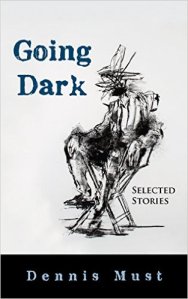
As I read Going Dark, Selected Stories by Dennis Must, (Coffeetown Press, 170 pages) I saw a realistic foundation in each story. Here is a recognizable world with real people suffering real-life anguish. What interested me, however, was the way the author then handled time, space, and imagination. To come to grips with it, I had to invent a literary term—lyrical surrealism—to distinguish Must’s work from fantasy which, to my mind, means dragons and dragonspeak, time warps, elves and men with long beards carrying oaken staves and speaking some dialect of incomprehensible origin. Continue reading →
Minimum Maintenance by Carolyn Colburn
The protagonist and narrator in Minimum Maintenance (Bonnie’s Mews Publications, 240 pages) by Carolyn Colburn is a thirteen-year old girl named Sugar, named so because her mother didn’t want to say “shit” on camera. Sugar bumps along in the wake of her untethered mother from Minneapolis to Up North to Montana, Oklahoma, Nevada and parts in between, smoking cigarettes and joints, working on a tattoo and making fleeting friendships along the way. The title indicates the nature of Sugar’s childhood along the back roads, where dead cars pile high and outliers hang onto reality for dear life, doing what they do with drugs, booze, guns, sex, and hair dye. Continue reading →
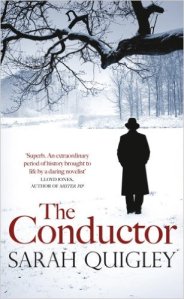
The Conductor by Sarah Quigley
It is easy to understand how The Conductor (Vintage, 303 pages) stayed on the best seller list for weeks and weeks in New Zealand. The story is compelling, and Sarah Quigley knows how to tell it. Against the background of the siege of Leningrad during the Second World War Dmitry Shostakovich is writing his Seventh Symphony, struggling to finish it while German bombs are falling all around him. Meanwhile, the main character, Karl Il’ich Eliasberg (1907-1978), the second-rate conductor of a second-rate orchestra, goes about his life of quiet desperation, unaware that circumstances are coming together so as to place him at the center of history. Continue reading →
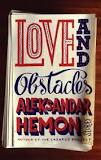
Love and Obstacles by Aleksandar Hemon
I’ve read all of Aleksandar Hemon’s books. They have been blurbed and reviewed by the most enthusiastic of blurbers and reviewers: “dazzling, astonishingly creative prose” with “remarkable, haunting autobiographical elements.” The latest Hemon offering, Love and Obstacles (Riverhead Books, 210 pages), is a series of short stories, most of which continue in Hemon’s now familiar reminiscent strain. They amount to a kind of Bildungsroman, the story of a guy from Sarajevo who comes to America—in a word, Hemon’s own story, and therein lies the problem. Or, to put it more precisely, there may have been no problem when he started writing in this nostalgic, reminiscent vein, but by now the problem is obvious. What I’m writing about below is, primarily, that problem. Continue reading →
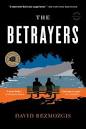
The Betrayers by David Bezmozgis
The Betrayers (Little, Brown & Co, 267 pages) begins with a Russian expression on a young woman’s face. A pretty blonde woman working as hotel clerk in Yalta is berated by a young woman from Israel, who insists she be given a room. The clerk “endured the assault with a stiff, mulish expression. A particularly Russian sort of expression, Kotler thought. The morose, disdainful expression with which the Russians had greeted their various invaders. An expression that denoted an irrational, mortal refusal to capitulate—the pride and bane of the Russian people.”
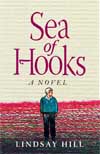
The 2016 Dactyl Literary Fiction Award goes to Sea of Hooks by Lindsay Hill
Sea of Hooks (McPherson & Co) was nominated by Barbara Roether, author of This Earth You’ll Come Back To. In her review of Hill’s unusual novel, Roether writes,
There is a paradox that floats through the Sea of Hooks, which is that the experience of reading it is almost the opposite of how it is written. That is to say, while the story is told in its short collage-like segments, their effect is an almost seamless classical narrative. The way sections move from multiple perspectives, dreamtime, real-time, then meld together with such cohesive and penetrating storytelling, is a testament to the author’s insightful eye for detail and character.
The Wild Horses of Hiroshima by Paul Xylinides
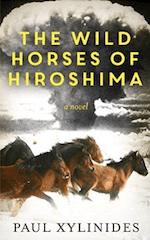
The wild horses in The Wild Horses Of Hiroshima (240 pages) are certainly intriguing, as with the title and cover art, and play a strong role at the story’s end by appearing in the streets of Hiroshima to wander about as a healing force, cared for by the citizens. They derive from the imagination of a novelist who is also a character in the novel, who is also creating a narrative. The horses seem to emphasize purity and nobility, pounding through the city in herds, a shield against nuclear war and against the violent nature of the human species itself.
This novel inside the novel begins approximately half way into the story, following a background beginning with the atom bomb attack on Hiroshima and its hideous devastation. A young American man has been a penpal with a young Japanese girl, and after the war, he goes to Hiroshima to find her. They marry and move to New Hampshire, bearing a son, Yukio. Yukio becomes a strong, husky young man who survives the attack of a bear which kills his father. He and his mother, Miyeko, return to Japan where he becomes a sumo wrestler. Time passes and he retires to write novels. The novel within a novel begins, with occasional returns to the exterior story of Yukio and his mother, plus Yukio’s geisha, Satoko. Continue reading →
Disgrace by J.M. Coetzee
In Disgrace (Penguin Books, 220 pages), Professor David Lurie’s crisis begins with his foolishly taking advantage of one of his students, then proceeds to his inadequate response under enquiry. Gradually, the story’s emphasis on “disgrace” pervades the entire narrative. It extends to white dominance and native reprisal in South Africa, to cruelty with animals, and to self-obsession within the human community generally.
An early reference on page 2 to the final chorus of Oedipus Rex, “Call no man happy until he is dead,” joins the suggestion David Lurie is a Lucifer in an earthly darkness, the fallen angel. Oedipus of course is humbled through his arrogance and self-righteousness, so the allusion clearly applies. Professor Lurie resists from inside the wall of his pretensions as an academic and Romantic, as if he has some kind of right to “desire” in an honorable history descending from his study of Byron, who is simultaneously his hero. His unlearning will take a long time. Continue reading →
Dismantle the Sun by Jim Snowden
Throughout most of our lives, we can ignore our fears about the threat of non-existence that yawns beyond the casket with as much reality as the non-existence out of which we came into our cradles. But when facing death, our own or that of a loved one, we feel compelled to review the idea of after life. Believers ratchet up their beliefs and atheists, like Hal in Jim Snowden’s Dismantle the Sun (Booktrope, 324 pages), hang tough.
According to conventional wisdom, atheists are imaginary creatures. No one (except other atheists) believes they exist, certainly not in the foxhole of impending death. This is why deathbed conversions are expected, even in the most “literary” of end-of-life novels, despite the fact that one of the accepted roles of a literary fiction author is to question how we make sense of our lives. If most novels have the same after-life-affirming answer, I wonder if these novelists are really asking themselves the question, or merely posing it rhetorically for the sake of a denouement. Every deathbed conversion, it seems to me, is another failure to actually question the meaning of life. Continue reading →
Sea of Hooks by Lindsay Hill
Lindsay Hill casts a magician’s spell across his Sea of Hooks (McPherson, 348 pages). On the surface his world is rendered in bright pixels of quivering light, while underneath a seamless narrative undercurrent pulls us into the mysterious depths of experience. For the reader willing to dive under, this journey is unforgettable.
Sea of Hooks is, on the one hand, a fiercely original Bildungsroman set in San Francisco in the 50’s and 60’s. Christopher is an overly imaginative boy, part Holden Caulfield and part Little Lame Prince, who lives in precarious affluence in a darkish Victorian on the edge of Pacific Heights. His delicate, high-strung mother is obsessed with Japanese culture and dead by suicide in the first paragraph. Dad works in finance on the Pacific Stock exchange, until he doesn’t anymore. There are prep schools, bridge games, Dickensian neighbors like the wise and wonderful Dr. Thorn; along with house fires, a very nasty tutor/pederast from Stanford, a trip to Bhutan and encounters with Buddhist monks. Hill’s rich prose makes us feel Christopher is someone we have always known, a boy who lives in a house we have been to, whose eccentric mother we’ve had tea with, whose city we are walking in. Continue reading →