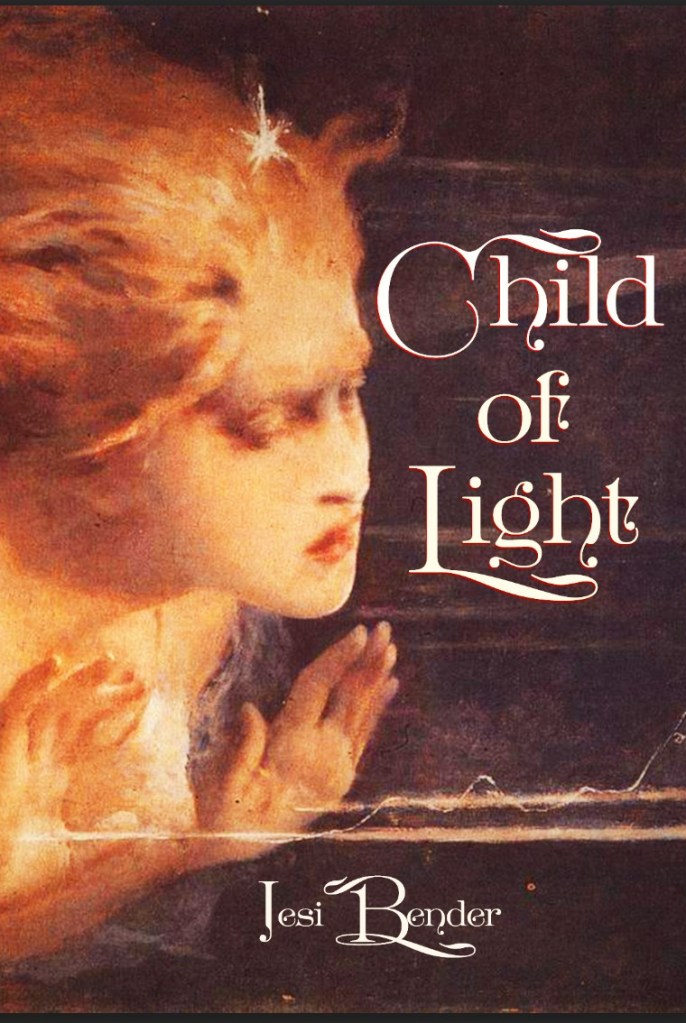
What do we really know when epistemic parameters are fluid? This question is central to Jesi Bender’s historical novel, Child of Light (Whisky Tit, 318 pages), set in upstate New York at the end of the 19th century. It centers on Ambrétte Memenon, a clever and dutiful young woman whose father is a French scientist immersed in his studies of electricity, and whose mother is a Québécoise enthusiast of Spiritualism. Papa seeks to illuminate cities at night, Maman to communicate with the dead.
These are rather different agendas, to put it mildly, but the story dramatizes how, within the context of the period, both pursuits are cutting edge. And Ambrétte, in an attempt to mend her broken family, tries to reconcile the two.
“You can be the conduit, she told herself. I have to connect them. If she could talk to Papa, if she could lead him to Maman at the nebulous edge between these two worlds, she might be able to save this family.”
A daunting task, but as a story-telling premise, a good one. Ambrétte possesses the guileless presumption and intensity of youth. Her motives are mainly personal, to restore the triad of parents and child, while the intellectual gulf that separates her parents is treated as negotiable. Ambrétte speculates: “Couldn’t the spirit be a form of electricity?”
Further complicating the situation is her brooding and sometimes menacing brother Georges, coupled with the fact that she must learn French in order to communicate with her father. Ambrétte also pursues a forbidden friendship with a local mulatto orphan, Celeste, whose mysterious ways provide her only emotional support. Lastly, Maman is convinced that her daughter, at an earlier age, had the ability to connect with the spirit world, and Ambrétte, eager to please, earnestly tries to cultivate this talent. Her vivid dreams enact her potential:
“The weight inside her chest flowed down her arm in a cool stream until it came out the tips of her fingers in a light blue scintilla. It started out like a small winterbourne but quickly grew into great cotton-like swaths of mist tumbling out of her in billowing loops and underscores. When she opened her eyes, she saw that the electricity pouring out of her was forming its own symbols. She suddenly recognized it spelling out CLAIR or L’AIR or LAIR. In its rush and swell, it seemed to be calling out to her, loud as a fire burning.”
This heightened awareness of language and how to decipher it recurs throughout the novel. There are passages in French along with transcriptions in English to depict Ambrétte’s imperfect understanding of conversations. The novel deploys variations in font, as well as pages with more than one column, requiring a different movement of the reader’s eye. Bender intersperses letters, “contes” and pages with musical notation, and includes a bibliography at the end. Ambrétte reads esoteric texts such as Dealings with the Dead, “penned by the Rosicrucian” which posit hidden meanings: “if you make a sentence long enough, couldn’t it be an anagram for anything?”
Bender’s style is sometimes surrealistic. A cow has “diamondiferous eyes” and “Maman’s bed was tooth-colored and fat like a cloud.” Child of Light has a pronounced romantic, even gothic flavor: Ambrétte spends time in a turret, “cocooned in black bunting, looking out the window into the valley and dreaming of imaginary amour.” She and her friend Celeste leave each other secret letters in a tree, which is likened to “a loquacious Lazarus aflame with the light of two young hearts.” There are harrowing episodes where her brother Georges closes Ambrétte inside a coffin, or assaults her in an open grave.
Amid these goings on, there’s also some fairly straightforward social history, regarding gender dynamics, class and race. These separations can be as hard to bridge as the material and spiritual realms. There’s an extended set piece about the real-life case of Lucien Gaulard, the French engineer who did pioneering work in the transmission of alternating current. Ambrétte’s father works with the temperamental Gaulard in the 1884 Turin Exhibition, a competition sponsored by Queen Margherita of Italy. This event left a lasting mark on her father and led to the family’s arrival in the United States.
For me, the combination of the real and other-worldly was most effective when the narration took an ironic distance from young Ambrétte’s point of view. She inadvertently witnesses a sexual act between her mother and her servant Lizzy, but she doesn’t understand what she sees and mistakes her mother’s orgasm for death throes. So the only way she can make sense what happens next is through the lens of Spiritualism:
“The first time Ambrétte saw Maman after she died, it was a surprise. She came down to the kitchen early on a Thursday morning. There was her mother, at the kitchen counter, buttering a piece of bread with her back towards Ambrétte. She was shrouded in black crinoline.
This was it. She had done it. Substantiated a full body in front of her own eyes.”
I started this review with a rhetorical question. What do we really know when epistemic parameters are fluid? Bender seems to suggest that the answer is, well, not as much as we think we do, even as there are more possibilities than we imagine. Child of Light is an intriguing and original historical novel that inevitably invites comparisons to the present day, when what we know (or think we know) seems less available to common consensus, but is rather a source of conflict. It also reminds us of how easily cruelty comes into play, regardless of who is right, or who is wrong.
______________________________________________
Charles Holdefer’s recent books are Don’t Look at Me (novel) and Ivan the Terrible Goes on a Family Picnic (stories).
 Dactyl Review