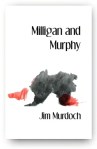
 Opening a novel with a quote, particularly one from a writer as universally celebrated as Samuel Beckett, risks much. A reader is apt to spend a good deal of the novel comparing the works of the writer before him to those of the great master, fall into a reverie about how great was the work of the great master, and lose track of what the book in hand is going on about. Jim Murdoch, the author of Milligan and Murphy (Fandango Virtual, 180 pages), assumes that risk. Continue reading →
Category / just literary fiction
If a Man be Mad by Harold Maine
 As cruel as the world itself.
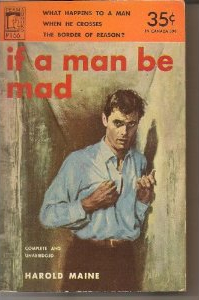
If a Man be Mad (Permabooks, 156 pages)…there couldn’t have been a more appropriate title for this gem hidden amidst the American literature. Walker Winslow, writing as Harold Maine, had written this fascinating book while living in Big Sur, at a time when other great writers, such as Henry Miller resided nearby. Whether it was Winslow’s gift or the proximity of some of the greatest in modern American literature, Mr. Winslow has achieved what only but a few writers are capable of. He shook my world. Continue reading →
A History of the World in 10 1/2 Chapters by Julian Barnes
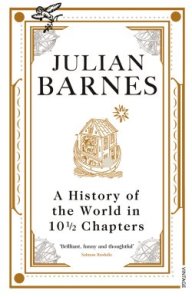 God’s all-time bestseller, The Book, might be described (I wish to offend no one) as metafiction; it was written, divinely, by its main character, Who appears in various forms, at crucial cliff-hanger moments, as Himself. Unfortunately, so the story goes, God’s sixth-day creation, us — or more accurately our ancestors — made a muddle of His work, so God recruited Noah & Sons to cruise.
Mr. Julian Barnes launches A History of the World in 10½ Chapters (Knopf, 307 pages) with his own mock-knowing version of history, as reported by a wiseacre, truth-telling woodworm (baby termite?) stowaway, one of several who survived the trip. Why the need to sneak? Woodworms were not one of God’s chosen species, which leads Continue reading →
The Beach Beneath the Pavement by Roland Denning
 Bernard Hawkes is a cynical, disillusioned journalist who finds himself in a spot of trouble when someone starts enacting the theoretical terrorist plots described in his satirical newspaper column. So begins this sardonic tale of conspiracies within conspiracies set in modern-day London.
With the sinister Tranquility Foundation (a New Age conglomerate promising “serenity with security”) on one side and the Primitive Front (a group bent on shaking people out of such complacency) on the other, Bernard’s previously humdrum existence suddenly becomes quite interesting as he is drawn ever deeper into the intrigue behind the bombings. Adding to his problems are Inspector Pitmarsh, the paradoxically chummy yet menacing police detective, a vivacious young revolutionary calling herself Animal, and Dillwyn, his alternatively rational and paranoid neighbor. Continue reading →
The Double Life of Alfred Buber by David Schmahmann
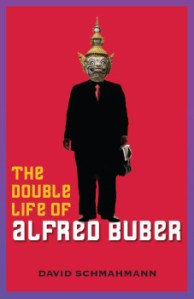 (Permanent, 197 pages) Who is Alfred Buber? In starkest terms, he is a respected Boston lawyer who falls in love with a Thai sex worker named Nok. Not surprisingly, they do not live happily ever after. This is not a book of neat resolutions.
But it is a story full of interesting ruminations, which are often amusing, sometimes provocative, and consistently engrossing. Narrated in the first person, the novel moves deftly between past and present and provides a nuanced portrait of loneliness. Continue reading →
Dr. Jesus and Mr. Dead by Cooper Renner
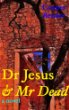 Spanish poetry translator, publisher of elimae press, and celebrated indie writer, Cooper Renner has written a debut novel Dr. Jesus and Mr. Dead (Ggantijia, 215 pages). The work is an amalgamation of historical fiction, and ebbs and flows across hundreds of years and multiple psyches. Disturbing, entirely entertaining, and expertly written prose which drawls in slow, southern sweeps, Dr. Jesus and Mr. Dead is dripping with beautiful language, harsh imagery and heady inquiry. Continue reading →
Editorial by Arthur Graham
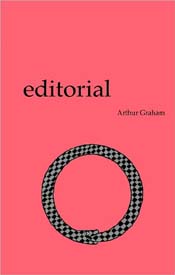 At the onset, our protagonist in Editorial (CreateSpace, 140 pages) is sent to live with an aunt/uncle after the untimely death of his parents, and he finds the routine and familiarity therapeutic in a sado-masochistic sort of way, until the day comes when his aunt and uncle basically throw him out on his own with nothing possession-wise to speak of other than his porn mag collection. Well, at least our narrator handles it well: with wit, sarcasm, and what was probably a heat stroke induced delusion.
The Death of Patsy McCoy by Levi Montgomery
 “His death began the moment we saw him. It just took a long time to consummate that death. We began to kill him when we first saw him…”
The Death of Patsy McCoy (Inflatable Rider Press, 147 KB) is a story about a murder, but long before that, it was a story about suicide. The suicide of a small town, the suicide of a new kid seeking acceptance, and the suicide of five young men who would never be able to push aside memories left behind in their childhood, memories that are nothing more than the strewn wreckage of innocence gone lost. Continue reading →
Cities of the Red Night, The Place of Dead Roads, and The Western Lands by William S. Burroughs
 NOTHING IS TRUE. EVERYTHING IS PERMITTED
Undeniably the magnum opus of his later (some might say entire) career, the trilogy of novels produced by William S. Burroughs between 1981 and 1987 continues to cast its shadow as one of the most enduring pieces of experimental American literature ever written.
Whether readers find this “great work” to be great indeed or just greatly disappointing will largely depend on their opinion of Naked Lunch (1959) and his other novels from the 60s and 70s, because although the form and substance have matured quite a bit in the intervening decades, there is still much from these early cut-ups prefiguring the wild rides that are Cities of the Red Night (1981), The Place of Dead Roads (1983), and The Western Lands (1987). The lurid descriptions of sex, drugs, and violence are still very much present in Continue reading →
Mefisto by John Banville
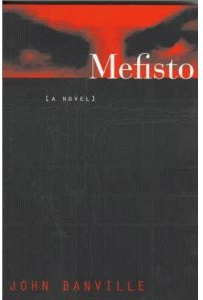 Gabriel Swan is the Faustian hero of Mefisto (Godine Press, pages 233). He is a savant mathematician, with talents that will make him out-of-place among uneducated poor Irish. With a desire to understand the truth of the universe, he believes that numbers will help him sense some “larger” pattern tying everything together. But as in Faust, what Swan does with his opportunities is disappointing. He hooks up with scam artists and junkies and, tragically, ends up being instrumental in his mentor’s efforts to prove there are no larger patterns. Continue reading →

