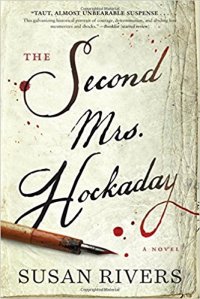
 The Second Mrs. Hockaday, (Algonquin Books, 272 pages) is an epistolary novel that moves seamlessly between letters to court documents to diary entries. There are chapters that end in the middle of a scene, a diary entry interrupted, leaving the reader to hold his/her breath. The scene continues at the beginning of the next chapter. It is an amazingly effective technique, one that makes us want to race through the pages. The ending of the book? Continue reading
Monthly Archives: July 2017
The Sense of an Ending, by Julian Barnes
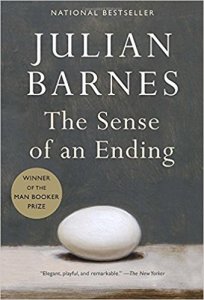 In Julian Barnes’ novel, The Sense of an Ending (Penguin Random House, 2011), we meet a narrator in the long tradition of the sad-sack loser telling his story. Anthony (Tony) Webster, resident of London, now in his sixties, looks back on his life from present time. The novel begins as Tony recalls his days as a student, a time when his life appeared to have a good deal of promise. We meet him as a teenage schoolboy in a public boys school—“public” being the British for “private”—pondering, along with his best friends Alex and Colin, certain grand philosophical issues, such as What is history?
Continue reading
Purity by Jonathan Franzen
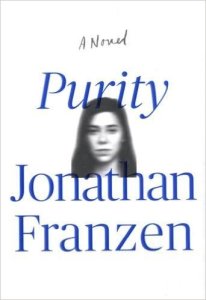 I listened to the audiobook of Purity (FSG, 576 pages) as I was held captive on a thirty-five hour road trip. Although the first fifty pages or so had some wit and interesting characters, such as Andreas Wolf, a Julian Assange persona, Purity soon devolved into stylistically bland chicklit. Jenna Lamia narrates the part of the twenty-something title character, with, appropriately for the writing style, that special millennial lilt that seems to run out of energy at the end of every sentence. The remaining 526 pages were concerned with relationship negotiations between men and women, children and parents. People complain, worry about their self-image, elaborate the details of “he said, she said” and, instead of having interests in the world, all the characters try to control and manage how other people feel about them. The characters are pure self-interest without any self-reflection. Worse yet, the plot is straight about of a women’s drug store novel: Purity’s love relationships fail as she seeks a father figure, having grown up without one. Confronting hard economic times and suffering through dead-end jobs, she finally stumbles upon her father and discovers that she is an heiress.
Seriously. An heiress. Continue reading
 Dactyl Review