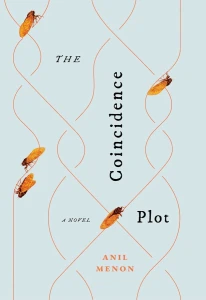
 Chances are you’ve never heard of Anil Menon. That’s a shame, but not your fault. Anil Menon is a brilliant Indian author writing wild, brainy and emotionally engaging stories and novels in English. His books, including the main one reviewed here, The Coincidence Plot (Simon & Schuster, 252 pages), are published by presses well known in the English speaking world, and his works can be found in online venues, but readers in the United States who would delight in his novels won’t find them in bookstores.
The Indian Constitution lists Hindi as the official language of the Union, but allows English to continue in use by the government, English being a legacy from British colonial rule. Today India has a growing population of 1.4 billion (it recently surpassed China in this) and of this billion, about 10.5 percent are English speakers. Anil Menon’s work is published for those millions upon millions of English speakers in India. Getting his novels from online sellers or by mail from India can be tedious, but it’s worth the hassle.
If you look him up online you’ll be informed that he’s an Indian writer of speculative fiction and also a computer scientist who’s written and edited works on evolutionary algorithms. On his web blog he defines himself rather simply: “I am a fiction writer. I am a few other things too, but I do spend a lot of my time thinking about imaginary people and their problems.”
At this point in his fiction-writing career Anil Menon has produced four major works, including a young–adult novel, The Beast with Nine Million Feet, and a collection of short stories, The Inconceivable Idea of the Sun. Those two can be classified as speculative fictions. The author himself doesn’t care for genera classifications; quite the contrary. “Truth is,” he has written, “I don’t take genre labels seriously.”
Menon’s Half of What I Say and the recently published The Coincidence Plot are books that don’t fit comfortably into pigeon holes. They’re both intricately plotted sophisticated works of fiction, and utterly different from each other. Every scene in Half of What I Say is immersed in Indian society and culture, and because of the way it’s written, readers in this country would miss or misunderstand some of what’s on the page. Even so, the novel is worth a few paragraphs here, if only to give a sense of Menon’s style and sensibility.
Before Half of What I Say begins, the central character, a mid-level governmental officer named Vyas, has written a letter to his wife, but the letter has accidentally ended up in the office of a powerful politician who has just now died after being roughed up by a mob of Hindu activists – “the usual saffron excitables,” one higher-up says about them. If the letter is discovered it will end Vyas’s career, so he must swiftly and surreptitiously get it back. The letter is the MacGuffin in this story, the object which initiates the action, as in countless cinematic thrillers. But unlike a neat ninety-minute movie, this narrative branches out through 436 pages and introduces a crowd of complex characters, each with his or her own career, social status, passion and private agenda.
Half of What I Say is as densely populated as a volume by Charles Dickens, and like Dickens, Anil Menon is a social critic. Half of What I Say has all the details and overall appearance of a contemporary realist novel, but the large omnipresent government agency under which Vyas works, the Lokshakti, doesn’t exist in India and isn’t a fictional parallel for any office there. Vyas manages the relatively small and obscure Department of Cultural Affairs.
As the novel develops, it becomes clear that the Lokshakti (People Power, in Hindi) keeps watch over Indian society –- like an Indian FBI plus CIA plus NSA –- and occasionally it has to adjust society by exerting its military or judicial power. As Vyas notes, “Those in need seldom find their way to me, partly because they are unaware of my existence, partly because my department may not exist, but mostly because locating my office is a non-trivial task.”
Amid this novel’s convoluted rush of events, Vyas pauses to tell the reader that locating any Indian government office that actually does any governing is a non-trivial task. Actual governing is an illusion while government buildings are designed to look like what people expect their government to do and be. ”Government should protect: the buildings are all in concrete. Government should be rational: the buildings are all Platonic solids surmounted by Platonic solids.” He tells us that the simulacrum’s ability to go from being a copy to something more useful than the original was brought home to him when he and his wife Tanaz made their first visit to the United States.
“The main thing that surprised me about the United States was the remarkable similarity with India. The same preening self-satisfaction, the same narcissistic disinterest in the world, the same multiplicity of idols, and the same passion for violence, masked with the same hypocritical claims to a superior morality. It gave me a lot of hope; there’s no reason why our toilets couldn’t raised to the same superior standards.”
It was in a room at the Loews Portofini Bay in Florida that Vyas and Tanaz discovered the deep authenticity of their love for each other “in one of the most inauthentic places on earth.” The inauthenticity didn’t matter to them: “indeed, the pretense we were lolling on the Italian Riviera was so exact (brochure: ‘cobblestones and outdoor cafes’) the effort was conducted so transparently, so good humouredly, and with such ludicrous faith in words, we would’ve probably found the actual Riviera quite unconvincing. …Foreigners who want to visit the ‘actual’ India would be better off waiting for the Loews Corporation to get around to faking one.”
The great narrative drive of this substantial novel comes from the interweaving of actions by each of its many characters who are positioned up and down in Indian society. At the same time, from the background and the margins comes an ironic commentary about truth and falsity, fiction and reality, words which might just as well have quotes around them.
Unlike Half of What I Say, Menon’s most recent book is not deeply embedded in India and was written with a more global readership in mind; namely, readers who delight in the play of ideas and the artifice of self-conscious fiction. The Coincidence Plot opens with a Postscript which sets the serio-comic tone for this work in it’s first sentence: “I have heard from multiple sources that I, Rama Rao, and not Xan Bharuch, am the real author of The God Proof.”
The first chapter is named “Artur & Sakshi / Berlin, 1930,” and subsequent chapters follow that title’s pattern. There are ten or so foreground characters who engage each other essentially in pairs in scattered places –- Berlin, Ithaca (New York), Mumbai, plus other cities, near and far. Despite the serpentine braiding of people and events, and despite the chapters non-chronological sequence, it’s an easy read. Each chapter is an entertaining episode and the novel as a whole has a nimble feel to it.
The tale opens with a stunning coincidence. It’s 1930 and Artur Alexanian is a graduate student in Berlin, hoping to complete his dissertation in mathematics; he has already spent three years on it and is now ready to write. On this particular day, his dissertation adviser, Herr Professor Doktor Ira Cohn –- who feels a certain affection and esteem for young Artur — gives him a document from a colleague who reports that another young man, the (non-fictional twenty-five-year-old) Kurt Gödel, has just now succeeded in showing that the concept of mathematical proof has fundamental limitations. That’s exactly what Artur had been getting ready to demonstrate. As he tells us. “I had proved it. I had discovered it. But Gödel had published it. What would I do with the rest of my useless life?”
It’s possible that you’re not familiar with Kurt Gödel’s proof, but not to worry, for as Artur tells us about his personal disaster he also explains the revolutionary nature of Gödel’s work. As Artur says, “There is nothing more sacred in mathematics than the concept of proof.” But what Gödel had demonstrated was that proofs in mathematics could be consistent or they could be complete, but they could not be both. If Gödel is right, there are things in mathematics that are true, but you won’t be able to prove them true. Artur had stalled in writing his dissertation because, although he had come to that very conclusion, he found such a thought “ugly.” As he put it, “Do you want a God who is omniscient or do you want a God who is omnipotent? You couldn’t have both.”
A few days later, Artur and his love, Sakshi from India, attend a small dinner party given by Herr Professor Doktor Cohn, and among the guests is Kurt Gödel. At one point, while the guests are still mingling, drink in hand, before going to the dinner table, Frau Cohn is chatting with Sakshi, and we have this exchange:
“How did you meet your mathematician, my dear?” said Frau Cohn. “My husband makes sure his students have no spare time.”
“I asked him for directions, and one thing led to another,” said Sakshi. “It was pure coincidence.”
“Nonsense. Providence knows nothing of coincidence! Why didn’t you ask someone else? Everything that is, is for a reason.”
“Not everything,” said Gödel.
“Everything!” insisted Frau Cohn, giving the greatest logician since Aristotle a stern glance.
Much later, after the other guests have left, Professor Cohn and Artur sit in the professor’s study, smoking cigars and having a somber and thoughtful conversation. Cohn asks Artur if he thinks Gödel is right and that some things have no discernible reason for why they’re true. “Have Gödel’s theorems put an end to Spinoza’s dream of a perfectly rational universe where there is a reason for everything?” asks Cohn.
Artur is passionately against such an idea. He believes in the philosophy of Baruch Spinoza as firmly as he believes in mathematics, and Spinoza’s philosophy is deterministic. In Spinoza’s “perfectly rational universe” there are no alternatives to the way things actually happen. The reason things are the way they are is because they were brought about by prior events which were, in turn, caused by still earlier events, and so on infinitely back to God. There are no actual accidents, no out-of-this-world astonishing coincidences, everything happens for a reason. Professor Cohn is surprised by Artur’s insistence on this point, and exclaims, “Gott in Himmel! You’re trying to prove God exists!”
In this way, the first chapter of The Coincidence Plot neatly brings together the two opposed themes that will pursue each other, fugue-like, throughout the novel: Do we have accidents and coincidences in our lives, or does everything that happens come about logically, driven by past events. One of the characters in this novel, sounding rather like the author himself, complains about the hard-to-believe coincidences in certain Victorian novels; certainly, in this novel, Anil Menon has deftly created a haphazard world where believable coincidences are the result of utterly commonplace circumstances.
To begin with, the two leading women, Farzana and Uma, were close friends in childhood, and the two men, Xan and Rama, are competitive writers who are thoroughly acquainted with each other. Furthermore, all four belong to an intellectual and artistic elite where their lives naturally and repeatedly overlap. Both men know both women, one way or another, or maybe it’s both women who know both men –- no matter –- a most important coincidence comes as the story approaches closure, for Xan and Rama have both grown interested in writing about the lost and almost forgotten Artur Alexanian. Xan’s grandmother was Sakshi Devi, the woman Artur Alexanian had brought to Professor Cohn’s dinner party in Berlin back in 1930, and a few letters, written from Artur to Sakshi shortly after that time, catch the imaginations of these two writers.
Any story that begins in Berlin in 1930 is going to have a dark thread in it, and that’s true of the doomed Professor Ira Cohn and his self-absorbed student, Artur Alexanian. Artur ends up as a librarian at a university in Syracuse, New York, still working toward his preposterous goal of mathematically proving the existence of God. His doppelganger, non-fictional Kurt Gödel, ended at the Institute for Advanced Study at Princeton where, among better endeavors, he concocted a mathematical proof of God, before succumbing to paranoia, self-starvation and death.
The concluding episode of this novel takes place in Mumbai, in 2019, as Xan and Rama have a drink to celebrate Xan’s literary success and have a talk. Farzana is there, too, but no Uma, for she has died. In the course of the novel, the lives of these four have crisscrossed in numerous ways; they’ve exchanged affections, men, women, and rental properties. The book the two men are drinking to is Xan’s The God Proof, which proof is what Artur Alexanian aspired to demonstrate mathematically.
Xan and Rama lacerate each other with verbal swordplay, making hostile jests as they thrust and parry on Spinoza, on who has priority to write about Alexanian, on success and on life. Amid the back-and-forth conversation the narrative’s first-person point of view shifts from Xan to Rama and back again in a purposely ambiguous fashion and similarly the grammatical pronouns change until there’s no distinguishing between persons, their ideas and the novel’s themes.
To say more, would be to make this easy-to-read fiction sound complicated, or, to put it another way, it would be like explaining a joke and would give pleasure to nobody. This novel, despite its references to Gödel’s theorems and the philosophy of Spinoza, is written to delight readers the way Bach’s Little Fugue in G minor delights listeners. The pleasure is in the crisscross of themes and lives, and in our recognition of how they play together or against each other. Menon is not as mathematically rigorous as Bach; quite the contrary, in fact, for there’s a slap-dash quality about some passages which suggests that the writer had fun composing them. It’s a shame this foreigner’s innovative fiction isn’t easier to acquire in this country. Yes, each reader can send for these books and pay the postage, but it would benefit all of us if they were available in book stores. All of Anil Menon’s writing should come to this country, and a good way to start would be with The Coincidence Plot.
–Eugene Mirabelli, author of RENATO! 2020
 Dactyl Review
Wow! An extremely well done review! And it’s certainly convinced me to search out Menon. — VAP