Fiction labeled magic realism is sometimes too squishy, to my taste, relying too much on novelty or hoped-for charm. Instead of providing an added charge to the storytelling, the other-worldly conceits can bring about a dilution, like a film that leans too heavily on special effects.
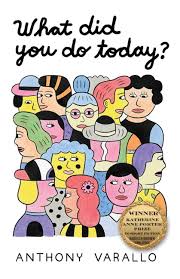
In What Did You Do Today? (UNT Press, 216 pages), winner of the Katherine Anne Porter Prize, Anthony Varallo avoids this pitfall across 45 stories that often defy realistic convention. He knows how to strike the right balance between the ordinary and the frankly impossible. Bizarre events occur against a backdrop of everyday domesticity, as parents and children go about their lives.
In “Bad Cat,” a man tries to be friendly to a wild-looking stray by pretending to offer food:
“Honey,” my wife said. “I think that might be a bad cat.”
“He’s not a bad cat,” I said, as the cat approached. Up close, I could see that his fur wasn’t actually black and gray: the black was really a little leather jacket studded with rivets, from which something I would soon learn was a switchblade bulged. The cat was smoking a tiny cigarette, which sent smoke into his crusted, bloodshot eyes.
“Here kitty-kitty,” I said.
This story doesn’t end well for the man or his family. (Feline nunchucks come into play.) But what makes this story more than a whimsical anecdote or weirdness for weirdness’ sake is its conclusion, which emphasizes the man’s perverse pride, despite the bad turn of events. Here, outlandish externals reveal something internal.
Definitions can be slippery: is this actually magic realism? Or is it rather an amped-up form of psychological realism, where the chaotic violence of an individual’s inner life and dreams imposes itself on the external world? In the end, I’m not sure the definition matters—suffice to say, Varallo’s fiction is full of events that are literally unbelievable but which also ring true. In “The Whole World,” a misfit named Jerry fashions a prototype sculpture out of a ball of soap with elaborate scrimshaw that appears, indeed, to be the whole world. In “Interview,” an interviewee and an interviewer speak at cross purposes and both get what they want. In “Long Distance,” a dead uncle telephones a ten-year-old with privileged insights from the beyond but the child has other preoccupations and can’t be bothered to listen too much.
In these and other stories, Varallo often conjures a sense of the uncanny but not for creepy ends. There is nothing overwrought or Lovecraftian here. Many stories are humorous, and Varallo seems bent on reminding the reader of strangeness in this world where so often we are merely pretending to be smart or to have things figured out. The stories constitute a remonstrance, in a way, but a pleasurable one.
Most of these pieces are flash fiction of only a few pages. Two longer stories are placed at the end of the collection, and they are more straightforwardly realistic. “First Everything” is a very strong narrative full of uncomfortable moments, centered mainly a young couple’s struggle to lose their virginity. Katherine, still in high school, has to endure the pomposity and insecurity of her boyfriend, a college freshman named Carlton:
“He seemed to have acquired so many deeply held beliefs in such a short amount of time that they all crowded one another out, jostling for space in Carlton’s rapidly expanding notion of himself. His opinions emerged as a rich composite of insight, speculation, and flat misunderstanding. His assertions arrived as firm and flimsy as newly dried glue.”
If this sounds unpromising for romance, for intimacy, for sex—well, it is. Varallo captures the convolutions of post-Me-Too youth, where young men give lip service to male privilege and the importance of consent. Carlton believes he’s considerate. But the fact that he’s not a bro doesn’t mean that he’s not a bore, and in the end, Katherine still has to do all the heavy lifting. Their coupling is painfully hilarious, masterfully described over a number of pages. Here’s a short sample:
Katherine could feel Carlton’s erection against her legs, which still hadn’t been shorn of their underwear, a task complicated by the blanket, which made spreading her legs apart nearly impossible, and was going to make everything that was to follow nearly impossible as well. “I don’t think this is going to work,” Katherine said.
“I wasn’t forcing you!” Carlton said. “I always said we didn’t have to do this.”
“Oh, would you please just shut up? I only mean this blanket isn’t going to work, that’s all.” She told him to get the cleanest sheet he could find from his laundry basket and bring it to the bed. Carlton complied, but not before pausing at his stereo. “Purcell or Mahler?” he asked.
This is Varallo’s sixth book and fifth collection of short fiction, and it bears all the marks of an artist in full control of his materials. What Did You Do Today? is wise, entertaining and consistently surprising.
___________________________________
Charles Holdefer is the author of Don’t Look at Me (novel) and the forthcoming Ivan the Terrible Goes on a Family Picnic (stories).
 Dactyl Review