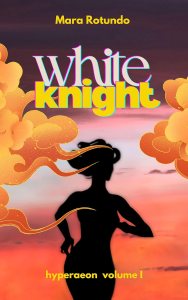
 Mara Rotundo’s debut novel, White Knight (Goldmund, 342 pages), is a love square set against the pandemic, literary fiction with strong elements of romantic domestic suspense and satire. It is a debut only in the sense that it is the first of her extraordinary writing she has allowed us to see. Her bio tells of many short stories and essays locked in a dusty drawer, like Bach’s music waiting to be found in that attic. If we could but read those writings, we would most likely find a step-by-step handbook for the development of a genuine writer, for in this book she springs full-grown from the loins of the muse, armed and dangerous.
For instance, these powerful lines start the romance,
“When her intrepid black eyes sunk their blade into his pudding face, a champagne cork popped somewhere. The earth’s rotation took a hit, the magnetic poles confused each other. She felt him melt, and he let her feel it.”
White Knight is a book of contradictions—a pulp novel love story on the surface.
The jilted bride to be was living her moment. This was it, the revenge against her parents, every judge on every show that had shunned her act, the world; her revenge against stupid beauty ideals that said you have to be fit to be attractive; against any idea that hard work and ambition are the key to success. Any idea that personal responsibility is somehow relevant. Against any idea.
Rotundo takes the knife of angst and observation and cuts the silliness and commonality of such a story out of it, leaving the sharp bones and bloody pieces of real lives somehow adrift in their foolishness and sin exposed to our wondering gaze.
Likewise, hearts break all the time. It’s a whole industrial process out there. One could imagine huge hangars of broken hearts like defective steel mechanisms just coldly loaded by crane into a crusher. Nobody cares. All these dead loves. Who cares. People bleed and stop breathing. Just statistics.
Hearts, lives, beauty, sacrifice, light, all crushed by the Giant Car Crusher of Time. Made into an amorphous paste that is oil fuel for the next unfortunates of the next cycle. And so on.
No writing rules need apply here—no dialogue tags to mar the flow, no adhering to lessons learned at boring writer’s conferences. No. This is a book that goes for the throat and doesn’t stop until the story is thoroughly pushed to its conclusion. It is a book where the writing itself outshines even the story and the characters, complex as it and they are. Is it a great book? Possibly. Is it great writing? Absolutely.
Writing in a classical style, influenced by Tolstoi and Dostoevsky, with elements of Gone with the Wind, Rontunda’s novel is poetic but also picaresque in places.
–Patrick E. Craig, author of Far on the Ringing Plains, 2020
 Dactyl Review