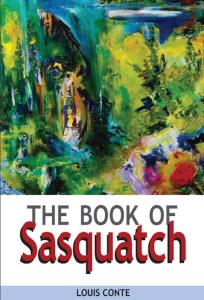
 Part allegory, part action novel, The Book of Sasquatch (City Bear Press, 230 pages) by Louis Conte views humanity through the eyes of a misunderstood monster.
Flirting with magical realism, this novel gives Big Foot highly-evolved capacities for sight and hearing, allowing him to perceive what humans cannot, while remaining unseen. He mostly surveils human activity through windows and from the trees above. The humanoid can also communicate telepathically with others of his tribe; he can cover ground almost as rapidly as the crow flies, all of which skills make him a near-omniscient narrator, who relates the activities of the townspeople of Deception Falls, as they deal with the consequences of modern development and changes in local demographics.
We can say Sasquatch is a monster insofar as he is prone to let loose his righteous rage against those who harm the powerless. He is a figure of retribution. He is the spirit of the pristine forests of North America. The Big Foot tribe is aligned with Native Americans. Their ancestors took revenge against early settlers who brutally killed their friends and they have walked “in the shadows,” cursed ever since, and banished like Cain.
Sasquatch is also figured as Grendel, as a mythical dominant male who fights to right the wrongs of the world. But using violence against violence just ensures that the cycle will continue and the killing will accelerate. Sasquatch must learn how to control his own anger before he can be better than the men who hunt him.
I looked at my reflection in the still water and noticed that I was beginning to show gray on my beard.
I felt my melancholy returning. There are times when I fear that I will simply become a shadow of a shadow, as though I never was. Darkness only leads to more darkness,
Sasquatch is pursued by those who would kill him and also those who would study him. Hesselbeck is a Big Foot hunter and his team of crypto-biologists have been tracking Sasquatch for years with no luck. Meanwhile, as Sasquatch observes them from above and sometimes messes with their equipment, he nevertheless has sympathy for Hesselback,
You’re a fringe kook who has walked away from a normal human life to pursue a creature that most of your kind believes is a myth. And modern people no longer respect myths.
Don’t you understand that you will destroy the reality — our reality — once you discover that the legend is just another kind of person?
Without myths, without magic, we are all just primates, scratching out an existence before we turn to dust. Once I am gone, once we are gone, the clock will begin ticking on your kind.
One day you will join us n the dust of time.
Sasquatch is drawn toward the humans, and he puts himself in positions where he will eventually be discovered.
Soon after the opening of the story, Sasquatch’s teen son is killed by a hunter. The father’s ancestral rage reawakens and makes him want to “kill them all.” Indeed, he does cause havoc in human affairs, specifically between two warring motorcycle gangs that are dealing drugs. Sasquatch just has to spark an argument, by peeing on one of the biker’s jacket, to get the all the members of the gangs to kill each other. The resulting carnage at the biker bar stands as a analogy to the likely fate of nation states, who may soon enough wipe each other out, due to some petty perceived injustice.
But at about the same time that Sasquatch is busy triggering violent justice among the criminal elements of the town, he is drawn to a human boy, Christopher, and it is their relationship that provides the catalyst for Sasquatch’s deeper understanding of his role as a force of nature.
It is from the link between Christopher and Sasquatch that the more complex symbolism of the story grows. Christopher is autistic. He is shunned by society. He can’t communicate. He is frustrated. He is misunderstood. He is locked in a body that won’t let him speak, even though inside he experiences all the complex emotions that all people do. As Sasquatch observes, that silence “casts a pall over your existence and lets people render you invisible.”
For reasons Sasquatch can’t understand, he can communicate telepathically with Christopher, as if he were his own kind. The native Americans understand that Christopher must be a shaman.
The novel is dedicated to Thomas, Conte’s son who has severe autism. Conte has three sons, triplets, two of whom were vaccine injured as infants, but Thomas, the child with the lowest birth weight, suffered the most. He is non-verbal.
In the last decade or so, parents of non-speaking autistic kids have discovered that, through a new method of shaping motor control responses, their children can learn to communicate by spelling out words. It turns out that these non-verbal kids have a full and complete understanding of language, can understand everything that’s being said. They’ve just been locked in. They’ve been misunderstood. They’ve been perceived of as having low intelligence, when in fact they are quite intelligent.
That’s horrifying to learn that these children have been imprisoned in their bodies like this. Think of all the autistic kids who have been institutionalized.
Conte, through Sasquatch, is speaking for his own son, in a way. I also speculate that, as a father whose two infant sons were injured by medical malpractice and who has been subsequently gaslighted by the courts and federal agencies, he must feel no small degree of rage. He must feel the Sasquatch within him seething with desire for revenge every waking day, and he must keep that in check, and try to make peaceful and positive changes in the world instead.
In addition to this novel, Conte has also published, The Autism War, a novel in which a pharmaceutical executive put on the stand actually tells the truth and the damage to children is thereby brought to an end. For the time being, that book is shelved in the fantasy section, but who knows, maybe it will come true some day. Conte was also the lead investigator for and coauthor of a seminal paper on the autism-vaccine controversy, “Unanswered Questions from the Vaccine Injury Compensation Program,” which appeared in Pace Environmental Law Review. That paper found that the government has indeed had to compensate many children with autism for vaccine-induced brain damage while at the same time declaring no link between vaccines and autism exists.
Sasquatch reflects, Christopher’s
own culture had poisoned and sacrificed him for reasons that were beyond my understanding. Whatever the reasons, the abuse he suffered as an infant triggered a cascade of problems for Christopher and his mother that led them to be outsiders among their own people. Like us, they were driven into the shadows, shunned and rejected.
In the end, the town of Deception Falls becomes a battleground, as the US Department of Defense moves in to take possession of the now captured Sasquatch in order to learn the secrets of his biology for nefarious purposes.
In keeping with the magic realism elements of the narration, the style is at time as sparse a screenplay with action and dialog dominating, but there are also liberal witty and ironic reflections from Sasquatch, who is quite likable despite or because of his beastliness.
The action moves as fast as the nine-foot Sasquatch; it is a fun read, while also delivering an important message.
–V. N. Alexander, author of Naked Singularity, 2003
 Dactyl Review