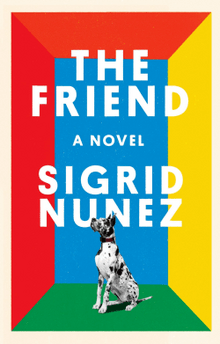
Maybe a better title for this book would be Bereavement, since that’s the main theme. We begin on the first page with a description of Cambodian women who had gone through hideous traumatic experiences and who, subsequently, appeared to have cried themselves blind. That, in a sense, is what the narrator is doing throughout the pages of the novel: metaphorically crying herself blind.
Names are scarce in this book. The unnamed first-person narrator, like the author herself, lives in New York City and teaches creative writing in a university. They appear to be about the same age (sixties or early seventies), so Nunez—who at some point has lost the tilde in her last name (that’s a different issue)—could be basing the action of the novel largely on her own experience. We do not know, for all that, if she ever lost a best-friend-fellow-writer to suicide and, subsequently, adopted that writer’s bereaved dog, a Great Dane. More on the dog later.
A question never really answered: what, exactly, was the narrator’s connection with the dead writer, the “You” to whom this novel is told throughout? She remarks at one point that “Our relationship was a somewhat unusual one.” Over the course of his life he had three wives, but she was not one of them. She does, however, consider him a very special friend, and she grieves for him as one grieves for a dead husband or lover. What was this man, this “You” of the narrative, like? He was a highly successful writer of fiction. “You had us believing that one day you’d win the Nobel Prize.” Like the narrator, he taught creative writing at a university. This man was a seducer, a preyer upon his female students, a cad by anyone’s at any time’s standards—and by today’s exacting, self-righteous standards an insufferable cad.
Why did “You” commit suicide in late middle age, taking his wives and friends by surprise? He was depressed, for one thing, because he was getting older and could no longer enjoy screwing his students. Well, yes, he still found some willing females, but now they clearly had ulterior motives and didn’t seem to enjoy much the physical part. Plus which, most of the younger generation was contaminated by feminist views. One group of his women students had lodged a complaint with the dean over the way he called them all “dear.” Another problem was/is the standing of creative literature in the modern Western world, what used to be called belles lettres,—a major theme of the whole book. “You” complained that “nobody in publishing seemed to care how anything was written anymore.” He “had become dismayed by the ubiquity of careless reading,” and by the fact that his students could not tell a good sentence from a bad one. Then again, he had lost his “conviction in the purpose of fiction—today, when no novel, no matter how brilliantly written or full of ideas, would have any meaningful effect on society.” He was utterly demoralized by the way political correctness and “cancel culture” ruled in the university ambiance. “What a load of crap,” he would say, “making the university a ‘safe place.’”
Notwithstanding You’s considerable faults and lapses as judged by modern standards, the narrator has always stood by him. When he dies she collapses into something like a temporary insanity that plagues her throughout the narrative. At one point her friends organize an intervention, informing her that she is in the throes of “pathological grief.” The magnitude of her emotional crisis is described three-quarters of the way through the book (p. 154): (1) “my feeling of living with one foot in madness; (2) “no matter how much I sleep I’m exhausted; (3) “the days when I don’t eat” (or eat nothing but junk)”; (4) absurd fears: “What if there’s a gas leak and the building blows up?”
At a point when this short novel is close to being over, the narrator describes herself as anxious about classes beginning in a week, having “open wounds, hidden fears, loneliness, rage; never-ending grief.” Worst of all, her only friend in bereavement and loneliness (a dog, the title character) is aging and moribund. The subject of suicide comes up periodically in the narrative. She muses at one point that “it could be a rational decision, a perfectly sound choice, a solution even” (but not for the young). She notes how suicides never get much sympathy, that they are almost always condemned. Listening to a radio program, she hears what those who call in have to say. “All the usual word-stones were cast: sinful, spiteful, cowardly, vengeful, irresponsible. Sick. No one doubted that the suicide had been in the wrong. A right to commit suicide simply did not exist. Monsters of self-pity, suicides were. Such ingratitude for the precious gift of life.” How facile we homosapiens are in our easy judgments and condemnations.
Certain ancient sages, on the contrary, have opined that “though generally to be condemned, [suicide] could be morally acceptable, even honorable, as an escape from unbearable pain, melancholy, or disgrace—or even just plain old boredom.” Meanwhile, the narrator goes on suffering through her bereavement, listening to “the monotonous woe-is-me of the mourning doves.” Her therapist informs her pointedly that suicide is contagious. “One of the strongest predictors of suicide is knowing a suicide.” As if she did not already know that.
On Writing and Writers
Some of the most creative of writers featured in the book are panhandlers that the narrator comes across, holding signs or wearing shirts. One drunk who “has pissed himself and is sprawled in a doorway,” wears a tee shirt reading “I Am the Architect of My Own Destiny.” Ha. Nearby is a guy with a handmade sign: “I used to be somebody.” I wonder if the most creative signs might make for the most beggarly of moolah handed out to the beggars. This would jibe with a major point of the book: that really creative lit gets no respect anymore.
One of the most prominent themes of the whole book is the theme of writing and writers, including the state of creative literary writing in the modern world. At one point the narrator mentions that good writing is all about rhythm: “Good sentences start with a beat.” Who in the book cares about that, besides her. Publishers? No. Readers? No. The students in her creative writing classes? Hell, no. A salient message of The Friend is that creative writing of fiction these days is in one sorry state. What’s wrong with fiction writing and fiction writers and wannabe fiction writers today? Many, many, many things, so tells us Sigrid Nunez through the intermediation of her writer/teacher narrator.
For one thing, animosity is rife. “The literary world is mined with hatred, a battlefield rimmed with snipers, where jealousies and rivalries are always being played out.” Missed your metaphor there, o ye writer. After sticking the snipers in you need, in the following clause, say, this: “where jealousies and rivalries lead to perpetual snipings—from guys and gals up in trees, in foxholes, behind buildings, everywhere.” A different metaphor: today’s writers are on something like a “sinking raft that too many people are trying to get onto.” If you are already safely ensconced on the raft, you must push those clammering desperately up, importunate newbies away, which “makes the raft a little higher for you.” You might want to shove some of your fellow writers off the raft as well; too many of them don’t belong there, at least certainly not the way you do.
After all, nobody much is reading fiction anymore—many, many, many are reading nothing—so why do we need more writers to crank out stuff that won’t be read? “In the news: 32,000,000 adult Americans can’t read. The potential audience for poetry has shrunk by 2/3 since 1992.” “Whenever a writer hits it big a lot of effort seems to go into trying to bring that person down.” Well, sure, but nothing new there; we human beings are out to boost our egos by way of deflating the egos of others. Human nature. Watch hummingbirds fighting each other over a hummingbird feeder: that’s us. Wouldn’t it be easier, and more civil, if the hummingbirds shared the feeder? Yes, but that’s not the way God made His/Her world—and all the multivarious creatures walking and creeping about it.
Another thing: writers, so it seems, are not happy people, and are ever more chagrined about the very thing they devote their lives to. There are no more “feckless bohemians” among today’s writers—that went out long ago. Today’s writers, at least in the U.S.—so Nunez tells us—are basically bourgeois. They don’t hunker down in a rat hole in Greenwich Village, frenetically typing out the Great American Novel on a manual typewriter while surviving on baked beans, cigarettes and hot dogs. They teach creative writing in universities, where they throw dinner parties for their fellow creative writing teachers. No smoking allowed. There they sample fine wines and bitch about how stupid and crass and intolerant their students are. Furthermore, “many writers today admit to feelings of embarrassment and even shame about what they do.”
Want to be a bad guy? Be a writer. Writing, so says Georges Simenon, is “not a profession but a vocation of unhappiness.” This astonishing admission from a man who “wrote hundreds of novels under his own name, hundreds more under two dozen pen names, and who, at the time of his retirement, was the bestselling author in the world. Now, that’s a lot of unhappiness.” Nunez has plenty more quotations from famous writers to back up her points. W.G. Sebald: “There seems to be no remedy for the vice of literature; those afflicted persist in the habit despite the fact that there is no longer any pleasure to be derived from it.” Read Austerlitz by W.G. Sebald; a book much praised as profound. A fine novel; and a book that appears to have been written by a writer deriving absolutely no joy in the writing of it.
Henry de Montherlant: “All writers are monsters.” Joan Didion: “Writers are always selling somebody out.” Rebecca West: “Any writer worth his salt knows that only a small proportion of literature does more than partly compensate people for the damage they have suffered in learning to read.” John Updike: “Whenever I see my books in a store, I feel as if I’ve gotten away with something.”
Things have been bad enough for some time, but now we have this new efflorescence of sanctimony that has burgeoned in the Western world. We are required, it seems, to judge harshly anyone who deviates even one eon from what are assigned and enforced mores and behavior. Who has the temerity to make these rules and why are we required to follow them? Is this a healthy, salubrious tendency? Apparently, you’re not allowed to ask such questions. The “cancel culture” movement has come down hard on writers of fiction. Famous writers themselves have contributed to this judgmental spirit. In a pious mood one day Toni Morrison, e.g., “called basing a character on a real person an infringement of copyright. A person owns his life, she says. It’s not for another to use it for fiction.” So we’re all personally copyrighted; we own our own inviolate selves. An interesting notion, which suggests that Toni Morrison is either (1) incredibly naïve about fiction writing and fiction writers, or (2) lying to herself and others. Most likely #2. If she were still alive I suppose she would support the latest absurd “rule” that any writer is forced to follow: “If you’re not a Mexican you’re not allowed to write fiction featuring Mexican characters and a Mexican setting. If you do, sucker, we’ll cancel you!”
“It’s become entrenched, hasn’t it. This idea that what writers do is essentially shameful and that we’re all somehow suspect characters.” So says a fictionalized You, in Ch. 11, which amounts to a short story the narrator writes, featuring her visit to a You who did not commit suicide after all. This story also treats more of the silly BS being churned out by “right-thinking” enforcers and self-congratulators. About how writers are, largely, of the white privileged society and therefore should not be allowed to write anymore. “They shouldn’t write about themselves, because that furthers the agenda of the imperialist white patriarchy. But they also shouldn’t be allowed to write about other groups [see above, Mexicans], because that would be cultural appropriation.” Ah, the fascist voices of the doctrinaire and dogmatic “illiberal left,” squeezing tight their sanctimonious sphincters, informing all and sundry what we’re allowed to say, what words we must use in saying it, and, ultimately, what we’re allowed to think.
In that same short story of Ch. 11 the narrator seems to speak approvingly of Svetlana Alexievich and her “documentary novels,” which feature the voices of women speaking directly into the narrative. “No invention. No authorial point of view.” Of course, most of her narrators are women; “women make better narrators because they examine their lives and feelings in ways men usually don’t, more intensely . . .” Here we speak in apparent praise of narrative creative fiction void of creator or creativity: Just give me the facts, ma’am. It’s only natural that there’s a twinge of male-bashing in this passage, given that some sixty years ago—with the feminist movement—is where so much of this illiberal balderdash originated.
People who teach creative writing, so the narrator tells us, are embarrassed to admit what they teach. They are, of course, working in a university ambiance, where the tight-sphinctered proponents of “progressive” notions explained above are in the ascendancy. They certainly must be embarrassed as well by the very students they teach. At one point Nunez writes, “The rise of self-publishing was a catastrophe.” Maybe so, but much, much greater is the damage done to the American literary scene by the rise of creative writing programs and the puerile, insipid published fiction that inundates the literary world—fiction that comes, largely, from those very writing programs. Nunez never directly makes that point, and for good reason: both she and her narrator make a living by teaching in creative writing programs. But The Friend pulls no punches in describing what the students of those programs are like in the twenty-first century.
Creative Writing Programs and Their Students
Flannery O’Conner quoted: “Only those with a gift should be writing for public consumption.” Flannery O’Connor had a gift, which she demonstrated early on, when she was a student in a creative writing program in Iowa. Way back when, in the 1940s and 1950s, she saw first-hand some of the problems with such programs. Another quote from her: “It’s dangerous to have students critique each other’s manuscripts: the blind leading the blind.” Those problems have now proliferated with the vast over-proliferation of creative writing instruction in universities all over the U.S. Today the blindness, and the blind insisting on informing the blind on what they are allowed to write, and how to write it, is overwhelming, and shocking.
Could Flannery have done without whatever they taught her at Iowa? Easily. She later said, in effect, that she already knew how to write before she went to Iowa. But her stay there was certainly not wasted. There she made the contacts that would ease her entry into the literary world of the Eastern Establishment. Without the help and encouragement of writers and intellectuals she met at Iowa, she might have returned to Milledgeville, Georgia, and wasted away unknown, unpublished. Then again, she was young, a raw talent when she arrived at Iowa. She had never heard, e.g., of Nikolai Gogol. At Iowa one of her mentors suggested she read Gogol; she did, and was influenced by him.
The narrator of The Friend tells us what it’s like to teach creative writing sixty years after Flannery O’Connor’s death, and twenty-five years into the twenty-first century. Not a pretty story. In the first place, universities these days—flush with certain “progressive” principles, judgmental and self-righteous to the core—are bent on restricting all sorts of academic freedom, both that of professors and students. She describes how the profs at her place of employ all are required to take an online course, Sexual Misconduct Training, in which they learn that practically anything they say or do may be construed as sexual misconduct. She does not say so, but I suppose that all students are also required to take such a course. The narrator confesses to skimming over the materials, only to discover that in the test she took online at the end, she got two out of ten questions wrong. Among other things, the narrator learns “that, yes, I was required to report immediately any knowledge I might have of a teacher dating a student, and that although not required I was strongly advised to report a colleague for telling an off-color joke, even if the joke didn’t personally offend me.”
No humor allowed, folks; after all, you might offend somebody. Laughing is best always suppressed. Given the touchy-feely students in the classroom, all hypersensitive to extremes, all needing to feel safe, and all prepared to report violations of touchy-feely rules to the dean, I’d guess that the modern-day prof must weigh his/her words extremely carefully. The situation reminds me of the atmosphere in the Soviet Union in Stalin’s time, when everyone spoke in whispers and there were stukachi (informers) denouncing people right and left. Or in today’s Russia, for that matter, where people can be arrested and sent to labor camps for calling Putin’s War a war.
Nowadays, so it appears, that fear of offending someone or “triggering” something affects even the creative writing exercises that students present for critique in class. So the narrator tells us, there is no sex in the writings anymore. Sex is kind of like laughter: dangerous and potentially offensive, so I better not put it in my story. The profs say they’re happy about this development, since they could get in trouble for discussing sex in class! Then again, discussing practically anything in class these days can get you in trouble. I would suppose that the obligatory course in Sexual Misconduct also informs the student how to go about properly engaging in sex—if anyone dares do that at a modern university. You have to go by the numbers, making certain that the partner is okay with each step by asking caring questions as you move along: is it okay if I hug you? Okay. Can I put my hand here, on your knee? Okay. Would it offend you if I caressed (worry, worry) your breast? Until you finally get—if all goes well—to the last question: would you mind very much if I put my wiener in your slot? By the way, I did not make this last thing up—about sex by the numbers. I heard it advocated in all seriousness by a member of the illiberal left.
Now for some of the worst of the bad news. The narrator informs us in some detail about what attitudes her students have toward the English language, toward words and creative literature. One English major thinks you put a period after a question mark. Another student is considering taking her course but sends out a questionnaire in advance. One of the questions: “Are you overconcerned with things like punctuation and grammar?” Student A complains about all the reading assigned: “I don’t want to read what other people write, I want people to read what I write.”
Sad fact: today’s creative writing students—at least the ones who have passed through the narrator’s classes, and You’s as well—don’t know zilch about creative writing. They don’t know what good creative writing is, nor do they care. They do not wish to read it, much less write it. Their social consciences are running amuck, and they want the voices of the oppressed, the insulted and the injured to be heard. When told that Rilke claimed writing “is a religion requiring the devotion of a priest,” they laugh derisively: ridiculous. That idea was pretty well accepted, says the narrator, when she was coming along. Now it’s universally absurd. In his imaginary dialogue with the narrator in Ch. 11, You says, “another thing I noticed about the students: how self-righteous they’ve become, how intolerant they are of any weakness or flaw in a writer’s character . . . I once had an entire class agree that it didn’t matter how great a writer Nabokov was, a man like that—a snob and a pervert, as they saw him—shouldn’t be on anyone’s reading list.” Anybody really interested in highly creative, artistic literature can only gape in astonishment at that evaluation—by a group of young dolts—of one of the greatest creative writers of the twentieth century.
The situation is so egregious that it calls for drastic measures. As for Nunez and her narrator—I mentioned this previously, but it bears repeating—neither of them can advocate such measures since their income depends on teaching in creative writing programs. The solution is one I have advocated previously—see a variety of postings on my blog and on the Dactyl Review website, where I have treated this subject in exhausting detail. The solution is to abolish all creative writing programs in all American universities. The state of creative literary fiction in this country would be much improved by such a measure. If there were at least one dissenting voice in that classroom of dolts advocating “cancelling” Nabokov, there might be some hope. Given that there were zero dissenting voices—a unanimity of doltitude—one can only declare the situation hopeless: abolish all creative writing programs. Take the writing students who hate Tolstoy, Hemingway, Nabokov, Shakespeare, Flannery O’Connor and “cancel” them, along with the writing programs they support. Yes, by the way, Flannery too, of late, has been making the cancellation lists; she, it seems, is not goody-goody enough in her treatment of racial matters. She has even dared to be so outrageous as to title one of her stories “The Artificial Nigger.” Where will all the creative writing students go if the programs are closed? Well, those who hate everybody worth reading can get a job somewhere worthy of their talents: say, in McDonald’s, flipping burgers.
Or maybe let a few creative writing programs continue to function, in, say, five or so American universities. Admission to these programs would require passing an entrance exam. Here is one of the multiple-choice questions: Why do you want to be a writer? (a) because I want to make the world a better place; (b) because I want to improve the lot of the insulted and injured of the earth; (c) because I want to produce a new kind of literature, all touchy-feely and safe, a literature having nothing in common with that written by the many nasty dead white men of the world; (d) because I’m in love with words and my dream is to write beautiful sentences. Anyone checking any box but “d” would automatically fail the exam. After all, there’s really no good reason for becoming a writer of literary fiction except being in love with words. And I don’t mean writing the dreck that’s called literary fiction all over the Eastern Establishment these days; I mean writing highly creative literary fiction.
One small ray of optimism lies in the fact that Sigrid Nunez—although complicit in the creative-writing-program racket and all the gruesomeness that it entails—has, nonetheless written a good novel. She’s not Proust or Nabokov, but with The Friend she has produced a lovely little novella reeking in literary creativity. Bravo.
A Bereaved Woman and Her Bereaved Dog
NB: in the final chapter the one addressed by the narrator as “you” is no longer You: the new you is her best friend and partner, the Great Dane named Apollo. I would guess that most readers of this book—little interested in the egregiousness of creative writing programs and the sad lot of literature—follow with most interest the narrative line of woman/dog and dog/woman. For this is a unique story about someone who becomes “the emotional support human” for a dog. Of course, had her emotions been anything other than skewed after the suicide of her friend, she never would have taken on the burden of keeping a dog that large in a small apartment in New York City. Where, incidentally, all pets are prohibited.
At the beginning she takes on the care of Apollo out of some sense of duty toward her friend. No one else wants his dog, who loved You and was loved by You. The dog, it so happens, is also in a state of bereavement, missing terribly his previous master, and he never gets over the loss. So that the book describes a woman leading a dog through a strange haze of mutual bewilderment and grief. Sounds like a bummer. Especially since, when the narrator becomes attached to the dog she abandons all other friends and devotes herself solely to Apollo—whose life expectancy is already short when she acquires him. So that this story can certainly not end well.
Since she is already in a deep emotional crisis over her recently demised friend, one does not even care to imagine how she will feel after her new only friend dies: which he does on the last page of the book. Oddly enough, the book is so well-written and entertaining that this dismal plot does not propel the reader into a depression. We (or at least I) prefer not to think about what happens after the action of the narrative is done. Which, I suppose, is one more advertisement for the writing of good sentences.
You can learn a lot about dogs by reading this book. There are “pointers [e.g.] that freeze in point posture and then can’t get out.” Sounds impossible, a sick joke, but apparently it’s true. You learn, in addition, some of the perils of being a pure pedigree dog. The message seems to be that God loves mutts best of all. “Idiot collies, neurotic shepherds, murderous Rottweilers, deaf Dalmatians, and Labs so calm you could shoot a gun at them and they wouldn’t suspect danger.” The Great Dane breed, that of the secondary hero of the book, has some bad press as well. The Danes are known to be dumb and have a very short life expectancy. As the narrator discovers, they poop copiously, and her efforts to deal with this while walking Apollo on the streets of New York furnish much entertainment to passersby.
Even more interesting is what you learn in this book about people who are avid dog lovers, people who, ever increasingly in our modern world, have a best friend, or even lover, who is a dog. The narrator cites the book, My Dog Tulip, by J.R. Ackerley (1896-1967). Thoroughly in love with a dog, the lovestruck Ackerley details his “fifteen-year marriage, the happiest years of his life.” Here we touch upon the subject of buggery, which, I suppose, makes for a satisfactory sex life for some people nowadays, since, so I’ve heard, sex with other humans is in decline these days. Different strokes for different folks. The so-called “Incels,” young male women-haters who can’t get laid, might consider this option: buy yourself a dog.
The narrator takes Apollo to the vet, “the sort of man who speaks to women as if they are idiots and to older women as if they are deaf idiots.” The vet says, “Whoever trained him made him understand that humans are the alphas, and you don’t want him to start thinking otherwise. You don’t want him getting it into his head that he’s the alpha.” The vet’s parting remark: “the last thing you want is for him to start thinking you’re his bitch.” We don’t know what Apollo is thinking, though thinking appears to be not his métier. But by the end of the book—although the possibility of buggery is excluded—it appears that the narrator is close to becoming exactly that: his bitch.
The very act of walking a Great Dane on the streets of New York creates a sensation. As older woman walking a big dog, the narrator does not have to put up with men’s off-color remarks, as she had to when she was a young, attractive woman walking a big (different) dog. This made me sympathize with what young women, especially the pretty ones, have to put up with from various idiot swinging dicks. I’d imagine that not being pretty is even somewhat to be preferred. Or being old, since the old, neither men nor women, get the least bit of attention, good or bad, from anyone.
Then there are the problems that come with an aging pet. As the narrator declares, “I want Apollo to live as long as I do. Anything less is unfair.” That statement is indicative of a sea-change in attitudes toward pets in the U.S. over the past 50-60 years. When I was young (long time ago) nobody would think of treating a dog as if it were a human being. Now vast numbers of human beings do exactly that, and those human beings spend exorbitant amounts of cash treating the ailments of pets, and even keeping moribund pets alive long after it makes no sense to do so. What does that say about the attachments people have these days? And about the epidemic of loneliness that has spread all over the U.S.?
######################
Appendix: List of My Jeremiads Against the Creative Writing Racket
(Available on the Blog, “U.R. Bowie on Russian Literature” and on the website Dactyl Review)
Analysis and Critique of George Saunders book, A Swim in a Pond in the Rain, with particular reference to his insipid, BS-laden “workshoppy” presentation of the Anton Chekhov short story, “In the Cart.” In a different posting I present my own critical analysis of the same story.
Book Review Article: Best American Short Stories, 2017. About how the “best” stories are often not very good. About the dull and weary genre of “domestic literary fiction,” produced largely by writers who come out of MFA programs in creative writing.
“The Great American Boondoggle (On the Sad State of the Short Story)” More on “domestic literary fiction,” on the bleak, anodyne “New Yorker story” and the ubiquity of bad published fiction.
U.R. Bowie, author of THE FUTILE SEARCH FOR A LIVING SOUL [A NEW READING OF GOGOL’S DEAD SOULS («МЕРТВЫЕ ДУШИ»)], forthcoming
 Dactyl Review
Perfect: “a unanimity of doltitude” — they’re everywhere! :-)
Good review, Robert. And even better rant.
Yeah, thanks, VN. I would not, however, want my rant against the illiberal left to be interpreted as in any way supportive of the clown we’ve got back in the oval office again. But I do hold the Democratic Party as partially responsible for the mess we’re in now. If that party had moved slightly to the center, abandoning some of its more idiotic left-wing causes, it could very well have won the recent election.