Train Dreams by Denis Johnson

traindreamsThe next time you walk into a bookstore, it’s worth remembering that unseen battles have raged over the shelf-space in front of you. Winning the prime, eye-level locations and avoiding the dustier corners requires strategy, charm, the offer of a good lunch and perhaps even hard cash.

The stores themselves, of course, want you believing that here is either what you want, or should want, and so going into London’s largest bookstore last week, I decided to be led. With time-plus-cash in hand, and my cynicism tucked away, I roamed only within a restricted locus near the main entrance. And it was here that I picked up Train Dreams, by Dennis Johnson (Granta, 128). The first thing to remark upon, is size: it’s eye-catchingly small. Continue reading
The Scapegoat by Sofia Nikolaidou

ScapegoatAs I begin to write this on January 20, 2015, the news from Buenos Aires isn’t good. Albert Nisman, the federal prosecutor assigned to finally uncover the truth about the 1994 bombing of the Argentina Israelite Mutual Association, a Jewish community center, was found dead in his apartment. Nisman was about to reveal a high-level government conspiracy to cover up Iran’s role in the bombing, which killed 85 people. Argentina has long struggled with corruption and politicization of its government institutions, making it almost impossible for the nation to confront its demons—from sheltering Nazis to the 1970s/1980s rounding up and killing of leftists, communists, intellectuals, and Jews who became known as the desaparecidos opposed to the ruling right-wing Junto. The powerful are usually protected. Continue reading

The Sea Trials of an Unfortunate Sailor by Kurt Brindley

seatrialsBefore I begin this review, let me first recommend to anyone whom it persuades to read The Sea Trials of an Unfortunate Sailor (Amazon,198 pages), that after doing so they further benefit themselves by looking again at their copy of Herman Melville’s Billy Budd, Sailor that I shall, however, quote from extensively. Kurt Brindley’s accomplishment should come into even greater focus when looked at through the lens of the nineteenth-century classic novel. Continue reading

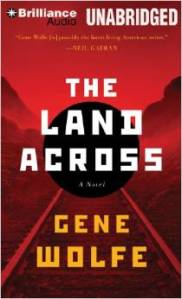
The Land Across by Gene Wolfe

landacrossLately I don’t read much science fiction, though it was once a passion. I received this book as a gift, though, and found the cover information intriguing. “Wolfe is our Melville,” proclaims Ursula Le Guin on the inside jacket. She’s an author I admire, so started in, not looking for Moby Dick, exactly, but maybe Billy Budd.

Continue reading

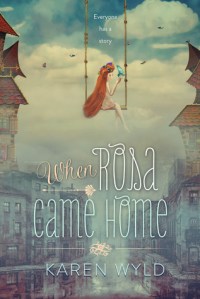
When Rosa Came Home by Karen Wyld


whenrosaOne after one, exotic characters, each with a miraculous tale to tell, come to visit comatose Rosa and her troubled family in Karen Wyld’s When Rosa Came Home (Amazon, 238 pages). Many of these visitors are circus performers or former circus performers. Some are human, some not. The Ambrosia family home is a remote vineyard and becomes yet another magical character — reacting to and affecting the actions set there. It’s trees and gardens fall into shadows when trouble prevails, and burst with light and life when joy arrives. Continue reading

Naked Singularity by V. N. Alexander

One of the many dark beauties of Victoria N. Alexander’s new novel, Naked Singularity (Permanent, 189 pages) is that, not only is it the proverbial good read, it is also an a proverbially brilliant one. Alexander — holder of a Ph.D in English from CUNY, Graduate School — has dished up a heart-stoppingly beautiful heroine who holds similar degrees in teleology (the study of why) and she thinks, and writes, like a dream. Witness this sample from a soliloquy by Hali on death: “You had thought death would at least be romantic, but now you realize there is nothing to be thankful for-how vacuous, how colorless, how without pity, how without regard for your intentions . . . . ” This, from a piece of popular fiction, is almost asking too much in the matter of sheer, unabused style.

Unfortunately, both narrator and author have run up against that same ontically insurmountable obstacle as described above: Hali’s beloved father, former pipe fiend Dave MacDonald, is, as we join the proceedings, being slowly undone, in sickbed and out, by a gross cancer that proceeds from mere discomfort of the throat areas to grueling pain of the neck and head, a progression unforeseen by his bubble-brained doctors to the utter despair of this wife and three daughters, including Hali.

Continue reading

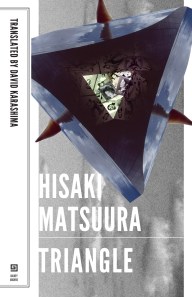
Triangle by Hisaki Matsuura (translation by David Karashima)

triangleTokyo, 1994. Japan is now well into what observers will later call the “lost decade,” a downward spiral triggered by the Japanese central bank’s bursting the speculative bubble of the 1980s. The seemingly inviolable climb of the Japanese economy—and society—has reversed.

Triangle, the 2001 novel by the respected Japanese writer Hisaki Matsuura released in its first English edition by Dalkey Archive Press (233 pages) this month, is an attempt to transform the Japanese downward spiral into a metaphysical thriller. But novels—even literary ones—based on conceptual ideas rarely work. Continue reading

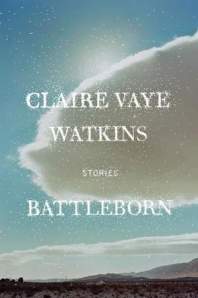
Battleborn by Claire Vaye Watkins

battlebornClaire Vaye Watkins writes as if she scratches her stories from the grit and mining detritus of the Nevada desert she grew up in, then transforms the elemental by gathering language as rich and as natural as the sand or minerals found there like an alchemist. The work is as layered as the often brutal human history of the region, a history she both draws upon and to which she will surely add her own narrative. And like the harsh landscapes and histories that everywhere informs these brilliant stories, when you peer long enough, closely enough, at what seems an empty, heartless place, you not only see its unforgiving beauty within the parched hills and among the tailings castaway after decades of exploitation, you also find glitter among the hardscape, the glint of silver and gold. Like the characters in her story collection Battleborn (Riverhead Books, 283 pages), the truths Watkins unearths require strong stomachs and strong wills to digest but reward the reader with sparkling prose, hard but achingly accurate portraits of unforgettable characters, and gemstones of hope among the chaos of despair and interior pain. Continue reading

Hush Now, Don’t Explain by Dennis Must

hush_nowThis is a unique American novel, written in the language of the heartland before Jesus became a pawn in the political battle for the American soul. It is written in a subdued, subtle, understated lyrical style. It is as rich and diverse as America herself. It is at once a romance complete with trains, whorehouses, steel mills, and the death of the drive-in-movie theater and a coming of age novel in which the protagonist emerges from the chrysalis to transform into a singing butterfly.

Here, in Hush Now, Don’t Explain (Coffeetown Press,  287 pages), Dennis Must cuts a swath a mile wide and generations deep through the America of the lost dream. On a pilgrimage across a spoiling land and on a quest for lost parents, the dual protagonists—Honor and Billy—experience America as raw and pure and as complex as she has ever been.
Continue reading

The World’s Smallest Bible by Dennis Must

smallestbibleDeath is always bearing down in Dennis Must’s somber, disquieting novel, The World’s Smallest Bible (Red Hen Press, 232 pages). Death knocks on the window above the bed shared by brothers Ethan and Jeremiah Meuller in the small town of Hebron, in north central Pennsylvania; death is in the hand-me-downs they receive as gifts from the parents of soldiers who have just been killed in World War II; death brews inside their suicidal mother Rose, who has been scorned by their father; death dogs at their Aunt Eva, a stripper at the Elks Club; and death badgers their neighbor, Stanley Cuzack, as he tries to invent a perpetual motion machine. Half suffocating himself, Must’s narrator, Ethan, tries to push himself away.

Continue reading