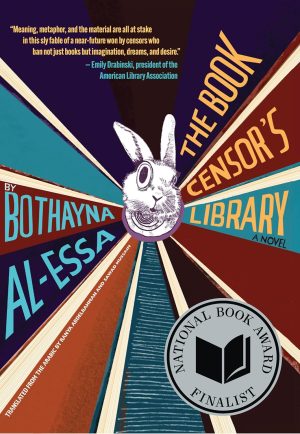
The Book Censor’s Library, by Bothayna Al-Essa

Translated by Ranya Abdelrahaman and Sawad Hussain
Book reviewers of “dystopian” novels often focus on how well iconic authors “predicted” our current world of mass surveillance, alternate realities, and grinding political crises. This helps determine whether they are classics. Orwell foresaw a forever-war of three great powers. Huxley anticipated mass-drugging of the populace. Margaret Attwood’s fear of male power hegemony crushing women’s autonomy and human rights still feels acute.

Then comes the inevitable, punctilious criticism of the iconic author for having forecast incorrectly. Orwell’s totalitarian state has been overtaken by a less comprehensive but more efficient model of regional autocrats. Huxley missed the rise of computers and the digital revolution. Attwood’s dark vision is limited by the unconscious biases of the feminism of the 1980s. 

Such tea-leaf reading makes Bothayna Al-Essa’s The Book Censor’s Library (Restless Books, 261 pages) refreshing; it is couched as a fable, blessedly free of futurism. Yet it is biting, partly because of its uncanny charm, and partly because it is aimed at one contemporary autocratic regime, the Emirate of Kuwait. Al-Essa leaves little wiggle-room that the target of her satire is a living example of authoritarian power—and an example that becomes a stand-in for any authoritarian state. 

Continue reading
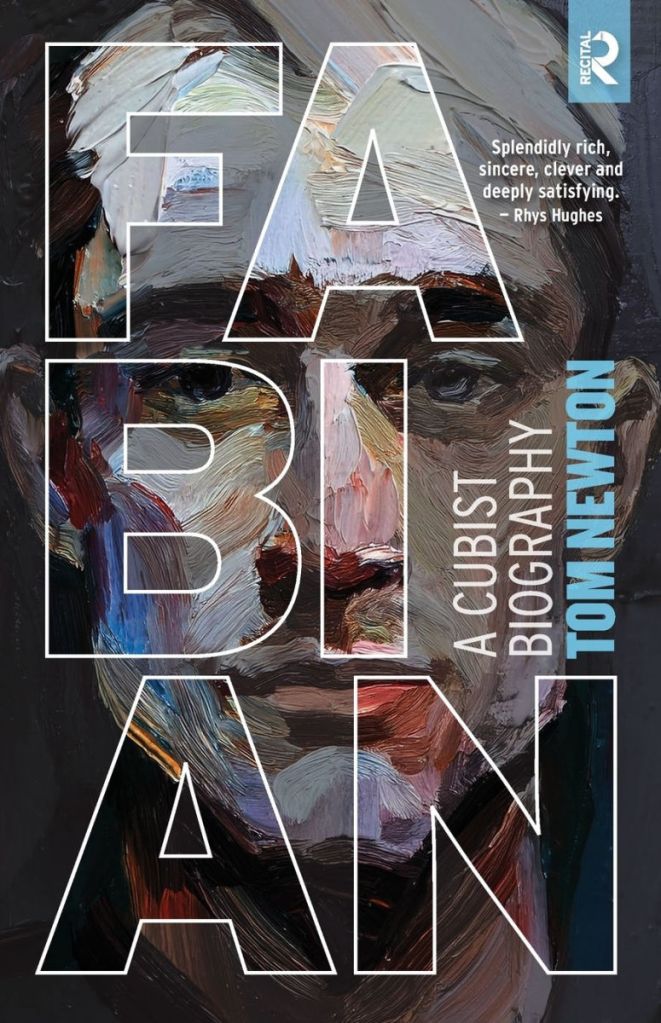
Fabian: A Cubist Biography, by Tom Newton

Tom Newton’s latest novel, Fabian: A Cubist Biography (264 pages Recital Publishing), presents itself as a biography of Fabian, a “disillusioned, would-be filmmaker.” Fabian, a civil servant in the British Ministry of Information during WWII, longs to make a groundbreaking film, but never quite does it. He creates a treatment. He thinks through his artistic desire. Leaving off a Godot-like deferral of Fabian’s planned film, the novel careens fantastically through epochs and ideas. We encounter Spanish conquistadors and Aztec priests, Dr. French (a time-traveling psychoanalyst), Junita (another enigmatic time-traveler) and more. Everyone has a backstory and place in intertwined narratives, arriving at a resolution that challenges the notion that a good book should tuck every loose end in place. 

Continue reading

Alexandria by Paul Kingsnorth

Alexandria (Graywolf Press, 408 pages) is a post-apocalyptic tale set a thousand years in the future, following a small band of survivors living in what once was England. The tiny clan inhabits a world where civilization has collapsed, and, not surprisingly, they have rejected technology, instead favoring ancient ways under a primigenial religion. They may be the last human inhabitants of the planet.

 The narrative revolves around the group’s opposition to a transhuman entity known as Alexandria. They were driven from their ancient homeland by the gradual encroachment of this anti-human force, which once spread across the planet as a successor to modern globalization. Now fully transformed into its posthuman form, Alexandria is in its mopping-up phase, tracking down the survivors with the assistance of an emissary known only as K. The novel unfolds as a series of monologues by the five surviving group members, supplemented by K, a loyal field operative for Alexandria who becomes entangled in the drama of the final collapse when he realizes that Alexandria has abandoned him. The surviving tribe’s language is hyper-simplified English, while K’s reports resemble a corporate memo. 

Continue reading