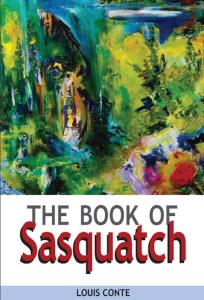
The Book of Sasquatch by Louis Conte

Part allegory, part action novel, The Book of Sasquatch (City Bear Press, 230 pages) by Louis Conte views humanity through the eyes of a misunderstood monster.

Flirting with magical realism, this novel gives Big Foot highly-evolved capacities for sight and hearing, allowing him to perceive what humans cannot, while remaining unseen. He mostly surveils human activity through windows and from the trees above. The humanoid can also communicate telepathically with others of his tribe; he can cover ground almost as rapidly as the crow flies, all of which skills make him a near-omniscient narrator, who relates the activities of the townspeople of Deception Falls, as they deal with the consequences of modern development and changes in local demographics.

We can say Sasquatch is a monster insofar as he is prone to let loose his righteous rage against those who harm the powerless. He is a figure of retribution. He is the spirit of the pristine forests of North America. The Big Foot tribe is aligned with Native Americans. Their ancestors took revenge against early settlers who brutally killed their friends and they have walked “in the shadows,” cursed ever since, and banished like Cain. Continue reading

A Book with No Author by Brent Robison

If the code, “Brent Robison,” were to undergo a random mutation—which in the writing world we call a typo—more likely than not, that “n” in the first name would jump, as even genes sometimes do, to the last name, where, as “Robinson,” it would create a more stable configuration.  And, of course the now isolated and wobbly “t” in “Bret” would likely undergo reduplication—as giraffe vertebrae have done—leaving us with the better reinforced product “Brett Robinson.”

Such are the circumstances that may lead a man to fancy he has a similarly-named double. If he is a writer of excellent literary fiction, he will take that fancy far. If he also moonlights in some other profession, say, as a photographer or videographer, the twinning can take on multiple dimensions. Continue reading

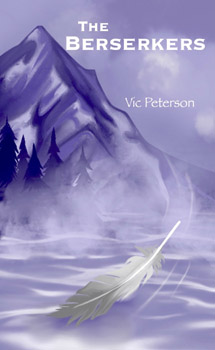
The Berserkers by Vic Peterson

Prominent on the lists of popular commercial fiction and television today is a category called “Scandi-Noir” or “Nordic Noir,” characterized by a police point of view, plain language, bleak landscapes, a dark and morally complex mood, and murder, of course. As I began Vic Peterson’s novel The Berserkers (Hawkwood Books, 240 pages), I was anticipating exactly that sort of genre experience. The first chapter, depicting a crime scene investigation on a frozen lake, did not begin to alter my expectations until its final two paragraphs:

“A pale tangle lay beside the hole the girl had been sunk in. It then dawned on me that the pale tangle was the girl. Her body lay sprawled on top of the ice, displaced by the minor tsunami of the sinking car, and ejected from the ice like the cork from a champagne bottle. Her clothes spread about her in wet snarls lurid under the dim sun, a cape and corset and stockings.

The girl’s pallor was blue and ruinous. My jaw slackened. I tried to utter some words, any words, whether of shock, wisdom, or warning. No sound emanated from my lips. For a pair of large wings had begun unfolding around the corpse, beautiful, wispy, shivering with each gust like the pinfeathers of a hatchling drying in the dying light.”

Continue reading

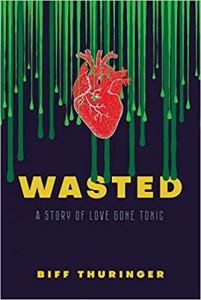
Wasted by Biff Thuringer

Sometimes I like to explore the foggy borderlands between genre fiction and literary fiction.

Raymond Chandler’s crisp and evocative prose and insightful character development transcend the hard-boiled detective genre. His novel The Long Goodbye was praised in an anthology of American crime stories as “arguably the first book since Hammett’s The Glass Key, published more than twenty years earlier, to qualify as a serious and significant mainstream novel that just happened to possess elements of mystery.”

For similar reasons, the movie Chinatown escaped its noir pulp pigeonhole to become a classic of serious film (if such can ever come from Hollywood). Screenwriter Robert Towne and director Roman Polanski took it deeper than the standard commercial mystery pic.

If “eco-thriller” can be said to be a genre today, Biff Thuringer’s novel Wasted: A Story of Love Gone Toxic (Chronic Publishing/Epigraph Books, 280 pages)  walks the liminal space where that category’s conventions give way to something more, an artful challenge to everyday thinking. Continue reading