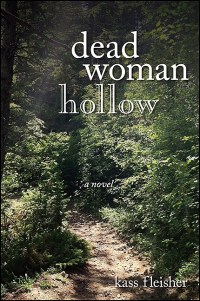
 In these Instagram days it seems any book can find itself tagged a #ForgottenClassic a little more than an hour after its published, and so the best books have to await the time when we find them, just beyond the nearest rise, waiting for us when we get to them. Kass Fleisher’s Dead Woman Hollow (SUNY Excelsior Editions, 194 pages) is one of the latter, a book for the ages, published just short of four years ago as I write, a historical novel in three parts and with two intermezzos, titled “Before” and “After” respectively and perhaps unsurprising. But that’s all that’s unsurprising about this tightly woven, triple-stranded, tragic yet transcendent, even triumphant, ages-of-women chronicle set in the mountains of twentieth century Appalachian Pennsylvania.
Continue reading
Category Archives: historical fiction
Andrew’s Brain by E. L. Doctorow


The Pilgrim of Love: a ludibrium by Charles Davis
“I was pleased to discover in myself an uncanny knack for interpreting the hermetic language of alchemy, as if my book learning had been but a preparation for decrypting enigmatic texts, reading meaning into that which, on the surface, seemed meaningless.”
So says the unnamed narrator of Charles Davis’ The Pilgrim of Love: a ludibrium, an obsessively researched and elaborately plotted parody of an historical romance. (Parody, as I understand the term, is best written by an author who actually loves his target, but who can put some ironic distance between himself and his subject.) The story is set in the abbey of the legendary Mont Michel in 1621, when the absence of roadway access meant visiting pilgrims had to make their way around quicksand between dangerously unpredictable tides. The landscape always plays an important and often symbolic role in Davis’ novels. The pilgrims must interpret the patterns in the sand to avoid sinking in the lise. Continue reading
Norwich 1144 – A Jew’s Tale by Bill Albert
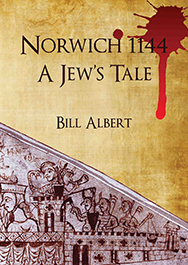 In the preface to his latest novel, Norwich 1144 – A Jew’s Tale (Mousehold Press, 256 pages), Bill Albert recalls the encounter that inspired his story:
“I was in a sixteenth century synagogue in Safed, a town 1000 metres above the Sea of Galilee. The rabbi, who looked as if he had been with the building since it was built, asked me where I lived. I told him I lived in Norwich, England. He looked alarmed, and then without missing a beat he turned and spat dryly over his shoulder three times. Having thereby ensured that the Evil Eye was placated, he told me the story of William of Norwich.
Continue reading
Road to Nowhere by Józef Mackiewicz
 Ezra Pound’s observation that “literature is news that STAYS news” certainly applies to Road to Nowhere (Henry Regnery Company, 382 pages). This excellent novel, first published by a Polish exile in 1955, is consistently engaging and, for its aching, visceral power, still feels fresh. Given the unfortunate fact that Józef Mackiewicz is generally unknown in the U.S. and most of his work is untranslated or out of print, he might as well be seen as a new writer, as far as Americans are concerned. Considered in this light, he is quite simply the most intriguing new writer I have encountered in years. Continue reading
Tales of Barranco Lagarto by Steven C. Levi
 According to a note on the title page Tales of Barranco Lagarto (277 pages, Kindle) is a collection of stories which first appeared in The Coachella Post Gazette. The tales were handed down by one Horatio Shackleton, who died in 1925, and eventually assembled into a single collection by his grandson, Horatio Shackleton III. These characters are based on actual persons. Grandson Horatio is the mask which the “editor”—author Steven C. Levi—utilizes for his satirical tribute to a time gone by. The book concentrates on American culture in the southwest in the late 19th and early 20th centuries. It is not so much an intellectual history as a whimsical foray into a forgotten past, with the narrator’s twinkling eye always at the ready. Continue reading
The Plague by Albert Camus
 Composed in 1948, Albert Camus’ The Plague (Vintage International, 308 pages) is a study of human habit and frailty in a time of widespread destruction and crisis. A plague appears in a modern city called Oran in Algeria, afflicting the community for most of a year, then as abruptly lifts. Residents celebrate, much in the way of celebrations for the ending of world wars, with renewed energy for humanity’s “humble yet formidable love” (301). It is this love, an adult’s understanding of love in the view of protagonist Dr. Rieux, that Camus highlights toward the ending of the novel—that is, love as desire to join with another, whether adult son with mother, father with child, doctor with patients, wife with husband, or “true healers” who seek peace (254). Continue reading
The Sojourn by Andrew Krivak
 There will, unfortunately, always be a need for books about war, and this need takes many forms. In The Sojourn (Bellevue Literary Press, 191 pages), Andrew Krivak successfully defends the parish of the novel. Although the harsh imperatives of history require much sifting of facts, places and victims—synthesis and hindsight are essential, as part of our troubled species’ perverse CV—the novel, with its relentless subjectivity and its bloody-minded insistence on the plight of individuals, brings its own kind of necessary testimony. Continue reading
My Dream of You by Nuala O’Faolain
 Nuala O’Faolain’s My Dream of You (Penguin, 464 pages) is a coming-of-middle-age tale about Irish women across decades looking for “something to love.” While the novel is overtly about passion, it also explores the meaning of coming home and leaving it, of familial ties, of friendship, and, most poignantly, of growing older. Fiftyish Kathleen de Burca finds herself bereft and alone when her best friend Jimmy dies, and she begins to question the choices she has made. A persistent memory of a former lover and his “gift” to her of court documents prompt her to quit her job as a travel writer and to research the scandalous affair between a Continue reading
Burr: a novel by Gore Vidal
 The passage of time edits history. The roughness and corners of detail wear away under the constant erosion of recall and interpretation. Eventually, unless events or people are sufficiently insignificant so they can be merely forgotten, the process rounds off what remains to form mere icons, summaries that become anodyne cartoons of once complex events and motives.
I can recall the celebrations that surrounded the bi-centennial of the American Revolution. At the time, I thought I knew something about the history. Names such as Washington, Jefferson and Adams became commonplace for a while. A couple of years before, Gore Vidal had published his novel Burr (Vintage, 448 pages), which I had not read. Having just finished it, nearly forty years Continue reading
 Dactyl Review