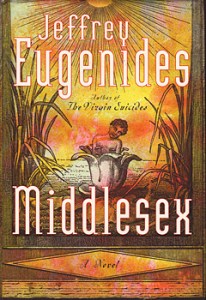
Middlesex by Jeffrey Eugenides

Like a hermaphrodite, Middlesex (Farrar, Straus and Giroux) by Jeffrey Eugenides is composed of two parts that are not usually joined together.

The first half of this 529-page novel is a memoir of an average Greek-American family living in Detroit. I was expecting a story about a person with genetic mutation that deeply affects his identity and sex life, but what is presented in that first half of the novel is a nostalgic tale of a Greek couple fleeing the Greek-Turkish war in 1922, settling down, in what was then becoming the Motor City,  having children, running into financial problems, and surviving a race riot.

None of this had much to do the immigrant couple’s grandson (née granddaughter, apparently). That novel didn’t start until the chapter called “Middlesex” on page 253 where an amazing coming-of-age story finally begins to unfold. Cal/Calliope was born with undeveloped genitals and was mistaken for a girl until puberty started to try to catch his body up at fourteen. Continue reading

A Book with No Author by Brent Robison

If the code, “Brent Robison,” were to undergo a random mutation—which in the writing world we call a typo—more likely than not, that “n” in the first name would jump, as even genes sometimes do, to the last name, where, as “Robinson,” it would create a more stable configuration.  And, of course the now isolated and wobbly “t” in “Bret” would likely undergo reduplication—as giraffe vertebrae have done—leaving us with the better reinforced product “Brett Robinson.”

Such are the circumstances that may lead a man to fancy he has a similarly-named double. If he is a writer of excellent literary fiction, he will take that fancy far. If he also moonlights in some other profession, say, as a photographer or videographer, the twinning can take on multiple dimensions. Continue reading

Wanderer Springs by Robert Flynn

wandererUp in that part of state just east of the Cap Rock, south of the Red River and west and north of Wichita Falls is a region of the country the residents continue to call “East Texas,” although, even at 70 mph it is hours from Amarillo, Lubbock or Spur, a half-day from San Angelo and Odessa, and a long, hard, hot day from Ozona or El Paso.

It is a part of the country that rhetorician Jim Cordon once called “terra incognito,” forgotten by most of Texas, ignored by everyone else. It is a hard land, filled with rattlesnakes, mesquite, winters that freeze livestock and people, summers that dry the ground so hard it cracks. Continue reading

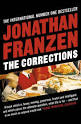
The Corrections by Jonathan Franzen

correctionsGifted chronicler of American life, Jonathan Franzen offers a rather quiet plot in The Corrections (FSG, 568 pages), which follows the lives of the Lambert family headed by Enid and Alfred, typical Midwestern parents, whose children have scattered, eager to find their own definitions of happiness.  The oldest, Gary, is a money manager, an asshole son, whose inner workings are described with surprising compassion; the middle son, Chip, is a lecherous and pretentious academic who’s just lost his position and his girlfriend and is working on an autobiographical screenplay that betrays a dreadful lack of self-awareness; the youngest, daughter Denise, is a talented chef who keeps throwing herself into undesirable relationships. Will they succeed?  Is the aging patriarch going completely mad? And why is Alfred  such an unhappy old man?  Will Enid get all her children to come home for one last Christmas together?

Continue reading

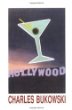
Hollywood by Charles Bukowski

Although far from Bukowski’s best, Hollywood (Ecco, 248 pages) is a revealing send-up of what happens when brutal honesty (Buk) interacts with the California entertainment industry. A roman a clef about the making of the independent film Barfly based on Bukowski’s life and some of his earlier stories,the book shows Bukowski finally gaining some recognition and acceptance near the end of his career. The movie stars Faye Dunnaway and Hollywood badboy Mickey Rourke who does a good job slurring and walking about with hemorrhoids. Yet it appears from the text that Bukowski would have preferred Sean Penn, who was originally cast in the part, to play him in the film–Penn had more heart. As always Continue reading

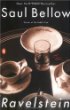
Ravelstein by Saul Bellow

Ravelstein (Penguin 233 pages) is based on intellectual and historian of ideas Allan Bloom, whose Closing of the American Mind stands as the meat to this ultimately gossipy, but not unrevealing, portrait of the man (closet gay, incorrigibly sloppy, resolutely positive, a big cigarette-smoking pizza-eating exquisite furniture-buying Saint Bernard of a man who plays Platonic soulmate matchmaker for his students, and gives his Chinese helpmate a car when he finally makes it big). Bellow apparently urged Bloom to write the book (which despite its reputation as a narrow conservative tract is actually a brilliant example of applied Platonism) which became a huge best seller, and for which the novelist wrote the introduction. Continue reading

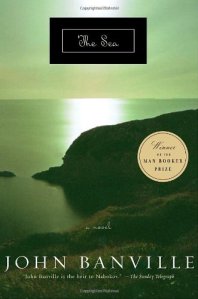
The Sea by John Banville

The Sea (Knopf, 208 pages) Spoiler alert. I don’t care for surprise endings, so I’m going to give this one away. If you’re at all like me, you may find it preferable to know more than what the jacket cover reveals about the story, that there was a death in the narrator’s childhood that he revisits in memory as an old man. It isn’t until the end of the book that we finally learn who dies, twin children with whom he had shared a memorable summer. They intentionally drown themselves. And although all suicides may seem shocking and unnecessary, these two especially so. The narrator also conceals Continue reading