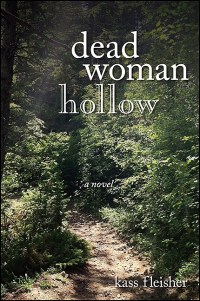
 In these Instagram days it seems any book can find itself tagged a #ForgottenClassic a little more than an hour after its published, and so the best books have to await the time when we find them, just beyond the nearest rise, waiting for us when we get to them. Kass Fleisher’s Dead Woman Hollow (SUNY Excelsior Editions, 194 pages) is one of the latter, a book for the ages, published just short of four years ago as I write, a historical novel in three parts and with two intermezzos, titled “Before” and “After” respectively and perhaps unsurprising. But that’s all that’s unsurprising about this tightly woven, triple-stranded, tragic yet transcendent, even triumphant, ages-of-women chronicle set in the mountains of twentieth century Appalachian Pennsylvania.
Continue reading
Wanderer Springs by Robert Flynn
 Up in that part of state just east of the Cap Rock, south of the Red River and west and north of Wichita Falls is a region of the country the residents continue to call “East Texas,” although, even at 70 mph it is hours from Amarillo, Lubbock or Spur, a half-day from San Angelo and Odessa, and a long, hard, hot day from Ozona or El Paso.
It is a part of the country that rhetorician Jim Cordon once called “terra incognito,” forgotten by most of Texas, ignored by everyone else. It is a hard land, filled with rattlesnakes, mesquite, winters that freeze livestock and people, summers that dry the ground so hard it cracks. Continue reading
California Rush by Sherwood Kiraly
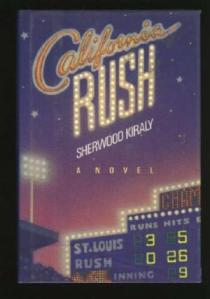 Ted Williams once said that the hardest thing in the world was to hit a baseball with a bat. The second hardest thing, he continued, was to throw baseball where a batter couldn’t hit it with a bat.
Williams might have added that the third hardest thing to do is to write an original novel about baseball. Oh, it’s been done. But for every home run such as Ron Hays’ The Dixie Association or Ray Kinsella’s Field of Dreams, for every Bull Durham and The Natural, for every book by Ring Lardner, Jim Bouton and Lawrence Ritter, there are volumes of strikeouts. Continue reading
Her 37th Year, An Index by Suzanne Scanlon
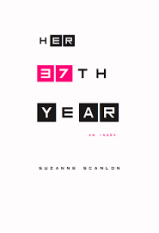
The abecedarium has a long literary history, and some of its best-known examples, such as Ambrose Bierce’s Devil’s Dictionary or Gustave Flaubert’s Le Dictionnaire des idées reçues, play with the form’s implied authority for purposes of satire. Recently Matt Bell’s Cataclysm Baby used the template to convey hellish fragments of an environmental dystopia. Suzanne Scanlon, author of Promising Young Women (2012), turns to a woman’s experience in contemporary America and offers a probing and artful inventory in Her 37th Year, An Index (Noemi Press, 161 pages). Continue reading
Nominate your favorite literary fiction author for the $1,000 Dactyl Award
 Dactyl Foundation offers a $1000 award to any literary fiction author, writing in English, who has published a book-length work, novel or collection of short stories. To be considered for the 2016 award, an author must be nominated by a peer, another published literary fiction author who must submit a review of one of the author’s works to Dactyl Review by December 31, 2015. Continue reading
The Corrections by Jonathan Franzen
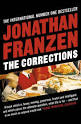 Gifted chronicler of American life, Jonathan Franzen offers a rather quiet plot in The Corrections (FSG, 568 pages), which follows the lives of the Lambert family headed by Enid and Alfred, typical Midwestern parents, whose children have scattered, eager to find their own definitions of happiness. The oldest, Gary, is a money manager, an asshole son, whose inner workings are described with surprising compassion; the middle son, Chip, is a lecherous and pretentious academic who’s just lost his position and his girlfriend and is working on an autobiographical screenplay that betrays a dreadful lack of self-awareness; the youngest, daughter Denise, is a talented chef who keeps throwing herself into undesirable relationships. Will they succeed? Is the aging patriarch going completely mad? And why is Alfred such an unhappy old man? Will Enid get all her children to come home for one last Christmas together?
The Marriage Plot by Jeffrey Eugenides
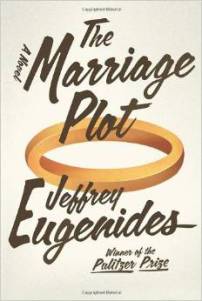 As the title confesses right up front, The Marriage Plot (FSG, 416 pages) is all plot, all 19th-century-style plot, with full biographical sketches and family histories for everyone who walks onstage for more than a few paragraphs to alter the action. Which of the two men will Madeleine, English major and lover of Jane Austen and George Eliot, end up with? Will it be Leonard, the big, broody sex-crazed boyfriend, a biology/philosophy double major? Or will it be Mitchell, the worshiping-from-afar religious studies student, whom Madeleine’s parents prefer? Continue reading
Andrew’s Brain by E. L. Doctorow


The Pilgrim of Love: a ludibrium by Charles Davis
“I was pleased to discover in myself an uncanny knack for interpreting the hermetic language of alchemy, as if my book learning had been but a preparation for decrypting enigmatic texts, reading meaning into that which, on the surface, seemed meaningless.”
So says the unnamed narrator of Charles Davis’ The Pilgrim of Love: a ludibrium, an obsessively researched and elaborately plotted parody of an historical romance. (Parody, as I understand the term, is best written by an author who actually loves his target, but who can put some ironic distance between himself and his subject.) The story is set in the abbey of the legendary Mont Michel in 1621, when the absence of roadway access meant visiting pilgrims had to make their way around quicksand between dangerously unpredictable tides. The landscape always plays an important and often symbolic role in Davis’ novels. The pilgrims must interpret the patterns in the sand to avoid sinking in the lise. Continue reading
The Talkative Corpse by Ann Sterzinger
 Lurking in the shadows of the seedy underbelly of the American heartland are the kinds of people you’re probably scared of. The kinds of people you, perhaps, don’t think of often. The kinds of people who just scrape by, praying for lottery-ticket miracles, and Heavenly rewards, and three consecutive days of tranquility and security. People like John Jaggo. Continue reading
 Dactyl Review