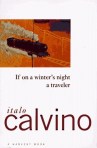
 Italo Calvino opens up his masterpiece, If on a Winter’s Night a Traveler (HBJ, 260 pages), in the second person, addressing and engaging the reader in a very direct way; a powerful, uncompromising way: Here you are – the reader; and here I am – the protagonist; the author is somewhere else, as impertinent to the story as is his publisher. It is what it is, and you, the reader, are here with me, sucked into the depths of my mind, where you’ll trip over threads that are seemingly random, unrelated and without ends, yet serve a purpose that you may or may not grasp unless you persist until the closing lines fade away as you turn the last page over and walk away, pensive, wondering whether you can make any sense of this work at all. Continue reading
The Most Distant Way by Ewan Gault
 The Most Distant Way (Holland House Books, 200 pages) is the vibrant first novel of Ewan Gault, a young Scottish writer. His story is set in Kenya, home of the world’s best competitive runners, where two young Scots, Mike and Kirsten, are training at the high-altitude running center in the Rift Valley. Their private neuroses, presumably acquired in the West, and the novel’s pervasive concern with their physical bodies reflect the single-minded drive required of runners; the anxious self-involvement of the two Westerners; and the social chaos in the Kenyan locations of Eldoret, Mount Elgon, and Mombasa. Continue reading
Black Spring by Henry Miller
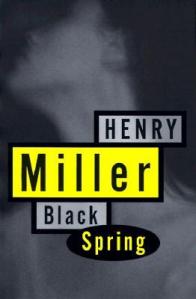 Warning: This review is long, has an excessive amount of quotes, and does not reach much of a conclusion. If you have a short attention span, this may not be for you. However, if you appreciate Henry Miller, one of the finest writers America has produced in the last century, I encourage you to read on.
When his name comes up, most readers associate Miller with sex, scandals, pornography. This is mostly due to the press attention given to his two books, The Tropic of Cancer, and The Tropic of Capricorn. Continue reading
Invisible Cities by Italo Calvino
 You pass adolescence and enter the world of adult literature. At first, you read anything and everything that found its way to your hands; then, slowly you begin discovering your own, unique literary taste, and you become selective. The more you read, the more selective you become. Your list of favorite authors and genres grows; you find literary voices that speak directly to your soul. By now, you have reached mid age, and you have over two decades of serious reading under your belt. Any new book that you open, any new author that you discover is judged against your favorites, against the voices that stimulated your mind over the years. Words and phrases are judged against those that provided comfort when you felt down; ideas and executions are compared against the benchmarks established over the years. You think you know what you like; you think you know what to expect. Well, perhaps you do. New books come along, and some attempt to quietly sneak in to your consciousness, while others attempt to shatter your world. Most, if not all, pale with your favorites, do not fit with your ideas, or leave you cold. Continue reading
The Master of Petersburg by J.M. Coetzee
 Coetzee’s novel of Dostoevsky (The Master of Petersburg, Penguin Books, 250 pages) is a mysterious portrait of the artist surrounding his The Possessed. Suppose a preliminary to Dostoevsky’s demons story could extend it via a narrative featuring the great author himself. Coetzee’s portrayal is that novel. Dostoevsky becomes a half-fiction in this role, somewhat real and somewhat false. Does that matter? It’s not easy to answer. As protagonist-novelist, Dostoevsky’s most important function for Coetzee might be as guide and exemplar, somewhat disheveled and brooding into our own age. Continue reading
The Art of Fielding by Chad Harbach
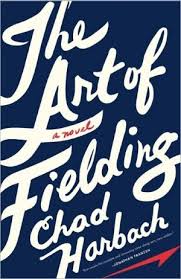 There’s a long tradition of writing about sport that tries to be more than writing about sport. Journalism, it seems, is not enough. The events of a game and the constraints of its rules become raw materials for allegory. Much fuss has been made in recent years about the rise of nonfiction and its power over the popular imagination—but when it comes to sport, the lure of myth remains strong. Continue reading
Witz by Joshua Cohen
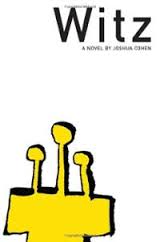 Oy vey you say. Another funny Holocaust book?
Now is the month of holidays, from the Jewish New Year through the Feast of Tabernacles and ending with Celebration of Torah. My (Orthodox) friend of forty years came to visit. I showed her a page from Witz (Dalkey Archive Press, 817 pages). She closed the book, fast. “There’s a lot in there I wouldn’t approve of,” she said.
Yes, O WickedWitz. Continue reading
The Untouchable by John Banville
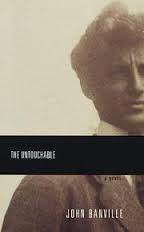 When Banville is writing at his best, he tends to reminisce about people and places rather than tell a story. In The Untouchable (Knopf, 668 pages), Victor Maskell, an Irishman living in England, becomes a spy for the Soviets during World War II. The book begins when the elderly Sir Maskell’s secret past has been revealed in the press. A young biographer, Serena Vandeleur, comes to interview him, and he takes the opportunity to look back over his life. Banville’s most artful writing is to be found in the plotless parts of the narrative, where he is working on characterization by relating memories of his childhood and young adulthood. Continue reading
Going Native by Stephen Wright
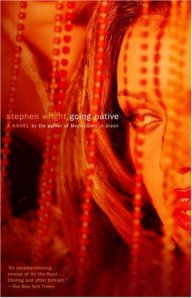 Going Native (Vintage, 305 pages), published in 1994, was Stephen Wright’s third novel. Meditations in Green (1983) was inspired by his experiences in Vietnam during the war. M31: A Family Romance (1988) is set among UFO cultists, who rely on an autistic child to communicate with aliens. Going Native is—more or less—a picaresque novel that follows a sociopath who abandons his Chicago family to travel to Los Angeles. It is not an easy trip. It is not an easy book. But it is a fascinating one, and, as I hope to show, one that says important things about modern American life. Continue reading
Escaping Barcelona by Henry Martin
 In Escaping Barcelona (Smashwords, 230 pages), Henry Martin demonstrates a subtle mastery of first-person fiction. His protagonist Rudy is an aimless but amiable narrator whose decision to backpack to Barcelona is just a slacker lark until he’s assaulted and robbed upon his arrival. Traumatized and penniless, Rudy suddenly has to fend for himself. Continue reading
 Dactyl Review