Sama Seeker in the Time of the End Times: A Spy Novel, by U.R. Bowie

New Book Announcement

The year is 2002, the devastating attack of 911 in New York still reverberates. Osama bin Laden is in hiding. Defense Secretary Rumsfeld says, “If he’s alive, he’s somewhere?” In reply, President Dubya Bush squints and makes threatening gestures. The U.S. government marshals all its forces to find and kill the archenemy of Western Civilization. Urell L. Buies, Ph.D., a college professor with a sideline of decades in low-level intelligence operations, is recruited to work with Russian intelligence in Central Asia. The Russians promise they can find Osama. While in Samarkand, Uzbekistan, doing little more than waiting for something to happen, Buies begins writing a long account of his formative years and his life as a double agent. Or what he terms, ironically, “a double non-agent.” As the story of his life moves closer to present time, the narrative moves to the climactic point: the day the Russian helicopter goes in after Osama.

Once again, using a multiplicity of influences from classical Russian literature, U.R. Bowie creates a fascinating imaginative world. In a novel that looks backward to the nineteen century, backward to a Florida childhood in the forties and fifties of the twentieth century, then forward to events culminating in the assassination of Osama bin Laden in the twenty-first, we are offered wit, intelligence, richness of detail, quirky characters, and an impressive grasp of Russian history, literature, arts and culture. The echoing, overlapping stories—but, more impressively, a large array of characters—draw in the reader and lead gracefully to a powerful crescendo. The author deftly manages the trick of scope, hitting all the right notes to sound out the big picture, while making us hear, feel, and commiserate with the people at the heart of the interwoven tales.
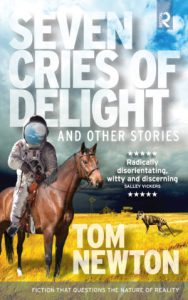
Seven Cries of Delight by Tom Newton

Seven Cries of Delight  (Recital Publishing, 170 pages) is not like most collections of literary short stories. As legions of MFA students busily workshop their childhood drama into market-friendly “realistic” fiction, Tom Newton has clearly been following a different muse. These stories (two dozen of them!) range widely in setting and imagery and allusion, but all are hung on a solid spine: a lively curiosity about the deeper, invisible nature of what we call reality. This curiosity is expressed as speculative imaginings and unharnessed mental rovings, with an articulate, wryly humorous voice that obviously springs from a well-traveled and well-read intellect. At every turn are enjoyable discoveries of unlikely connections, unpredictable logic, and unanswerable questions.
Continue reading →

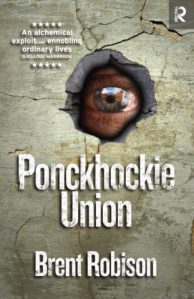
Ponckhockie Union by Brent Robison

New Book Announcement

My first novel just emerged into the world after too many years in gestation. It has a strong Hudson Valley NY presence but also ventures to Utah deserts and further foreign hotspots. In addition to the blurbs on the website, I like John Burdick’s take on it in the Almanac Weekly: “Ponckhockie Union is a mad fireworks display of global conspiracy and paranoia, haunted synchronicities, shadow-world manipulations of history, tricksters and false guides and the sudden and irreparable rupture of everything normal and stable in one man’s life. It also posits a model of what a sturdy self might look like after such a rupture, after acute exposure to the things going on underground and overhead. And it takes place down by the Rondout.” That’s a reference to the creek adjoining the Ponckhockie neighborhood of Kingston, NY, where the British landed in 1777 to burn down New York’s first capital. But historical fiction this is not. There are shadowy assassins, but it’s not a “whodunit;” perhaps a “who-am-I” is more accurate. With a pinch of metafiction thrown in. Available online and by order at bookstores.

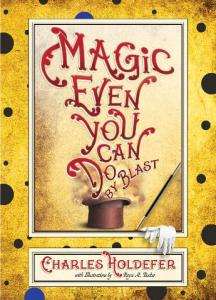
Magic Even You Can Do: by Blast, by Charles Holdefer

New Book Announcement

by Charles Holdefer, illustrations by Royce M. Becker

From Genii Magazine:

This wee tome is very attractive. Royce M. Becker’s design and colorful illustrations are beautiful.
Mr. Holdefer is an abundantly gifted, witty writer. His creation, his delightful doppelganger Blast, is a funny, goofy, erudite, Baron Munchausen of magic… Highly Recommended.


Such Is the Scent of Our Sweet Opalescence by U.R. Bowie

The reader of a good book can hear the narrator speaking, can even envision the narrator’s gestures and facial expressions. Dactyl Review contributing editor, U. R. Bowie consistently produces fiction that animates itself in the reader’s mind. And now this, an audiobook of Bowie’s short story collection, Such Is the Scent of Our Sweet Opalescence (Ogee Zakamora, 148 pages), read by the author. (Paperback also available.) The narrator of title story is Uretherer V. Lamb, a character reminiscent of one of Kurt Vonnegut’s memorable creations. The story opens when U.V. is struck by lighting in the midst of taking a leak roadside. He meets death, in the form of grinning Delmas W. Pruitt, but somehow U.V. cheats Delmas and goes on to live his life as a “backslider” without a soul, it seems.
Continue reading →

Reviewers: Do you have a book announcement?

Beginning immediately, authors who have reviewed on this site in the past year are encouraged to send in news and announcements about their own books. Let us know if you have a new book out, or your old book just got another good review, or any noteworthy anecdote about your novel or short story collection. Keep it brief. About 500 words.

← Back

Thank you for your response. ✨

Also Dactyl Review continues to offer you the opportunity to post your available review copies here.

We might as Well Light Something on Fire by Ron Maclean

Three Dialogs about Ron Maclean’s Three-Part Short Story Collection, We Might as Well Light Something on Fire (Braddock Avenue Books, 179 pages):

I. goats, rabbits, etc.

We’re going to talk about we might as well light something on fire .

Right. You know the writer?

Yes.

Is he brave?

I was never in combat with him. Why do you ask?

Guy writes a really far out book called we might as well light something on fire, some smartass will say, right, let’s start with this book.

That would be an incendiary insult to one of the most original collections I have ever read. How do you want to proceed?

Section by section, one of the three sections for each meeting, and concentrate on one story. Continue reading →

Thoughts on Publishing and the Plight of the Writer of Literary Fiction

Lot of good ideas by V.N. Alexander, in her recent post on publishing; co-op publishing may be the future. For me the great innovation in book publishing is POD. V.N. Alexander’s article makes it crystal clear why pre-printing an entire run of books–I have, largely, literary fiction in mind–makes absolutely no sense anymore.

“Other roles of the traditional publisher have been effectively eliminated by technology.” Right. Then again, the author, through social media, is now expected to do all, or practically all, publicizing of the book. Who needs a publisher, then?

“The two most valuable services that traditional publishers provide are editing and proofreading,” but, as V.N. asserts, finding competent people to proofread or copy edit books is not that difficult.

Actually, there is one big thing that traditional publishers can do for a writer of literary fiction. They can get the writer IN with the literary establishment. This, ultimately, is the only thing that really counts. Once you are IN, your books get reviewed by Kirkus, Library Journal, Publishers Weekly and Booklist. If you never get IN nobody ever knows you exist. And the huge majority of all writers who publish literary fiction will remain, egregiously, OUT. Continue reading →

Platform Cooperative Book Publishing

We have Internet now.

Why hasn’t book publishing improved? Technology has changed a bit since books the days of cut wood blocks and repurposed wine presses. With browser-based editing tools, print-on-demand (POD), ebooks, audiobook files and the Internet, upfront capital investment in the material aspects of publishing is no longer required and the role of the traditional publisher has diminished.

We all have access to this wonderful newish invention called the Internet search engine which should have realized the dream of decentralized connectivity and reduced the need for a middleman to select, distribute, market and sell books. Blocking the way between author and reader are the vestigial organs of the old publishing system that mainly dealt in offset print paper books that had to be produced, stored and distributed at great cost. Technological progress frees human beings from the material drag of the old system and leaves only the tasks that will never be performed by machines: writing, editing, final proofreading and reviewing. The profits from book sales need not be siphoned off by those now useless middlemen, distributor, marketer, and seller. Even though the Internet has made these roles obsolete, they have, monstrously, become even more powerful and centralized than ever. The “big five” publishing industry monopolies, Google and Amazon are the very opposite of what the Internet promised humanity. Good literature is essential for a thriving culture.

What do we need?

A cooperative platform model of publishing and selling, designed to cut out unnecessary middlemen, reward the essential work of those directly involved in writing and editing and ensure that authors can be paid for every book sold or borrowed throughout the extended lifetime of the book.

Small independent presses, that are struggling to turn a profit and whose authors earn too little for their writing, can convert to a cooperative model in order to reduce their financial risk and reduce the workload of the editors while maintaining a high quality booklist by accessing the talent pool of their authors, who, in turn could receive a higher return on their investment of time and effort. Dactyl Foundation proposes to be the umbrella organization that provides online access to a cooperative platform for independent publishers.

Continue reading →

The Good Soldier, by Ford Madox Ford

Ford Madox Ford, The Good Soldier: A Tale of Passion (“Beati Immaculati”), Vintage Paperback, 1989, 278 pp., with an introduction (“An Interpretation”) by Mark Schorer, and the author’s dedicatory letter to his wife Stella Ford (January 9, 1927). The novel was first published in 1915.

 SERIES: LOOKING BACK AT GREAT WORKS OF LITERARY FICTION

The blurb on the front cover is from Graham Greene: “One of the fifteen or twenty greatest novels produced in English in our [20th] century.” Blurbs usually exaggerate. So too does this one, but it exaggerates in the wrong direction. The first time I read this book I thought, “This is the great American novel.” In rereading it again for this review, I have not changed my opinion. Continue reading →