A Book with No Author by Brent Robison

If the code, “Brent Robison,” were to undergo a random mutation—which in the writing world we call a typo—more likely than not, that “n” in the first name would jump, as even genes sometimes do, to the last name, where, as “Robinson,” it would create a more stable configuration.  And, of course the now isolated and wobbly “t” in “Bret” would likely undergo reduplication—as giraffe vertebrae have done—leaving us with the better reinforced product “Brett Robinson.”
Such are the circumstances that may lead a man to fancy he has a similarly-named double. If he is a writer of excellent literary fiction, he will take that fancy far. If he also moonlights in some other profession, say, as a photographer or videographer, the twinning can take on multiple dimensions. Continue reading

Zone 23 by C. J. Hopkins

In his novel Zone 23 (SS&C Press, 483 pages) expat playwright C.J. Hopkins depicts a society, much like ours at its worse — some six or seven hundred years in the future — when any departures from prescribed ways of thinking are pathologized. Being melancholy, pondering larger philosophical questions, or contemplating the lack of fairness of the system can earn one a diagnosis of mental illness. Virtually everyone is on medication. Those who can’t be controlled by medication are deemed “Anti-Social Persons” and are removed from the society of “Normals” and relegated to various zones of abandoned and bombed-out cities, where they are eventually blown to bits by gamer-controlled drones.

Human reproduction is the central theme. That, too, has been pathologized. Continue reading

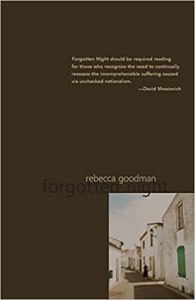
Forgotten Night by Rebecca Goodman

In Rebecca Goodman’s novel Forgotten Night (Spuyten Duyvil, 296 pages) the unnamed narrator–we will call her N hereafter–is searching desperately but determinedly for a Madame Brissac. The reader is immediately enlisted in the search and will never leave N’s side, not even after putting the novel down. The night of the title may be forgotten, but this novel will remain forever in memory, a touchstone whenever World War I or the Holocaust is recalled.

N is one of those people you are irresistibly drawn to but are wary of. You are afraid for her. She knows that she’s looking for Madame Brissac, a name that has come to her from her grandfather Joseph’s tattered diary of WWI. But N is not an adept seeker, inquiring here and there, assailed by distractions, often in the form of artists of dubious motives. Nor is it clear in the beginning exactly what she hopes to learn from Madame Brissac. Who is Madame Brissac anyway? She would be a descendant of a fellow youth N’s grandfather encountered in 1907 in flight from Romania, where a peasant uprising focused its hatred on Jews. Does N find Madame Brissac? That is for each reader to decide, because Madame Brissac is not merely a person. She is the bearer of N’s hope that out of the senseless carnage of WWI and the unspeakable horrors of the Holocaust some meaning will emerge.

Continue reading

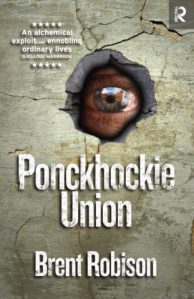
Ponckhockie Union by Brent Robison

New Book Announcement

My first novel just emerged into the world after too many years in gestation. It has a strong Hudson Valley NY presence but also ventures to Utah deserts and further foreign hotspots. In addition to the blurbs on the website, I like John Burdick’s take on it in the Almanac Weekly: “Ponckhockie Union is a mad fireworks display of global conspiracy and paranoia, haunted synchronicities, shadow-world manipulations of history, tricksters and false guides and the sudden and irreparable rupture of everything normal and stable in one man’s life. It also posits a model of what a sturdy self might look like after such a rupture, after acute exposure to the things going on underground and overhead. And it takes place down by the Rondout.” That’s a reference to the creek adjoining the Ponckhockie neighborhood of Kingston, NY, where the British landed in 1777 to burn down New York’s first capital. But historical fiction this is not. There are shadowy assassins, but it’s not a “whodunit;” perhaps a “who-am-I” is more accurate. With a pinch of metafiction thrown in. Available online and by order at bookstores.

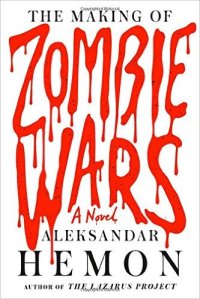
The Making of Zombie Wars by Aleksandar Hemon

zombiewarsA literary truism: good comic writing, any comic writing that professes to call itself literary fiction, must be undergirded with a firm foundation in seriousness. Nikolai Gogol was/is the greatest comic writer in Russian literature; his works are profound. Vladimir Nabokov wrote the following about Gogol’s long story, “The Overcoat,” widely considered the best story ever written in Russia: “The diver, the seeker for pearls, the man who prefers the monsters of the deep to the sunshades on the beach, will find in ‘The Overcoat’ shadows linking our state of existence to those other states and modes which we dimly apprehend in our rare moments of irrational perception.”

Too many contemporary American writers of literary fiction are under those umbrellas on the beach. If they are swimming at all they are swimming in the shallows. There are depths to be plumbed through the art of writing creative fiction. Why not plumb them? Is it too risky? Is it easier to wade into tepid waters and potter around there? Time to take a deep breath and dive down deep now, modern American author. Time to stop your “shit-swimming” (Hemon’s term, taken out of context) in the literary shallows.

The Making of Zombie Wars (Farrar, Straus and Giroux, 307 pages) begins with Hollywood silliness—amateur screenwriters pitching ideas to one another in a Chicago workshop—the idiocy and mindlessness of Hollywood (and of the whole U.S. A.), lurks in the background all the way through to the end. Practically all of Hemon’s books with American characters in a U.S. setting present a picture of our country teeming with idiots. This novel is set in 2003, just as we were embarking on what will surely go down as one of the most idiotic foreign-policy decisions of the twenty-first century: the invasion of Iraq. Continue reading

The Wild Horses of Hiroshima by Paul Xylinides

Wild Horses cover

The wild horses in The Wild Horses Of Hiroshima (240 pages) are certainly intriguing, as with the title and cover art, and play a strong role at the story’s end by appearing in the streets of Hiroshima to wander about as a healing force, cared for by the citizens. They  derive from the imagination of a novelist who is also a character in the novel, who is also creating a narrative. The horses seem to emphasize purity and nobility, pounding through the city in herds, a shield against nuclear war and against the violent nature of the human species itself.

This novel inside the novel begins approximately half way into the story, following a background beginning with the atom bomb attack on Hiroshima and its hideous devastation. A young American man has been a penpal with a young Japanese girl, and after the war, he goes to Hiroshima to find her. They marry and move to New Hampshire, bearing a son, Yukio. Yukio becomes a strong, husky young man who survives the attack of a bear which kills his father. He and his mother, Miyeko, return to Japan where he becomes a sumo wrestler. Time passes and he retires to write novels. The novel within a novel begins, with occasional returns to the exterior story of Yukio and his mother, plus Yukio’s geisha, Satoko. Continue reading

Andrew’s Brain by E. L. Doctorow

Andrew’s Brain (Random House, 244 pages), by E. L. Doctorow, is the narrative of a brain whose content has been digitized, whose DNA code has been cracked, and which now resides in a vat or has been uploaded to a computer at some Bush-era detention or torture site, unaware that he is no longer embodied, believing himself to be telling his story to a therapist (who, Andrew suspects, may be CIA), sometimes imagining himself to be elsewhere, writing to or phoning his therapist, sometimes visiting his office, but never realizing that he, like any human perhaps, has no true self-awareness because a brain cannot objectively know itself. Continue reading
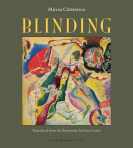
Blinding: The Left Wing by Mircea Cărtărescu

Blindingforweb1It starts in adolescence. The questions come to you while lying in bed (certainly now with a growing awareness of your sexuality), the walls of your room expanding into endless grainy darkness, as if the room itself could encompass the entire world: why am I here, why is there anything at all?

The questions may haunt you at age 13 or 15 or 17, but by adulthood they tend to feel banal. Unanswerable, impossible, if taken seriously debilitating, they are in a word blinding, and so you tend to avert your gaze. But suppose you can’t, suppose the inviolable white light only draws you closer, to madness possibly, to paint or write or drink or pray (to what God, tell me?) almost certainly. And so perhaps you scribble, the pages of your notebooks filling with furious script, like eons of sediment piling into sad mute mountains no one else will ever excavate or carve or climb. Continue reading

The Master of Petersburg by J.M. Coetzee

TheMasterOfPetersburgCoetzee’s novel of Dostoevsky (The Master of Petersburg, Penguin Books, 250 pages) is a mysterious portrait of the artist surrounding his The Possessed. Suppose a preliminary to Dostoevsky’s demons story could extend it via a narrative featuring the great author himself. Coetzee’s portrayal is that novel. Dostoevsky becomes a half-fiction in this role, somewhat real and somewhat false. Does that matter? It’s not easy to answer. As protagonist-novelist, Dostoevsky’s most important function for Coetzee might be as guide and exemplar, somewhat disheveled and brooding into our own age. Continue reading

Flaubert’s Parrot by Julian Barnes

indexJulian Barnes’ Flaubert’s Parrot (Picador 2002, 190 pages) is the story of one man’s quest, his “project” to find the writer outside his writings, despite Flaubert’s insistence that the books should be enough, the writer should disappear and be left alone. Geoffrey Braithwaite, this amusing novel’s British protagonist, is a medical doctor about sixty. He pursues museums, letters, literary works, criticism, and Flaubert the person in a long quest as unofficial biographer and tireless seeker. Continue reading