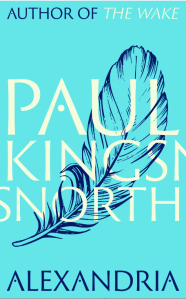
Alexandria by Paul Kingsnorth

Alexandria (Graywolf Press, 408 pages) is a post-apocalyptic tale set a thousand years in the future, following a small band of survivors living in what once was England. The tiny clan inhabits a world where civilization has collapsed, and, not surprisingly, they have rejected technology, instead favoring ancient ways under a primigenial religion. They may be the last human inhabitants of the planet.

 The narrative revolves around the group’s opposition to a transhuman entity known as Alexandria. They were driven from their ancient homeland by the gradual encroachment of this anti-human force, which once spread across the planet as a successor to modern globalization. Now fully transformed into its posthuman form, Alexandria is in its mopping-up phase, tracking down the survivors with the assistance of an emissary known only as K. The novel unfolds as a series of monologues by the five surviving group members, supplemented by K, a loyal field operative for Alexandria who becomes entangled in the drama of the final collapse when he realizes that Alexandria has abandoned him. The surviving tribe’s language is hyper-simplified English, while K’s reports resemble a corporate memo. 

Continue reading
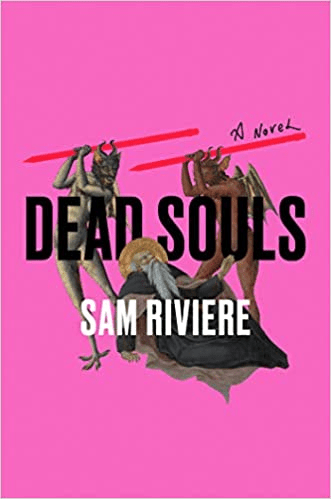
Dead Souls by Sam Riviere

Believe the Blurbers

Dead Souls (A Novel by Sam Riviere, NY: Catapult, 2021, 289 pp.) is a rare example of a book containing believable blurbs. This wild gallimaufry of a novel, which runs a monologue through almost three hundred pages of text, without pauses for paragraphs or new chapters, is a tour de force of literary mania. Reviewers have pointed to possible influences: Roberto Bolaño, Georges Perec, Thomas Bernhard, Italo Calvino. One blurber, Nicolette Polek, describes the novel as “a rare and brilliant pleasure, a coiling, searing fugue of a book that takes our deranged culture and pulls forth from it a box of stars.” She’s right. Or, to put it in the fully neutered style in which the book is written, they are right.

There are chapters of sorts, but you have to figure them out yourself. In the front matter the author provides a kind of contents page—not labeled as such—listing names of characters as names of chapters, along with the pages where they start. Begin with an introductory chapter (not listed in these “contents”), then go, first, to “Zariyah Zhadan,” p. 32: this is, presumably, Chapter One. Proceed from there, filling in the chapter numbers beside the given name and page number. Chapter Six comprises two named characters. We end up with “The Scholastici,” p. 253, which is the last of twelve chapters. Continue reading

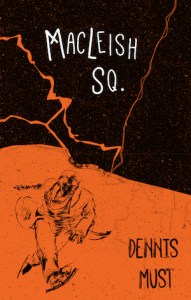
MacLeish Sq. by Dennis Must

Edward Said, writing about Beethoven’s late style, defined late style as that time wherein the artist freed from the expected cultural and historical restraints of form and content unleashes a newness that both confounds and instructs. Dennis Must has achieved that hour of newness in MacLeish Sq (Red Hen Press, 209 pages). With its visual complexities coupled to broad-ranging literary interconnections, Must’s writing raises the text to a “beyond” state where the readers have to let go of what they know. The readers must accept that their own hidden stories have been eclipsed and take this writing on its own without any pre-conceived notions of what “a novel” is or should be. Roland Barthes, now out of fashion to the post-post modern mind, wrote in his essays–Degrée zéro de l’écriture–that there are two kinds of writers which he called “l’écrivain and l’écrivant.” Must, in MacLeish Sq., brings us a third iteration of writer as his work approaches mythic status in which time, character, past, present, alive, dead—just a few of the literary polarities inhabiting this writing—interact at a level no reader can accept without relinquishing his/her own sense of person and being. Interweaving Dante, Melville, Hawthorne, Pirandello into a single narrative that seizes the essence of each, isn’t a style most readers will be comfortable with. Here, however, Must puts them together with such skill that the author lives on par with the masters. It will take an honest reader to admit–I have never read anything like this.

Continue reading

The Hollow Middle by John Popielaski

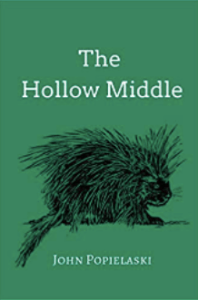
In John Popielaski’s The Hollow Middle (Unsolicited Press, 381 pages), forty-something Albert, an English teacher in a private school, longs to retreat from the human world. Early on, hungover, he looks out on a river and “waits for the compass needle to flutter less.” The answer, he senses, leads back to nature.

Albert’s wife Mary senses their childless marriage has been on some kind of border and, partly for that reason, develops an interest in adopting two ten-year old autistic boys, twins. Albert is drawn into the plan by the generous stipends the couple will receive for the boys’ care, money which can help fund his back-to-the-land dream. Additionally–in keeping with the novel having an ear toward environmental tampering–he receives funds from a settlement with the U.S. Government for his father’s cancerous death after working decades on a radiation tainted site. Continue reading

The Weight of Smoke by George Robert Minkoff

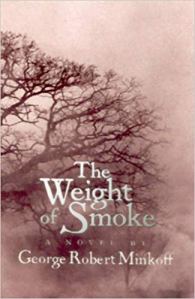
Presented as a memoir of Captain John Smith, founder of Jamestown Colony, Virginia in 1607, The Weight of Smoke (McPherson & Co, 389 pages) is the work of a self-described antiquarian, rare books dealer whose imagination is stacked to the ceiling with historic archives and Elizabethan letters. With this volume of historical fiction, Minkoff truly does seem to inhabit the language of those times.

Smith’s narration has a reflexivity to it that radically alters the reader’s sense of time. Every line is both fraught with Smith’s rich backstory and, at the same time, is nervously peering into his bleak future. Such tricks with time are only possible in literary narrative. And it’s a reading experience that is mind-expanding. If his narration had a shape it would torus-like, perhaps, or arabesque, but definitely not linear. Continue reading

Mean Bastards Making Nice by Djelloul Marbrook

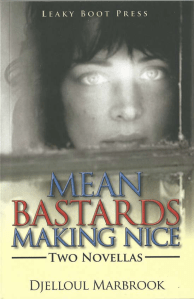
Mean Bastards Making Nice (Leaky Boot Press, 168 pages) is a slim volume from small UK publisher Leaky Boot Press. It contains two novellas related by theme and setting. It’s a thoroughly New York book, but that doesn’t mean stock Big Apple accents or tired tropes from TV. It means both city streets and upstate forests are simply there: as integral as the air the characters breathe.

To gloss the surface: “Book One: The Pain of Wearing Our Faces” introduces a painter, a composer, their shared alcoholism, and a mysterious woman who is a muse for both of them, but a dangerous one. “Book Two: Grace” follows a girl on the run from country to city, her discovery of her own warrior strength on the streets, and her profound impact on a few of the city’s art-world glitterati. Continue reading

The 2016 Dactyl Literary Fiction Award goes to Sea of Hooks by Lindsay Hill

seaofhooksSea of Hooks (McPherson & Co) was nominated by Barbara Roether, author of This Earth You’ll Come Back To. In her review of Hill’s unusual novel, Roether writes,
There is a paradox that floats through the Sea of Hooks, which is that the experience of reading it is almost the opposite of how it is written. That is to say, while the story is told in its short collage-like segments, their effect is an almost seamless classical narrative. The way sections move from multiple perspectives, dreamtime, real-time, then meld together with such cohesive and penetrating storytelling, is a testament to the author’s insightful eye for detail and character.

Continue reading

The Wild Horses of Hiroshima by Paul Xylinides

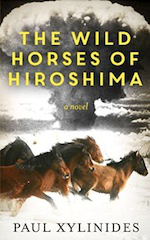
Wild Horses cover

The wild horses in The Wild Horses Of Hiroshima (240 pages) are certainly intriguing, as with the title and cover art, and play a strong role at the story’s end by appearing in the streets of Hiroshima to wander about as a healing force, cared for by the citizens. They  derive from the imagination of a novelist who is also a character in the novel, who is also creating a narrative. The horses seem to emphasize purity and nobility, pounding through the city in herds, a shield against nuclear war and against the violent nature of the human species itself.

This novel inside the novel begins approximately half way into the story, following a background beginning with the atom bomb attack on Hiroshima and its hideous devastation. A young American man has been a penpal with a young Japanese girl, and after the war, he goes to Hiroshima to find her. They marry and move to New Hampshire, bearing a son, Yukio. Yukio becomes a strong, husky young man who survives the attack of a bear which kills his father. He and his mother, Miyeko, return to Japan where he becomes a sumo wrestler. Time passes and he retires to write novels. The novel within a novel begins, with occasional returns to the exterior story of Yukio and his mother, plus Yukio’s geisha, Satoko. Continue reading

Sea of Hooks by Lindsay Hill

seaofhooksLindsay Hill casts a magician’s spell across his Sea of Hooks (McPherson, 348 pages). On the surface his world is rendered in bright pixels of quivering light, while underneath a seamless narrative undercurrent pulls us into the mysterious depths of experience. For the reader willing to dive under, this journey is unforgettable.

Sea of Hooks is, on the one hand, a fiercely original Bildungsroman set in San Francisco in the 50’s and 60’s. Christopher is an overly imaginative boy, part Holden Caulfield and part Little Lame Prince, who lives in precarious affluence in a darkish Victorian on the edge of Pacific Heights. His delicate, high-strung mother is obsessed with Japanese culture and dead by suicide in the first paragraph. Dad works in finance on the Pacific Stock exchange, until he doesn’t anymore. There are prep schools, bridge games, Dickensian neighbors like the wise and wonderful Dr. Thorn; along with house fires, a very nasty tutor/pederast from Stanford, a trip to Bhutan and encounters with Buddhist monks. Hill’s rich prose makes us feel Christopher is someone we have always known, a boy who lives in a house we have been to, whose eccentric mother we’ve had tea with, whose city we are walking in. Continue reading

Lion and Leopard by Nathaniel Popkin

LionLeopardIt may very well be that Nathaniel Popkin’s novel Lion and Leopard (The Head and The Hand Press, 345 pages) requires more than one reading in order fully to appreciate its argument. Certainly the discerning reader should have no trouble recognizing the quality of its painterly effects that so thoroughly complement the subject matter of this passionate work. Whoever seeks out literary writing for its own sake will not be disappointed. Nathaniel Popkin is a writer’s writer and possesses the prized capacity to render the essentially poetic not only in accessible but also in original phrases and images:

Continue reading