Ierapetra, or His Sister’s Keeper by Joachim Frank

In Ierapetra, or His Sister’s Keeper (Canoe Tree Press, 247 pages), Joachim Frank’s splendid new novel, we find ourselves in the company of Reiner and his sister Monika. Reiner has two passions, science and writing. Monika has family and quilting. We accompany them on holiday to Island of Crete. We are immediately immersed in an archetype, innocents abroad in a challengingly unfamiliar culture, in this case two youths from the stern clime of northern Germany transported to the sunny sensuality of the Mediterranean.
The powerful narrative that pulls the reader relentlessly through the novel from beginning to end is familiar. What effect will culture shock have on our siblings while they are in Greece, and will it persist when they return home? Will their old commitments survive? Continue reading

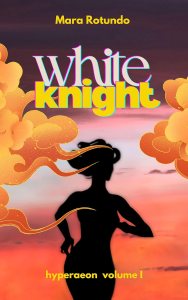
White Knight by Mara Rotundo

Mara Rotundo’s debut novel, White Knight (Goldmund, 342 pages), is a love square set against the pandemic, literary fiction with strong elements of romantic domestic suspense and satire. It is a debut only in the sense that it is the first of her extraordinary writing she has allowed us to see. Her bio tells of many short stories and essays locked in a dusty drawer, like Bach’s music waiting to be found in that attic. If we could but read those writings, we would most likely find a step-by-step handbook for the development of a genuine writer, for in this book she springs full-grown from the loins of the muse, armed and dangerous.

For instance, these powerful lines start the romance,

“When her intrepid black eyes sunk their blade into his pudding face, a champagne cork popped somewhere. The earth’s rotation took a hit, the magnetic poles confused each other. She felt him melt, and he let her feel it.”

White Knight is a book of contradictions—a pulp novel love story on the surface. Continue reading

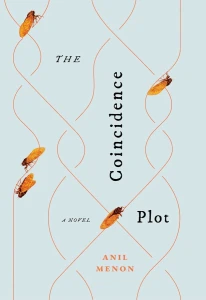
The Coincidence Plot by Anil Menon

Chances are you’ve never heard of Anil Menon. That’s a shame, but not your fault. Anil Menon is a brilliant Indian author writing wild, brainy and emotionally engaging stories and novels in English. His books, including the main one reviewed here, The Coincidence Plot (Simon & Schuster, 252 pages), are published by presses well known in the English speaking world, and his works can be found in online venues, but readers in the United States who would delight in his novels won’t find them in bookstores.

The Indian Constitution lists Hindi as the official language of the Union, but allows English to continue in use by the government, English being a legacy from British colonial rule. Today India has a growing population of 1.4 billion (it recently surpassed China in this) and of this billion, about 10.5 percent are English speakers. Anil Menon’s work is published for those millions upon millions of English speakers in India. Getting his novels from online sellers or by mail from India can be tedious, but it’s worth the hassle.
Continue reading

A Book with No Author by Brent Robison

Like an ancient Buddhist master, Brent Robison is fond of mind benders, and his restless spirit never tires of questioning reality. In his new novel, A Book with No Author (Recital Publishing, 223 pages), Robison’s wicked inquisitiveness is on display out of the gate. In a preface disclaiming Robison’s authorship of the book, he writes, “I, Brent Robison, am not the author of the fragmented story that follows.” Yet, plainly, the book cover bears his name, and the copyright is in place. The hall-of-mirrors never stop from there.

A.J. Campbell discovers a short story in an obscure literary journal that changes his world. But the change is not welcome, because the fiction is based on his life.  He has no idea how the writer could know so much about him, or why he would be the subject of the stories. Worse, his life is messy; divorce, and painful rebuilding. Incensed by invasion of his privacy, he embarks of a difficult task of finding the author who “stole” his life story, and his life.

Yet while the echo-chamber storyline could derail, it always rights itself through the constraints of a gothic detective-thriller plot. We find the narrator earnestly on the trail of his persecutor Continue reading

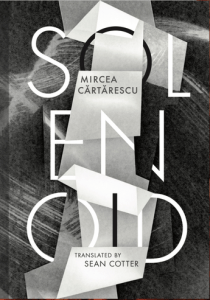
Solenoid by Mircea Cartarescu, translated by Sean Cotter

In “he Garden of Forking Paths,” Jorge Louis Borges’s postulates a novel so complex it would become “a labyrinth in which all men would become lost.” Left unfinished by its fictional author, the novel is a legacy emblematic of the innumerable possibilities of existence. For Borges, multitude makes the case for universal elusiveness—a sublimity in extremis.

With celebrated Romanian writer Mircea Cartarescu’s massive novel Solenoid, we are deep into Borges territory. Solenoid (Deep Vellum Press, 672 pages) is a chronicle told by an unnamed high school teacher whose Kafkaesque days are spent at public School 86 in Bucharest, “the saddest city in the world.” At night, the unnamed protagonist surrenders himself to the phantasmagoric spell of a “solenoid” buried beneath his house; the solenoid is a strange electromagnetic coil with dimension-bending properties. The solenoid causes the narrator to float above his bed. We learn how the mysterious contraption is built from concepts of Nicholas Tesla and the notion of the hypercube. Later, the solenoid is revealed to be one among an array of solenoids buried throughout the city. Ultimately, the narrator meets a woman with whom he falls deeply in love. In a finale that owes as much to science fiction as James Joyce, the couple, and the entire city of Bucharest, are launched spaceship-like from the surface of the earth, trailing a cone of infrastructure and debris. Continue reading

Forgotten Night by Rebecca Goodman

In Rebecca Goodman’s novel Forgotten Night (Spuyten Duyvil, 296 pages) the unnamed narrator–we will call her N hereafter–is searching desperately but determinedly for a Madame Brissac. The reader is immediately enlisted in the search and will never leave N’s side, not even after putting the novel down. The night of the title may be forgotten, but this novel will remain forever in memory, a touchstone whenever World War I or the Holocaust is recalled.

N is one of those people you are irresistibly drawn to but are wary of. You are afraid for her. She knows that she’s looking for Madame Brissac, a name that has come to her from her grandfather Joseph’s tattered diary of WWI. But N is not an adept seeker, inquiring here and there, assailed by distractions, often in the form of artists of dubious motives. Nor is it clear in the beginning exactly what she hopes to learn from Madame Brissac. Who is Madame Brissac anyway? She would be a descendant of a fellow youth N’s grandfather encountered in 1907 in flight from Romania, where a peasant uprising focused its hatred on Jews. Does N find Madame Brissac? That is for each reader to decide, because Madame Brissac is not merely a person. She is the bearer of N’s hope that out of the senseless carnage of WWI and the unspeakable horrors of the Holocaust some meaning will emerge.

Continue reading

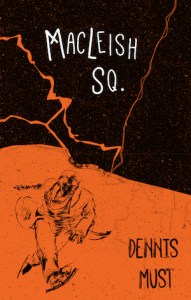
MacLeish Sq. by Dennis Must

Edward Said, writing about Beethoven’s late style, defined late style as that time wherein the artist freed from the expected cultural and historical restraints of form and content unleashes a newness that both confounds and instructs. Dennis Must has achieved that hour of newness in MacLeish Sq (Red Hen Press, 209 pages). With its visual complexities coupled to broad-ranging literary interconnections, Must’s writing raises the text to a “beyond” state where the readers have to let go of what they know. The readers must accept that their own hidden stories have been eclipsed and take this writing on its own without any pre-conceived notions of what “a novel” is or should be. Roland Barthes, now out of fashion to the post-post modern mind, wrote in his essays–Degrée zéro de l’écriture–that there are two kinds of writers which he called “l’écrivain and l’écrivant.” Must, in MacLeish Sq., brings us a third iteration of writer as his work approaches mythic status in which time, character, past, present, alive, dead—just a few of the literary polarities inhabiting this writing—interact at a level no reader can accept without relinquishing his/her own sense of person and being. Interweaving Dante, Melville, Hawthorne, Pirandello into a single narrative that seizes the essence of each, isn’t a style most readers will be comfortable with. Here, however, Must puts them together with such skill that the author lives on par with the masters. It will take an honest reader to admit–I have never read anything like this.

Continue reading

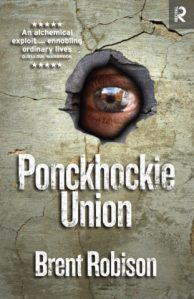
Ponckhockie Union by Brent Robison

Ponckhockie Union (Recital Publishing, 208 pages) is a novel for the connoisseur of the uncanny. The story is about Ben Rose, a documentary filmmaker, who stumbles into a vortex of metaphysical uncertainties when trying to make a film about a Revolutionary War historical site. He is estranged from his wife, doubtful about his future prospects, and vulnerable to having his bedrock assumptions upended. The more Ben grasps, the less stable his life is. The tipping point in the narrative comes when Ben encounters – or encounters again – a lying sociopath who may or may not be an assassin and may or may not get murdered. Ben is held hostage in a cellar for two weeks before escaping, realizing only too late that the way out had been available all along.

I don’t want to let the cat out of the bag with too much detail, but the narrative seesawing is on par with Kafka or Borges. Once certainty is asserted, it is as quickly diminished. Add to that a dollop of paranoia a la Philip K. Dick, and you get the drift. If there is a cat to be let out of the bag, it is Schroedinger’s.

The overall atmosphere is of a thriller. An intense thriller. The notes of ominous transformations are quietly sounded in the introduction of the sociopath calling himself Les Spanda:

He gave me a wide grin and reached out a broad meaty hand. As I shook it, a vague sensation began to dawn in me that I had met this man before. I couldn’t grasp any specific memory, so I just thanked him, and walked back to my car.

Later, we learn that “spanda” is a Sanskrit word meaning divine vibration or pulse inseparable from being, a cosmic expansion, and contraction. Breathe in. Breathe out. Now hold your breath, and keep holding, holding, holding. That’s the mood Robison seems to be after. Continue reading

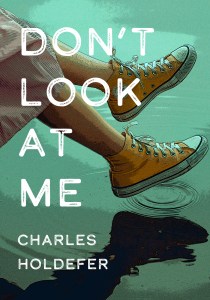
Don’t Look at Me, by Charles Holdefer

Go big or go home. In his new novel Don’t Look at Me (Sagging Meniscus Press, 282 Pages), author Charles Holdefer chooses to go big.

At the center of Don’t Look at Me is a young woman sidelined from a promising college basketball career by a nasty leg injury. Her name is Holly Winegarten, and she is six-foot-nine inches tall. Holly is never described as a giant and doesn’t suffer from the deadly ills immense size brings. Still, her height makes her unusual, painfully so.

After casting around for a personal direction post-accident, Holly discovers solace in an unexpected place, literature. Great language offers the self-conscious woman a much-longed-for way to diminish the isolation that accompanies her physical stature. Continue reading

Renato! by Eugene Mirabelli

Renato! (McPherson & Co, 577 pages) is a vast, rambling, delightful tale about the life and loves of Renato Stillamare, a once noted painter who mourns the decades-long dwindling of his reputation. He is also struck to the core by the loss of his wife, his near life-long love, and his complicated muse. The story is three previous novels merged through adroit craft into one. The first section offers the fantastic family origins in Renato’s mythic grandfather, a man half human and half horse. The second section is set a century later, covering the life of Renato, an aging painter wishing to reclaim his prominence in the art world. The third section follows Renato as he tries to revive his reputation and endure the scorching misery of widowerhood. Continue reading