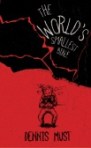
 Death is always bearing down in Dennis Must’s somber, disquieting novel, The World’s Smallest Bible (Red Hen Press, 232 pages). Death knocks on the window above the bed shared by brothers Ethan and Jeremiah Meuller in the small town of Hebron, in north central Pennsylvania; death is in the hand-me-downs they receive as gifts from the parents of soldiers who have just been killed in World War II; death brews inside their suicidal mother Rose, who has been scorned by their father; death dogs at their Aunt Eva, a stripper at the Elks Club; and death badgers their neighbor, Stanley Cuzack, as he tries to invent a perpetual motion machine. Half suffocating himself, Must’s narrator, Ethan, tries to push himself away.
Category Archives: just literary fiction
The Contractor by Charles Holdefer
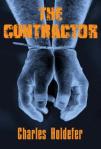
As the twenty-fist century accelerates toward a new low point in modern political history, eighty-five people possess about forty percent of the world’s wealth (that’s not a typo),* second- and third-generation war-terrorized children are born to benumbed, dehumanized parents, and most news reports would probably seem horribly unreal to even Bradbury and Orwell.
One may ask, What does twenty-first century art have to say about all this? We’ve heard from activists, a few courageous whistle-blowers; we’ve seen Hollywood thrillers with at least one Cheney-like character snarling with glee as he slaughters the hopes of yet another welfare mom. But where is the nuanced rendering of this story about the death of democracy?
Blinding: The Left Wing by Mircea Cărtărescu
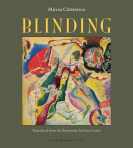 It starts in adolescence. The questions come to you while lying in bed (certainly now with a growing awareness of your sexuality), the walls of your room expanding into endless grainy darkness, as if the room itself could encompass the entire world: why am I here, why is there anything at all?
The questions may haunt you at age 13 or 15 or 17, but by adulthood they tend to feel banal. Unanswerable, impossible, if taken seriously debilitating, they are in a word blinding, and so you tend to avert your gaze. But suppose you can’t, suppose the inviolable white light only draws you closer, to madness possibly, to paint or write or drink or pray (to what God, tell me?) almost certainly. And so perhaps you scribble, the pages of your notebooks filling with furious script, like eons of sediment piling into sad mute mountains no one else will ever excavate or carve or climb. Continue reading
The Grievers By Marc Schuster
 This wry, touching novel, The Grievers (The Permanent Press, 175 pages), takes an intelligent look at the meaning of friendship, a distinctly pertinent topic in an age when “friend” and “unfriend” are ubiquitous verbs referring mostly to people we’ve never met. It’s a novel of ideas that also dares to be funny, a dangerous strategy when so many critics see humor as a crime against literature. After all, doesn’t serious writing demand uncompromising hopelessness and despair? Continue reading
Our Tragic Universe by Scarlett Thomas
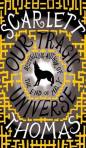 I love Scarlett Thomas. I love the fact she writes novels that are unabashedly about big ideas. Philosophical novels spliced with alternative theories from the worlds of science and medicine in the quest to find out what it’s all about. Life I mean. I also love the fact she isn’t too bothered by the intricacies of plot or character. In the two other novels of hers that I have read, PopCo and The End Of Mr Y, I got irritated when she reverted to plot or relationship details that interrupted the flow of creative thinking and speculation. So I am very indulgently disposed to her writing and accept that not everyone else might be so like minded. Continue reading
Cobralingus by Jeff Noon
 William Burroughs and Terry Southern’s cut up techniques were a bit too oblique to me. Supposedly cutting up classic texts and resuturing them together like the two halves of a car chop shop, while certainly creating a new text, but was also supposed to maintain echoes of the original ghost texts working under the surface. The problem for me was that I couldn’t locate any of the original texts, not being that well read classically, so that I didn’t get any undertones.
In Cobralingus (Codex, 120 pages) Jeff Noon provides the reader with the classical Continue reading
Dactyl Foundation Literary Fiction Award 2013
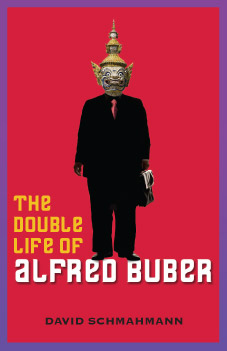
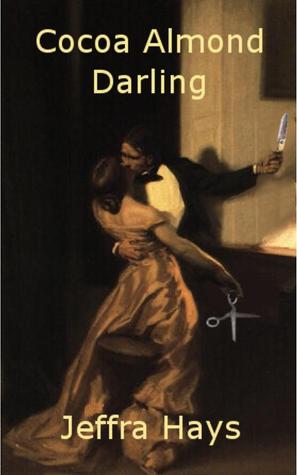 Because we were unable to give awards in 2011 and 2012, due to lack of qualifying entries, we decided to give two awards in 2013. The first award goes to The Double Life of Alfred Buber by David Schmahmann, which was reviewed by top DR reviewer Charles Holdefer. The second award goes to Cocoa Almond Darling by Jeffra Hays, which was reviewed by Peter Bollington, also a top DR reviewer, and VN Alexander, DR editor. Both authors receive a $1000 prize. Congratulations to David and Jeffra for their fine work.
The Unfortunates by B.S. Johnson
 (Picadorm 176 pages) A book that comes in a book-shaped box! Twenty-seven sections, one labelled ‘first’, one ‘last’ and the reader is free to choose the order in which they read the interceding 25 sections. This isn’t a device for the sake of being tricksy, but the author wants to replicate the random and unreliable nature that our memories work.
Chronic City by Jonathan Lethem
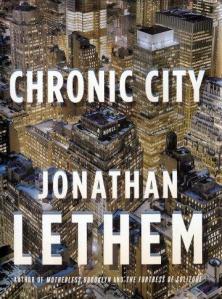
Lethem is the best fiction author writing today. Fact (usual IMhO disclaimers). Chronic City (Faber & Faber 467 pages) isn’t even one of his best, yet still knocks the socks off all his would-be pretenders. Every sentence is hand-crafted out of the marble of language with a literary chisel. Every word has a tiny detonation when placed next to the trip switch and timer of the other words in its sentence. You don’t believe me, try “his hide-and-seek muse” or “his bare-knuckly shoulders”. But having said all that, there was something slightly unsatisfying about this, his latest Meisterwerk. In thesame way that Quentin Tarantino really needs now to shoot a film without a gun or a sword in it, Lethem maybe needs to widen his canvas beyond that of New York City. NYC stands for many things, but is perhaps too idiosyncratic to bear the full weight of an investigation into hyper-realities for the whole world. Continue reading
If on a Winter’s Night a Traveler by Italo Calvino
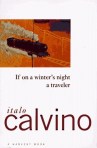 Italo Calvino opens up his masterpiece, If on a Winter’s Night a Traveler (HBJ, 260 pages), in the second person, addressing and engaging the reader in a very direct way; a powerful, uncompromising way: Here you are – the reader; and here I am – the protagonist; the author is somewhere else, as impertinent to the story as is his publisher. It is what it is, and you, the reader, are here with me, sucked into the depths of my mind, where you’ll trip over threads that are seemingly random, unrelated and without ends, yet serve a purpose that you may or may not grasp unless you persist until the closing lines fade away as you turn the last page over and walk away, pensive, wondering whether you can make any sense of this work at all. Continue reading
 Dactyl Review