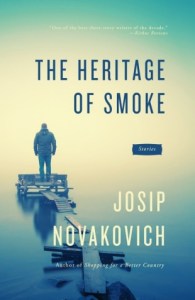
 In The Heritage of Smoke (Dzanc, 240 pages), a collection of short stories set mainly in 20th century war-wrecked Croatia or Ex-Yugoslavia, Josip Novakovich makes American-born writers, whose plots inevitably turn on sexuality and identity, seem merely whiny and self-obsessed. This masterful storyteller follows ordinary lives in the relatively small, recently-renamed Eastern European country, of which Americans are only vaguely aware, whose diverse cultures and old animosities persist through regime change. Caught between the whims and wars of super power nations and petty dictators, the characters revealed here endure, curse, and try to have fun. Novakovich’s characters tend to be listless, jaded, and stubborn, but they also have a kind of a dignified persistence, like old trees growing in the cracks of mountaintop stone . Continue reading
It’s that time of year
 In 1959 Elizabeth Hardwick, novelist, reviewer, and wife of poet Robert Lowell, wrote a pointed critique of the book reviewing industry. She noted that the most trusted of review organs, the New York Times Book Review, was remarkable only for “the flat praise and the faint dissension, the minimal style and the light little article, the absence of involvement, passion, character, eccentricity — the lack, at last, of the literary tone itself.”
That was 1959. The year is now 2017 and coming to a close, and that means it’s time for me to come to you, hat in hand, to ask for your support for Dactyl Review, a literary fiction book review created by and for the literary community. If sixty years ago literary reviewers had begun to dwindle, as Hardwick noted, in the following decades we have seen the disappearance of the literary reader, the literary writer’s habitat. You may think rightly of this as an appeal to save an endangered species.
Every year, about this time, I try to explain why literariness matters, why we all need a little poetics in our lives. You can find some of these appeals here and here and here. The same still goes for 2018. Please be as generous as you can. We’ve got some great authors and reviewers here who need readers. And your donation is tax-deductible.
–VN Alexander, Editor

Hard Mother by U R Bowie
 Russia. Russia. Russia. Ever since the Wicked Witch of the West succumbed to the Reality Circus Clown, the popular press has been serving up reconstituted Cold War propaganda, declaring that the Russian “enemy” is brainwashing us through Facebook posts and massaging our malleable minds via sexy Russian public television hostesses. Clapper, former U.S. intel head, went so far as to warn us that all Russians are genetically predisposed to lying and meddling.
Before we learn to love the idea of trying to bomb them into oblivion, let’s consider the question of the Russian Soul. Who are these people? What characteristics do they share, if any, with you and me?
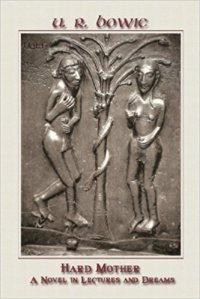
U. R. Bowie offers his meditation on Russianness in an extraordinary travel log through Ultimia Thule, the farthest point, exploring dreams, lectures and diaries. Hard Mother (Ogee Zakamora, 429 pages) is a challenging novel; never boring; persistently humorous, it is organized with staggering complexity, interweaving dreams with fiction with anthropology, flashing forward, back and around. The book cover warns the reader to “keep both hands on the wheel.” Good advice. Continue reading
The Trick of It, by Michael Frayn
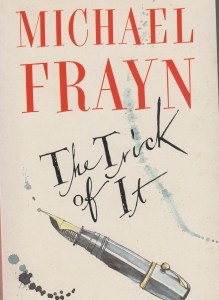 Two professors of literature, old friends, one in England (RD, our narrator), one having emigrated to Australia (R), are writing letters to each other. This suggests one of the many metaphors in The Trick of It (Viking, 1989, 172 pp.): “Forgotten questions and meaningless answers passing each other somewhere over the Indian Ocean at thirty thousand feet—an image of human communication. Of love and literature and life.” So is this an old-fashioned epistolary novel? Far from it. The Trick of It is a marvelous, sparkling-new one-way-epistolary and modern piece of metafiction. I would rank it right up there with Don DeLillo’s White Noise as one of the great comic novels of the twentieth century. Continue reading
Dactyl Review selected by Feedspot for Top 50 Fiction sites
 Dactyl Review is unlike any other fiction review site, helping readers find the particular kinds of “literary fiction” they prefer. Because Dactyl is not a commercial site, they don’t favor the newest books or books by best-selling authors. They publish reviews of only the best literary fiction, older and new, as judged by other literary fiction writers.
Errata by Jacob Smullyan
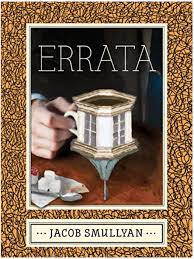
To describe a book as unclassifiable is, of course, to classify it, but that fact is entirely in keeping with the spirit of Jacob Smullyan’s Errata (Sagging Meniscus, 72 pages). Comprising thirty short chapters of mini-essays, stories and philosophical aperçus, it straddles numerous genres and grapples with the process of making sense.
Continue reading
Why I started Dactyl Review
 I had been director of the Dactyl Foundation in NYC for a dozen years, organizing art-science collaborations and hosting poetry readings, before it occurred to me that we were doing nothing to support literary fiction. As a literary fiction novelist myself, I was well aware that these unlikely-to-be-bestsellers could use some support. But it was not immediately clear to me what I could do to help. Hosting readings did not work. Poets tend to turn out for each other and buy each other’s work; they dedicate poems to each other and even write poems about each other’s poems, but not literary fiction novelists; they are as independent as cats. They keep to themselves, don’t do reviews, fear influence, and reserve their admiration for dead authors.
I was such a writer, I realized. What could I do to get mavericks, like myself, to form a community?
Continue reading
Tenth of December by George Saunders
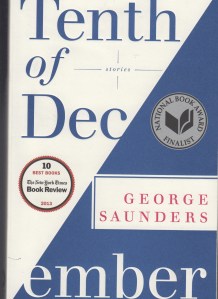 In a recent rant I wrote on the sad state of the contemporary American short story, I railed against what is sometimes known as ‘The New Yorker story,’ that all-too-common pedestrian thing called “domestic literary fiction.” Happily, there are always exceptions to egregious trends, and George Saunders (Tenth of December, Random House, 272 pages), who is a contributor to The New Yorker, is a big one. Exception, that is.
How is his fiction different from the normal, run-of-the-mill domestic stuff—the kind of fiction I can’t stand? A good place to begin would be with a comparison between his Tenth of December and another book of short stories recently published, The Refugees, by Viet Thanh Nguyen. I picked up Nguyen’s book with high expectations, having read his novel, The Sympathizer, which has great writing, wonderful sentences on every page.
Continue reading
The New Yorker short stories
 THE GREAT AMERICAN BOONDOGGLE
(The Sad State of the American Short Story)
The situation has been the same for years. Nothing ever seems to change and practically no one deems it necessary even to talk about it. Almost forty years ago a colleague at the university where I taught, a lifelong reader of The New Yorker and a person whose intelligence I respect, said to me, “I love The New Yorker, but I never read the fiction. ‘The New Yorker story’ does not appeal to me.” In a visit to my general practitioner a month ago, the doctor, an avid reader of classical literary fiction—the canonical literary works of the world—remarked, “I love the articles in The New Yorker, but I never read the fiction. Most of it is a total bore.” Over a period of forty years how many other intelligent readers of fiction have said the same thing? Repeatedly. Why is nobody listening? Continue reading
Infinite Summer by Edoardo Nesi
 Edoardo Nesi’s new novel, Infinite Summer, translated from the Italian by Alice Kilgarriff (Other Press, 320 pages), takes place in Tuscany between August 1972 and August 1982, right in the middle of the period known in Italy as the “Years of Lead,” a period of social and political turmoil marked by left-wing and right-wing killings and bombings. Knowing a bit of this history gives the novel a feeling of unfolding in an alternate Italy, an Italy of booming growth, expanding global markets for Italian goods, and limitless possibilities.
Nesi is a translator, writer, filmmaker, and politician. He has translated Bruce Chatwin, Malcolm Lowry, Stephen King, and David Foster Wallace, among others. He’s written a dozen books, one of which, Fughe da Fermo, was made into a film that he directed. In 2013 he was elected to the Italian Parliament’s Chamber of Deputies. Continue reading
 Dactyl Review