 Dismantle the Sun (Booktrope, 324 pages) is literary, but if you are looking for a novel of bright sunshine, lollipops along with skittles and beer, this is not the book for you. It reeks pathos; “wrenches” is the term used on the back cover of the book, and the work lives up to that term. It is an uncomfortable read because you are being dragged into the intimate, excruciating dynamics of a couple where the wife is dying and the husband is struggling with that reality.
Continue reading
The Darling by Russell Banks
 “[M]erely the story of an American darling,” Banks’ 2004 novel The Darling (Harper Perennial, 393 pages) ends on September 10, 2001, one day before “a new history” in America begins. The words “merely” and “darling” are strongly ironic, suggesting the “new history,” beginning on the next day, will be even more ominous and horrible than the one recounted by Hannah Musgrave, the novel’s protagonist. She is also known as Dawn Carrington, her adopted pseudonym due to youthful foolishness in abetting the Weathermen revolutionary group in America during the late 1960’s into the 1970’s. Hannah is essentially still on the run, although she will manage to marry a Liberian minister close to President Samuel Doe, plus later be exploited by the CIA in arranging the escape from prison of Charles Taylor. She has been a self-necessitating fugitive, obliging herself with a life of running and hiding, and unaware of herself as also a political tool easily exploited. Continue reading
Milligan and Murphy by Jim Murdoch
 Opening a novel with a quote, particularly one from a writer as universally celebrated as Samuel Beckett, risks much. A reader is apt to spend a good deal of the novel comparing the works of the writer before him to those of the great master, fall into a reverie about how great was the work of the great master, and lose track of what the book in hand is going on about. Jim Murdoch, the author of Milligan and Murphy (Fandango Virtual, 180 pages), assumes that risk. Continue reading
If a Man be Mad by Harold Maine
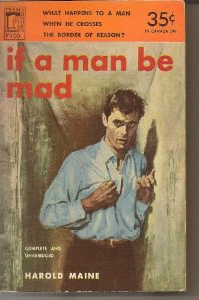 As cruel as the world itself.
If a Man be Mad (Permabooks, 156 pages)…there couldn’t have been a more appropriate title for this gem hidden amidst the American literature. Walker Winslow, writing as Harold Maine, had written this fascinating book while living in Big Sur, at a time when other great writers, such as Henry Miller resided nearby. Whether it was Winslow’s gift or the proximity of some of the greatest in modern American literature, Mr. Winslow has achieved what only but a few writers are capable of. He shook my world. Continue reading
The Miraculous Journey of Edward Tulane by Kate DiCamillo
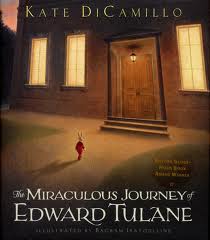 Edward Tulane is a china rabbit…
The bulk of my reviews deal with serious fiction and not with children’s literature. Therefore, you may ask yourself, “What does a china rabbit have to do with literary fiction?” Well, to answer that question honestly, I must say: “Nothing…nothing at all.”
There is no question that a children’s book about a china rabbit is an unlikely contestant to end up in my `favorite books’ pile. After all, this book is not about a character contemplating the murderous attitude of the world. Nevertheless, the book is about a character – a china rabbit Continue reading
Pnin by Vladimir Nabokov

He is not a very nice person but he is fun – Nabokov describing the character of Pnin in a letter to his editor at The New Yorker
Readers of my third novel, The More Things Change, who at the current moment in time comprise a not entirely significant two, my current wife and my only daughter (though not a daughter to my current wife despite the fact she treats her like a second daughter), will recall – Continue reading
Stripped: A Collection of Anonymous Flash Fiction edited by Nicole Monaghan
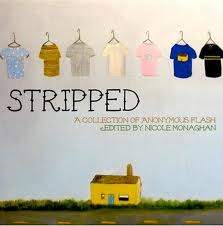 The premise here is interesting: an anthology of flash fiction with the bylines removed so that the reader can’t know the identity of the author. According to Nicole Monaghan, editor of this collection, the purpose is to question a reader’s assumptions about gender.
As an experiment, Stripped: A Collection of Anonymous Flash Fiction (PS Books, 102 pages) recalls I.A. Richards’ Practical Criticism and his withholding authors’ identities from his Cambridge students in the 1920s in order to come to grips with their literary values. It was a step forward in reading awareness. We live in a very different world now, to put it mildly—gender was not on Richards’ radar—but some of the same questions of reception persist. Continue reading
Frog City Updike by Arthur Graham
Frog City Updike never would’ve been without Brautigan’s Trout Fishing in America, the book that showed me just how loose I could get with form. — Arthur Graham, Big Al’s Books and Pals
One of the words I use too often in reviews is “interesting,” but I never really make it clear whether a particular word piques my interest or holds it. It’s the same with “nice,” which I also overuse; nice can have negative connotations; the last thing your wife wants to hear when she walks in wearing a new outfit is, “You look nice, Dear.” Even more confusing I would expect is when something gets referred to as “nice and interesting.” Frog City Updike–the place, not the book–sounds like a nice, interesting place. I’m not sure I’d want to live there but if I did I can see myself running across interesting things and saying, “Oh, that’s nice,” or vice versa. Continue reading
Editorial by Arthur Graham
 The following is my editorial of Arthur Graham’s Editorial (Bizarro Press Edition, 149 pages).
The following (edited) definitions of editorial are from Dictionary.com:
noun — an article presenting the opinion of the editor.
Whoever the editor is–the unnamed narrator, a young orphan who remembers “days of reading and masturbating in my room” but doesn’t remember, at the time of telling, what his age was (17 or 28)–is dumped by auntie and uncle into the cruel sea of the outside world with his heavy burden, a suitcase filled with dirty magazines. The narrator assumes that the reader is surprised: Continue reading
All About H. Hatterr by G.V. Desani
 Warning!!
Warning!!
Better heed those first warnings, and all those !!!!! This – fellers! femmes! — this book – is mad. Like a hatter?
Ostensibly an “autobiographical,” All About H. Hatterr, by Govinas Vishnoodas Desani (New York Review Books, 318 pages) was first published in 1948. Desani explains,
…Though I was attending a world war, the first row, I worked….It seemed I’d be stuck for years; the post-Cease Fire ones too…well meaning people kept butting in, demanding that I stop breathing the bracing air of war-time England with my windows shut. I do anything for peace…the windows open, work would be impossible…
 Dactyl Review