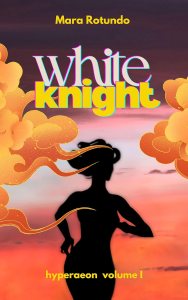
 Mara Rotundo’s debut novel, White Knight (Goldmund, 342 pages), is a love square set against the pandemic, literary fiction with strong elements of romantic domestic suspense and satire. It is a debut only in the sense that it is the first of her extraordinary writing she has allowed us to see. Her bio tells of many short stories and essays locked in a dusty drawer, like Bach’s music waiting to be found in that attic. If we could but read those writings, we would most likely find a step-by-step handbook for the development of a genuine writer, for in this book she springs full-grown from the loins of the muse, armed and dangerous.
For instance, these powerful lines start the romance,
“When her intrepid black eyes sunk their blade into his pudding face, a champagne cork popped somewhere. The earth’s rotation took a hit, the magnetic poles confused each other. She felt him melt, and he let her feel it.”
White Knight is a book of contradictions—a pulp novel love story on the surface. Continue reading →


 Machines Like Me (Nan A. Talese, 352 pages) by Ian McEwan is set in the possible world of the 1980s if Alan Turing had not died in 1954, Kennedy had not been shot in Dallas, and Britain had not won the war in the Falklands. In the story, Open Source information has allowed technological progress to sprint ahead, and the automatization of work is leading, first to high unemployment and then, presumably, to the creation of a universally idle population supported by the labor of machines. The hero, Charlie Friend, has recently purchased a life-like robot named Adam and he and his new love interest Miranda Blacke will together train and condition Adam to develop a personality and consciousness.