Child of Light by Jesi Bender

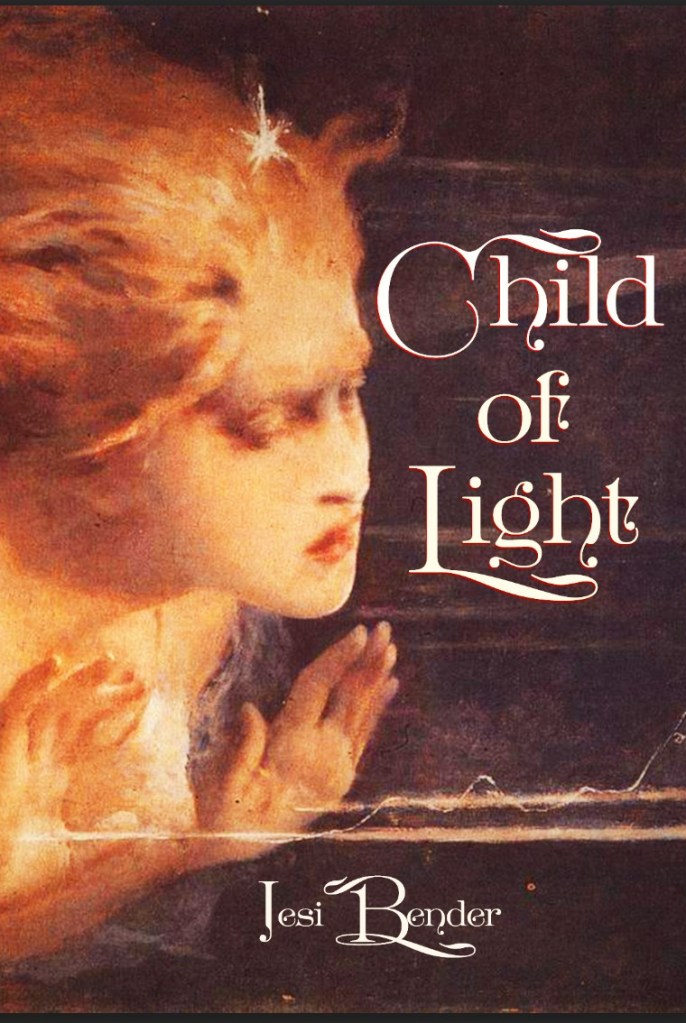
What do we really know when epistemic parameters are fluid? This question is central to Jesi Bender’s historical novel, Child of Light (Whisky Tit, 318 pages), set in upstate New York at the end of the 19th century. It centers on Ambrétte Memenon, a clever and dutiful young woman whose father is a French scientist immersed in his studies of electricity, and whose mother is a Québécoise enthusiast of Spiritualism.  Papa seeks to illuminate cities at night, Maman to communicate with the dead.

These are rather different agendas, to put it mildly, but the story dramatizes how, within the context of the period, both pursuits are cutting edge. And Ambrétte, in an attempt to mend her broken family, tries to reconcile the two.

Continue reading
The Melancholy of Resistance, by László Krasznahorkai (translated by George Szirtes)

Part One: “An Emergency: Introduction”

The Malaise

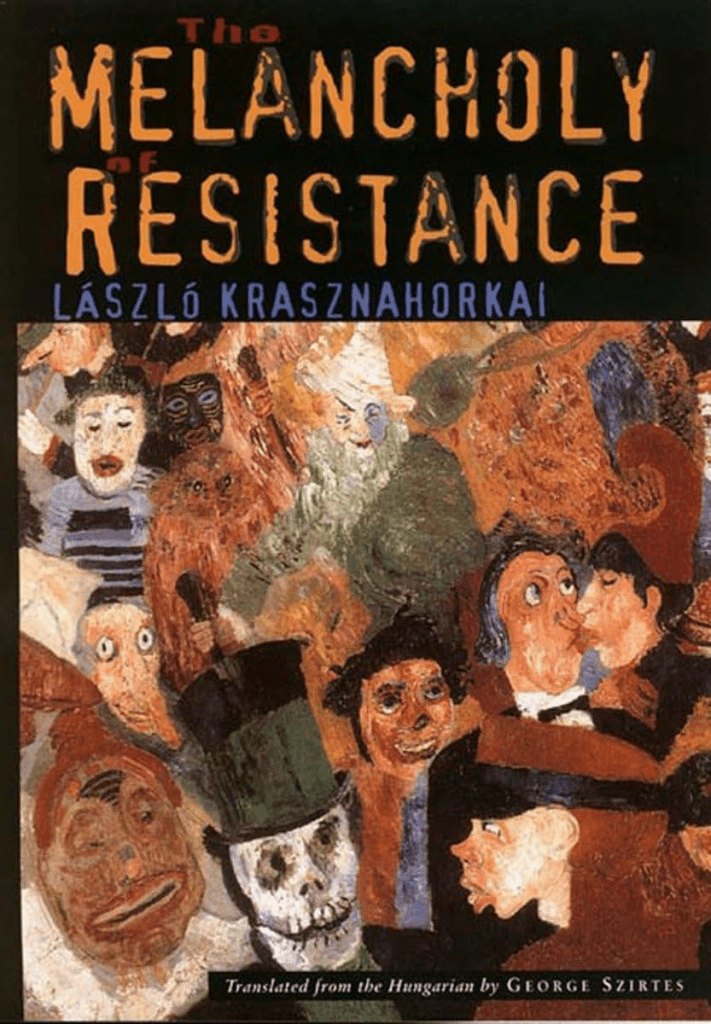
[Note: the part in quotes above is Krasznahorkai’s. These brief titles for various sections of the book are all he gives the reader to go on. I see this as a kind of perversity on the part of the storyteller, a middle finger stuck up in the face of the reader. Figure it out for yourself, sucker. Therefore, in my review—in aide of the reader—I sometimes provide chapter numbers and titles, the things the writer himself should have provided. A few breaks for paragraphs would have been a nice thing too. The words are crammed together in huge glomps on every page, so as to squeeze the tender brains of any reader. Dialogue is not set off in separate paragraphs, but placed in quotation marks in amidst the glomps.]

Continue reading

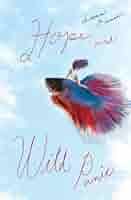
Hope and Wild Panic by Sean Ennis

Some writers refuse to get in line with linearity, or take up common cause with causality. In Sean Ennis’s Hope and Wild Panic (Malarkey Books, 202 pages), the reader finds a depiction of life in the contemporary U.S. with recognizable settings and characters—realism, in a word—but it is also fundamentally destabilized, relying on non-chronological fragments (chapters? flash fictions?) of only one or two pages to explore the lives of a middle-aged narrator and his family. One section begins as follows:

“Rejoice with me, I have beaten psoriasis. There’s this trick I have of not watching the news. Most things don’t happen, and there’s been some debate internally about the order of events. I keep losing things and the obvious answer is that they’ve been stolen! But the investigation is finished—it is what it is. A black government helicopter is circling, and I’m just reading my big heavy book like that’s just a ceiling fan. Our neighbors behind the house, across the gulch, have been growing marijuana. I wonder what for. A family of foxes is our other neighbor. Is there some apophenia going on here? Doot-dee-doo.”

Continue reading

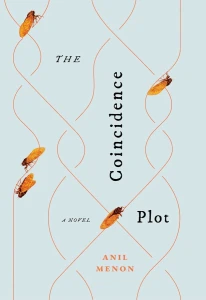
The Coincidence Plot by Anil Menon

Chances are you’ve never heard of Anil Menon. That’s a shame, but not your fault. Anil Menon is a brilliant Indian author writing wild, brainy and emotionally engaging stories and novels in English. His books, including the main one reviewed here, The Coincidence Plot (Simon & Schuster, 252 pages), are published by presses well known in the English speaking world, and his works can be found in online venues, but readers in the United States who would delight in his novels won’t find them in bookstores.

The Indian Constitution lists Hindi as the official language of the Union, but allows English to continue in use by the government, English being a legacy from British colonial rule. Today India has a growing population of 1.4 billion (it recently surpassed China in this) and of this billion, about 10.5 percent are English speakers. Anil Menon’s work is published for those millions upon millions of English speakers in India. Getting his novels from online sellers or by mail from India can be tedious, but it’s worth the hassle.
Continue reading

There’s Something I Want You to Do, by Charles Baxter

The Short-Story Novel

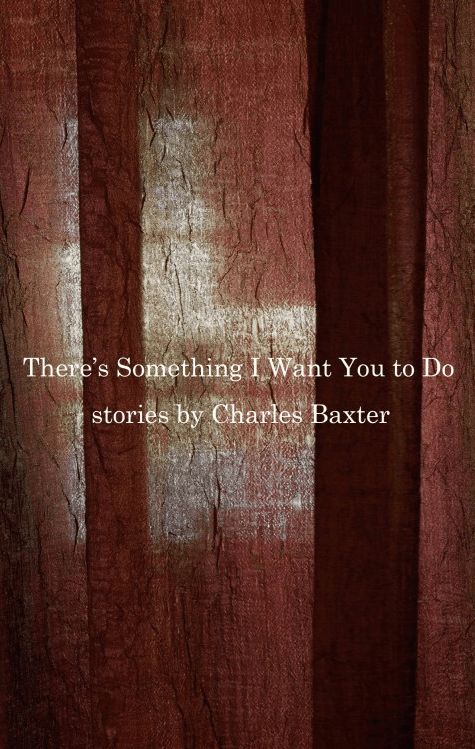
There is probably a better term for this, but I don’t know what it is. I refer to a book of short stories, so put together as to feature similar themes and recurrent appearances of the same characters: Charles Baxter, There’s Something I Want You To Do, Penguin Random House, 2015, Vintage paperback, 2016, 221 pp. The result being, if not a novel, at least something resembling a novel. All of the stories in this collection have titles featuring one aspect or another of human character, positive or negative. Part One: bravery, loyalty, chastity, charity, forbearance; Part Two: lust, sloth, avarice, gluttony, vanity. The stories are presented so that—with one exception—each story in Part One has a companion story (same characters) in Part Two.

America in the Twenty-First Century: Full of Somethings Somebody Wants

Quotations from various stories in the collection: “something has happened, I need to say something to you, something was about to happen, something is out there, we’re going somewhere [or nowhere?], something will happen to me, something wants something from me, there’s a thing that’s come up.” And, of course, the line that provides the title of the book: “There’s something I want you to do.” That line appears five times in various contexts. Continue reading

Solenoid by Mircea Cartarescu, translated by Sean Cotter

In “he Garden of Forking Paths,” Jorge Louis Borges’s postulates a novel so complex it would become “a labyrinth in which all men would become lost.” Left unfinished by its fictional author, the novel is a legacy emblematic of the innumerable possibilities of existence. For Borges, multitude makes the case for universal elusiveness—a sublimity in extremis.

With celebrated Romanian writer Mircea Cartarescu’s massive novel Solenoid, we are deep into Borges territory. Solenoid (Deep Vellum Press, 672 pages) is a chronicle told by an unnamed high school teacher whose Kafkaesque days are spent at public School 86 in Bucharest, “the saddest city in the world.” At night, the unnamed protagonist surrenders himself to the phantasmagoric spell of a “solenoid” buried beneath his house; the solenoid is a strange electromagnetic coil with dimension-bending properties. The solenoid causes the narrator to float above his bed. We learn how the mysterious contraption is built from concepts of Nicholas Tesla and the notion of the hypercube. Later, the solenoid is revealed to be one among an array of solenoids buried throughout the city. Ultimately, the narrator meets a woman with whom he falls deeply in love. In a finale that owes as much to science fiction as James Joyce, the couple, and the entire city of Bucharest, are launched spaceship-like from the surface of the earth, trailing a cone of infrastructure and debris. Continue reading

Drift by Craig Rodgers

Sometimes a novel’s originality is less a matter of affirmation than an act of refusal. Refusal to go along with received ideas of how to tell a story or create verisimilitude or even how words signify. Saying no opens up new space, or at least points towards what has been neglected by complacence.

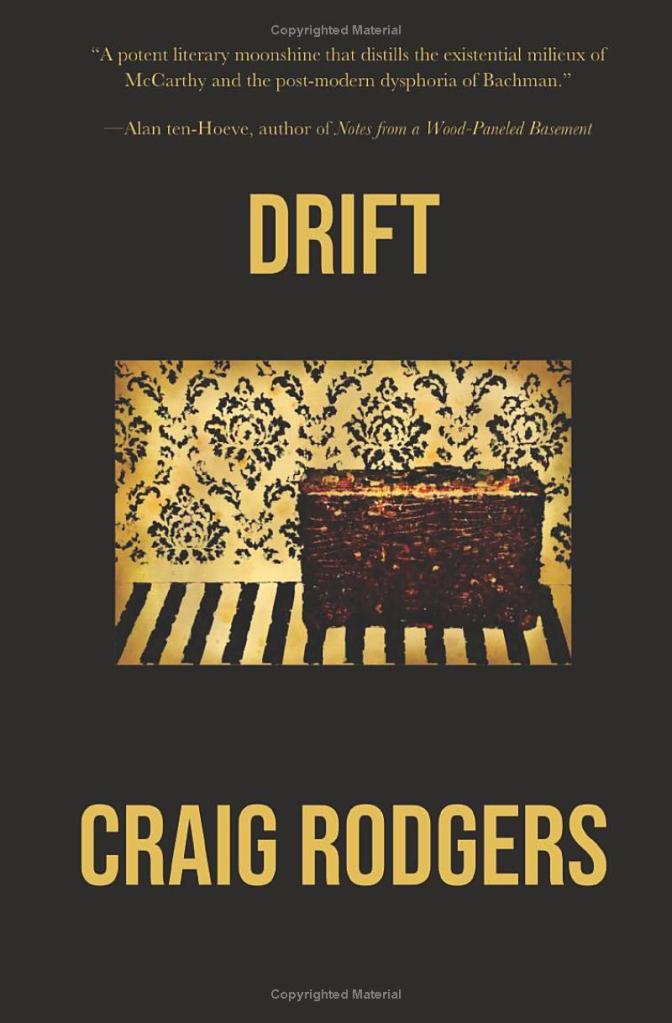
Craig Rodgers’ Drift (Death of Print, 156 pages) is such a novel. A dystopian tale of a bible salesman named Charlie, it will defy the ingrained expectations of many readers. Plotwise, Charlie has no trouble making a sale: everyone seems to want his product. He has no idea why. Women like Charlie—no struggles there, either. Other characters include a clown on a rampage and a mysterious goon in a dented bowler hat who seems to be following Charlie. There’s a bearded lady, with whom Charlie has sex, and a young boy afflicted by plague who becomes his travel companion. Then the boy steals Charlie’s car. Continue reading

Dead Souls by Sam Riviere

Believe the Blurbers

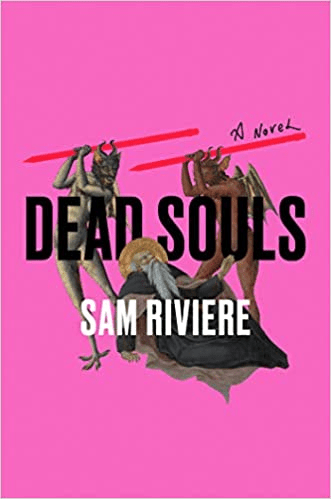
Dead Souls (A Novel by Sam Riviere, NY: Catapult, 2021, 289 pp.) is a rare example of a book containing believable blurbs. This wild gallimaufry of a novel, which runs a monologue through almost three hundred pages of text, without pauses for paragraphs or new chapters, is a tour de force of literary mania. Reviewers have pointed to possible influences: Roberto Bolaño, Georges Perec, Thomas Bernhard, Italo Calvino. One blurber, Nicolette Polek, describes the novel as “a rare and brilliant pleasure, a coiling, searing fugue of a book that takes our deranged culture and pulls forth from it a box of stars.” She’s right. Or, to put it in the fully neutered style in which the book is written, they are right.

There are chapters of sorts, but you have to figure them out yourself. In the front matter the author provides a kind of contents page—not labeled as such—listing names of characters as names of chapters, along with the pages where they start. Begin with an introductory chapter (not listed in these “contents”), then go, first, to “Zariyah Zhadan,” p. 32: this is, presumably, Chapter One. Proceed from there, filling in the chapter numbers beside the given name and page number. Chapter Six comprises two named characters. We end up with “The Scholastici,” p. 253, which is the last of twelve chapters. Continue reading

MacLeish Sq. by Dennis Must

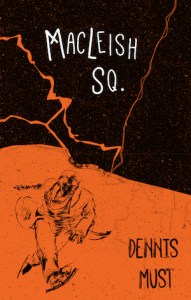
Edward Said, writing about Beethoven’s late style, defined late style as that time wherein the artist freed from the expected cultural and historical restraints of form and content unleashes a newness that both confounds and instructs. Dennis Must has achieved that hour of newness in MacLeish Sq (Red Hen Press, 209 pages). With its visual complexities coupled to broad-ranging literary interconnections, Must’s writing raises the text to a “beyond” state where the readers have to let go of what they know. The readers must accept that their own hidden stories have been eclipsed and take this writing on its own without any pre-conceived notions of what “a novel” is or should be. Roland Barthes, now out of fashion to the post-post modern mind, wrote in his essays–Degrée zéro de l’écriture–that there are two kinds of writers which he called “l’écrivain and l’écrivant.” Must, in MacLeish Sq., brings us a third iteration of writer as his work approaches mythic status in which time, character, past, present, alive, dead—just a few of the literary polarities inhabiting this writing—interact at a level no reader can accept without relinquishing his/her own sense of person and being. Interweaving Dante, Melville, Hawthorne, Pirandello into a single narrative that seizes the essence of each, isn’t a style most readers will be comfortable with. Here, however, Must puts them together with such skill that the author lives on par with the masters. It will take an honest reader to admit–I have never read anything like this.

Continue reading

The Songs and Laments of Loömos, by René de Saint-Denis

With his Loömos book (Laocoön Press, 2021, 128 pp.), the author attempts a presentation of art as an integrated whole. As the subtitle tells us, “Text, drawings, paintings, music and sculpture” are included here. We read the words of the book, but, simultaneously, we interact with everything else. We, of course, do not interact directly with the sculptures by Saint-Denis—here we must be content with their visual representations. Nor do we hear the actual music, as this is not an audiobook. But the final section, “Songs and Laments,”—four separate pieces comprising a total of fourteen pages—consists entirely of musical notations.

Therefore, in order to “hear” the music of the final section you have to be a musician yourself, able to read the notes provided on paper. The author may have considered publishing an audiobook, or including a CD of the final section with this paperback. But then again, given certain unique and avant-garde features of Loömos, he may have deliberately intended the final section not to be played. So as to achieve something like what the composer John Cage created when he wrote his famous composition consisting of silence. All the musicians sit in stillness on the proscenium, holding their instruments, while the conductor stills his baton and all his gesticulations. The “music” consists of isolated coughs and throat-clearings from the audience, plus a few car horns blowing and ambulance sirens from the outside world.

Continue reading