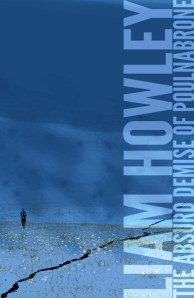
The Absurd Demise of Poulnabrone by Liam Howley

Liam Howley opens The Absurd Demise of Poulnabrone (Jagged C Press, 344 pages) with an introduction to Cornelius Solitude Conlon, an aging man who, I assumed, was the primary protagonist. In fact, my assumption continued throughout a good portion of the novel, even though the narrative shifted to various other characters as I read along. Nevertheless, as the story progressed, Cornelius became but one piece in the game board that is Poulnabrone.

It is, in fact, Poulnabrone that is the centerpiece of this story. Primary and secondary characters appear on the scene, make an impact, and leave. Some return later on, some never appear again, yet others remain present to weave the fabric of the tale as it is spun along, carrying with them the thread of continuity without overshadowing the main premise.
Continue reading
If on a Winter’s Night a Traveler by Italo Calvino

wintersnightItalo Calvino opens up his masterpiece, If on a Winter’s Night a Traveler (HBJ,  260 pages), in the second person, addressing and engaging the reader in a very direct way; a powerful, uncompromising way: Here you are – the reader; and here I am – the protagonist; the author is somewhere else, as impertinent to the story as is his publisher. It is what it is, and you, the reader, are here with me, sucked into the depths of my mind, where you’ll trip over threads that are seemingly random, unrelated and without ends, yet serve a purpose that you may or may not grasp unless you persist until the closing lines fade away as you turn the last page over and walk away, pensive, wondering whether you can make any sense of this work at all. Continue reading

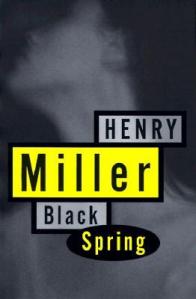
Black Spring by Henry Miller

blackspringWarning: This review is long, has an excessive amount of quotes, and does not reach much of a conclusion. If you have a short attention span, this may not be for you. However, if you appreciate Henry Miller, one of the finest writers America has produced in the last century, I encourage you to read on.

When his name comes up, most readers associate Miller with sex, scandals, pornography. This is mostly due to the press attention given to his two books, The Tropic of Cancer, and The Tropic of Capricorn. Continue reading

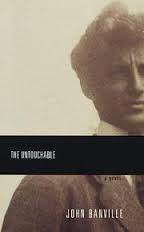
The Untouchable by John Banville

untouchableWhen Banville is writing at his best, he tends to reminisce about people and places rather than tell a story. In The Untouchable (Knopf, 668 pages), Victor Maskell, an Irishman living in England, becomes a spy for the Soviets during World War II. The book begins when the elderly Sir Maskell’s secret past has been revealed in the press. A young biographer, Serena Vandeleur, comes to interview him, and he takes the opportunity to look back over his life. Banville’s most artful writing is to be found in the plotless parts of the narrative, where he is working on characterization by relating memories of his childhood and young adulthood. Continue reading

A Room Where the Star Spangled Banner Cannot Be Heard by Levy Hideo, translated by Christopher S. Scott

This short novel in three parts comes with high praise from Nobel Prize winner Oe Kenzaburo: “Have we failed to catch the calm but earnest tone that echoes like music through Levy Hideo’s prose? With his unique literary voice, this writer clearly represents a new kind of novelist for Japanese literature….” Continue reading

Dr. Jesus and Mr. Dead by Cooper Renner

Spanish poetry translator, publisher of elimae press, and celebrated indie writer, Cooper Renner has written a debut novel Dr. Jesus and Mr. Dead (Ggantijia, 215 pages). The work is an amalgamation of historical fiction, and ebbs and flows across hundreds of years and multiple psyches. Disturbing, entirely entertaining, and expertly written prose which drawls in slow, southern sweeps, Dr. Jesus and Mr. Dead is dripping with beautiful language, harsh imagery and heady inquiry. Continue reading

Shadowplay by Norman Lock

Shadowplay (Ellipsis Press, 137 pages) by Norman Lock, is the 2010 Dactyl Foundation Literary Fiction Award recipient. Lock’s novella is a dense fable, mixing magic realism with self-reflexivity. The entire story is given to us in miniature at the beginning, such that the novella itself is really a constant retelling–a folding and refolding–rather than an unfolding.  A shadow puppet master named Guntur falls in love with Candra, who comes into his theater one day to buy puppets.  When she dies of typhoid fever six days later, he falls into despair for many years, until finally he understands how to enter the world of  the dead, Continue reading

Shadowplay by Norman Lock

An uncanny tale of the limits and power of story telling, Shadowplay (Ellipsis Press, 137 pages) also works with a mesmerizing and subtle structure where the story repeats and folds into itself over and over again. Among Lock’s best work, it continues the self-conscious fascination and manipulation of the theme of “other” that appeared in works like A History of the Imagination and Land of the Snow Men. Here however Lock’s uproarious and dark-humored wit has been replaced with a different mode: that of a parable or fable. The alienation, vanity, occasional triumph, and seemingly inevitable destruction of the story-teller are almost classically illustrated in this compact and powerful tale. Continue reading

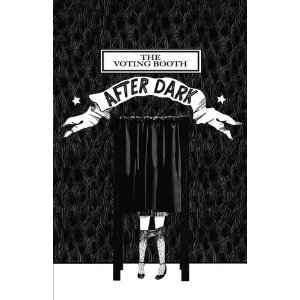
The Voting Booth After Dark: Despicable, Embarrassing, Repulsive by Vanessa Libertad Garcia

Vanessa Libertad Garcia’s first book, The Voting Booth After Dark: Despicable, Embarrassing, Repulsive (Fiat Libertad Co., 92 pages), is a slim volume  of 23 short pieces, some of them poems, many of them first-person or third-person vignettes that capture a few minutes or hours of a given character’s “despicable, embarrassing, or repulsive” life.

Gritty and unflinching, the tone of the book is one of desperation and starkness as each character depicted—Marta, a young, disenchanted lesbian; or Diaz Diaz, a gay fashion designer, for example—speaks to us of their heartbreak, alienation, and sometimes of suicidal plans. The personas that Garcia invokes are products of a society that is too fast-paced, too materialistic, and too shallow for twenty-somethings or thirty-somethings trying to find a meaningful niche in life, as they struggle simultaneously to pay bills, be successful in a career, find true love, or simply forge a connection to someone or something outside of themselves that can make their lives fulfilling. Welcome to the underbelly of Los Angeles. Continue reading