Herscht 07769 by László Krasznahorkai, translated by Ottilie Mulzet

[October 9, 2025, it was announced that László Krasznahorkai was awarded the Nobel Prize in Literature.] Here is a pertinent citation from Dennis Overbye (NY Times, 12/22/2024): “Everything that scientists have learned tells us that the universe is dynamic, and so is our knowledge of it. Nothing lasts forever, not even forever itself. Stars are born and they die, their ashes congeal in new generations of flash and crash. And so the show goes, until the last, biggest black hole gasps its last puff of subatomic vapor into the void.

“We don’t know what wonders await discovery back in the first nanosecond of time or in the yawning eons yet ahead. We don’t know why there is something instead of nothing at all. Or why God plays dice, as Einstein put it as he mulled the randomness implicit in quantum mechanics, the house rules of the subatomic realm.”

Continue reading
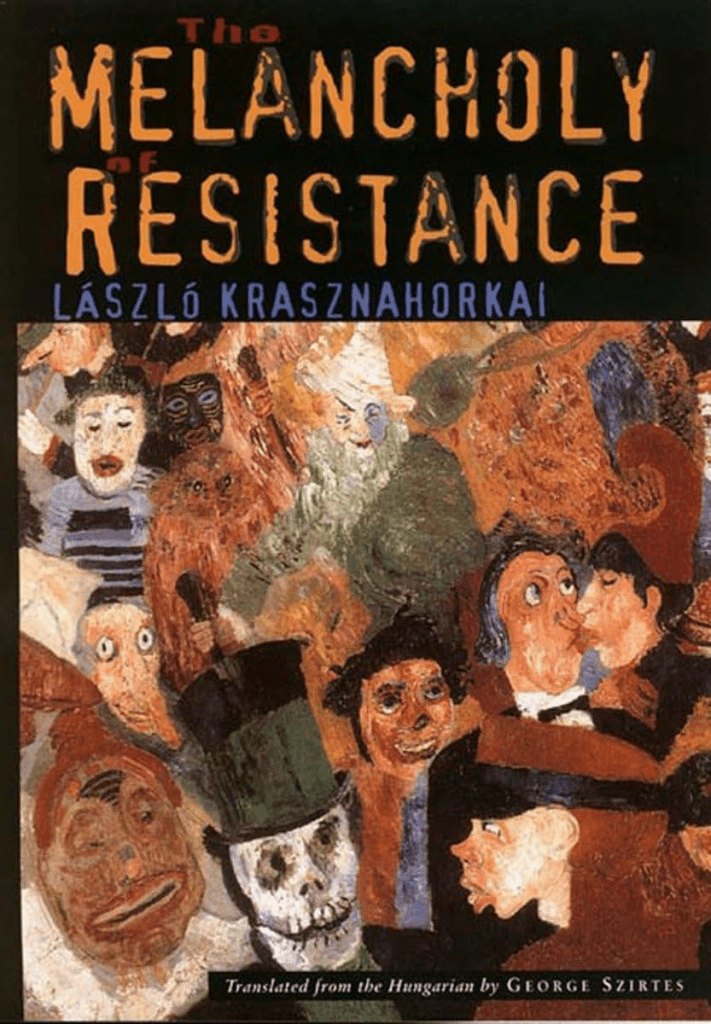
The Melancholy of Resistance, by László Krasznahorkai (translated by George Szirtes)

Part One: “An Emergency: Introduction”

The Malaise

[Note: the part in quotes above is Krasznahorkai’s. These brief titles for various sections of the book are all he gives the reader to go on. I see this as a kind of perversity on the part of the storyteller, a middle finger stuck up in the face of the reader. Figure it out for yourself, sucker. Therefore, in my review—in aide of the reader—I sometimes provide chapter numbers and titles, the things the writer himself should have provided. A few breaks for paragraphs would have been a nice thing too. The words are crammed together in huge glomps on every page, so as to squeeze the tender brains of any reader. Dialogue is not set off in separate paragraphs, but placed in quotation marks in amidst the glomps.]

Continue reading

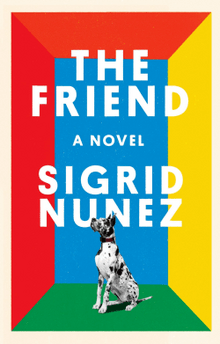
The Friend, by Sigrid Nunez

Maybe a better title for this book would be Bereavement, since that’s the main theme. We begin on the first page with a description of Cambodian women who had gone through hideous traumatic experiences and who, subsequently, appeared to have cried themselves blind. That, in a sense, is what the narrator is doing throughout the pages of the novel: metaphorically crying herself blind.

Names are scarce in this book. The unnamed first-person narrator, like the author herself, lives in New York City and teaches creative writing in a university. They appear to be about the same age (sixties or early seventies), so Nunez—who at some point has lost the tilde in her last name (that’s a different issue)—could be basing the action of the novel largely on her own experience. We do not know, for all that, if she ever lost a best-friend-fellow-writer to suicide and, subsequently, adopted that writer’s bereaved dog, a Great Dane. More on the dog later.

Continue reading

Son of the Morning, by Joyce Carol Oates

A man attempting to escape time and being in flesh, a man who does not wish to be, which is, for the most part, what all earthly creatures wish for most fervently: to be. In flesh. But for the most fanatic of religious believers, flesh is a problem. Time is a problem as well, and the most perfervid of believers seek timelessness and fleshlessness. Which is to be found where, other than in Death? One view: such a believer is beloved of the Lord, in that he is willing to renounce all earthly existence in flesh and being to embrace godliness. Another view: a person who refuses to accept the precious gift that God has given him—life in flesh with being in consciousness—is the worst of heretics. Is possibly even in the camp of Satan.

We begin on the first page with a direct address to the Deity by an unknown speaker; we begin with a man in flesh with time on his hands—someone crying out in the wilderness to the Lord. “You have promised that there shall be time no longer. Yet there is nothing but time in the desolation of my soul . . . I don’t want mankind, nor do I want the happiness of the individual without mankind. I want only You . . . There shall be time no longer, yet we are deep in time, and of it; and it courses through us like the secret bright unfathomable blood through our bodies, bearing us along despite our childlike ignorance of its power . . . Save me, O God, by thy name, and judge me by Thy strength and not by my weakness . . . I think of my mother’s broken body and of my father’s swarthy beauty and of my own soul, which drains away in time, minute after minute, even as I compose my desperate prayer to You.” Continue reading

There’s Something I Want You to Do, by Charles Baxter

The Short-Story Novel

There is probably a better term for this, but I don’t know what it is. I refer to a book of short stories, so put together as to feature similar themes and recurrent appearances of the same characters: Charles Baxter, There’s Something I Want You To Do, Penguin Random House, 2015, Vintage paperback, 2016, 221 pp. The result being, if not a novel, at least something resembling a novel. All of the stories in this collection have titles featuring one aspect or another of human character, positive or negative. Part One: bravery, loyalty, chastity, charity, forbearance; Part Two: lust, sloth, avarice, gluttony, vanity. The stories are presented so that—with one exception—each story in Part One has a companion story (same characters) in Part Two.

America in the Twenty-First Century: Full of Somethings Somebody Wants

Quotations from various stories in the collection: “something has happened, I need to say something to you, something was about to happen, something is out there, we’re going somewhere [or nowhere?], something will happen to me, something wants something from me, there’s a thing that’s come up.” And, of course, the line that provides the title of the book: “There’s something I want you to do.” That line appears five times in various contexts. Continue reading

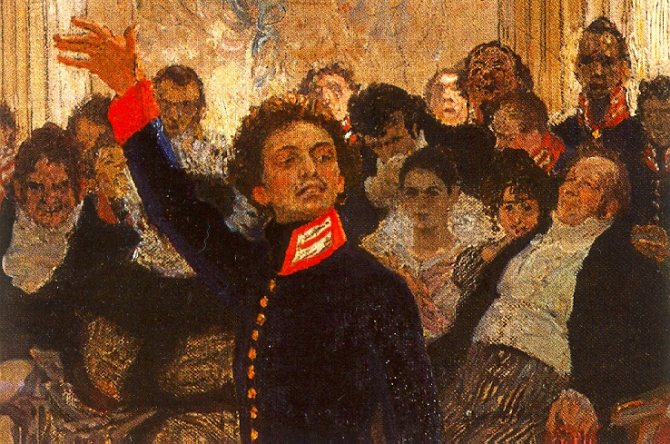
Young Pushkin, by Yury Tynyanov

Yury Tynyanov, Young Pushkin: A Novel

(translated by Anna Kurkina Rush and Christopher Rush (New York: Overlook/Rookery) 2008, 515 pp.

[the Russian original: Юрий Тынянов, Пушкин (М: Издательство «Правда»), 1981]

Introduction

This is a historical novel, treating the life of Russia’s greatest poet from the year of his birth, 1799, to shortly after he graduated from the Lycée school in Tsarskoe Selo in 1817. Tynyanov’s original plan was to cover all of Aleksandr Pushkin’s life, until his death in a duel in 1837, but the author’s health failed. Beginning in 1935, the novel was serialized, but by 1943 Tynyanov was terminally ill with multiple sclerosis; at the end of that year he died at the age of forty-nine, leaving Part One (“Childhood”) and Part Two (“The Lycée”) completed to his exacting standards. What is Part Three as published here (“Youth”) is clearly in rough draft form, lacking the literary polish of the first two parts (more on this later). Even worse, what would be, say, Parts Four and Five—in which we would meet the mature poet, plus his mature literary works—remained a chimera. Continue reading

Dead Souls by Sam Riviere

Believe the Blurbers

Dead Souls (A Novel by Sam Riviere, NY: Catapult, 2021, 289 pp.) is a rare example of a book containing believable blurbs. This wild gallimaufry of a novel, which runs a monologue through almost three hundred pages of text, without pauses for paragraphs or new chapters, is a tour de force of literary mania. Reviewers have pointed to possible influences: Roberto Bolaño, Georges Perec, Thomas Bernhard, Italo Calvino. One blurber, Nicolette Polek, describes the novel as “a rare and brilliant pleasure, a coiling, searing fugue of a book that takes our deranged culture and pulls forth from it a box of stars.” She’s right. Or, to put it in the fully neutered style in which the book is written, they are right.

There are chapters of sorts, but you have to figure them out yourself. In the front matter the author provides a kind of contents page—not labeled as such—listing names of characters as names of chapters, along with the pages where they start. Begin with an introductory chapter (not listed in these “contents”), then go, first, to “Zariyah Zhadan,” p. 32: this is, presumably, Chapter One. Proceed from there, filling in the chapter numbers beside the given name and page number. Chapter Six comprises two named characters. We end up with “The Scholastici,” p. 253, which is the last of twelve chapters. Continue reading

Commentary on Analysis by George Saunders of Story by Anton Chekhov


“In the Cart” (Yarmolinsy Translation)

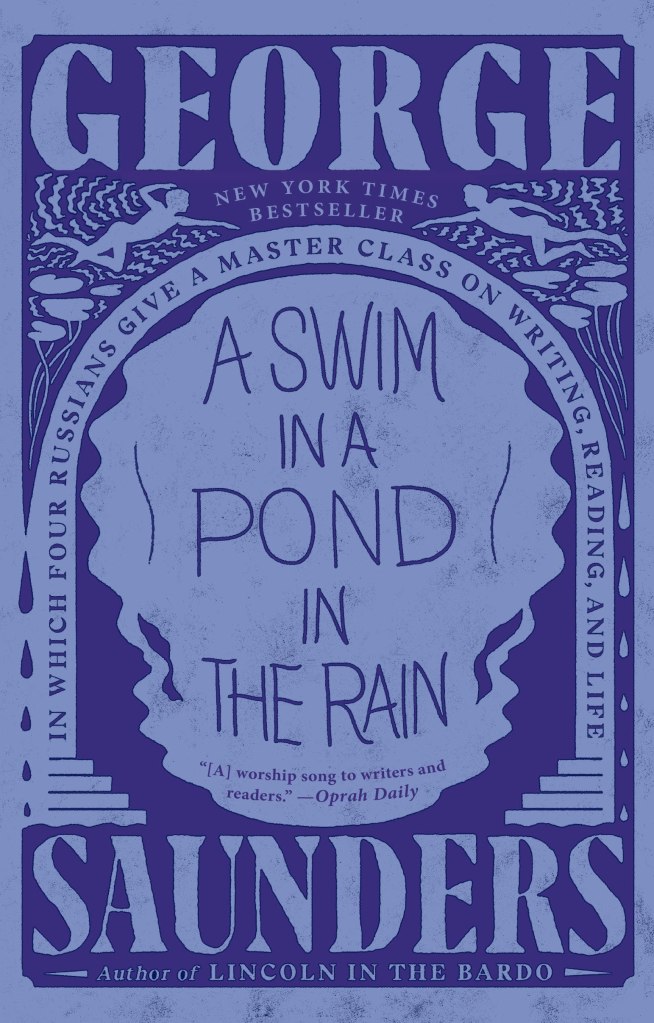
From the book by George Saunders, A Swim in a Pond in the Rain

Note: I taught Russian literature in a university for thirty years. Naturally, I was intrigued when the short-story writer George Saunders published a book detailing how he teaches Russian stories in his creative writing classes at Syracuse University. Among those stories are two by Anton Chekhov that I once taught (“The Darling” and “Gooseberries”) and one by Nikolai Gogol (“The Nose”).

I decided that before looking at the Saunders commentary I would publish my own critical remarks on each story. The result would be an interesting contrast: material as presented by a teacher of Russian literature versus material as presented by a teacher of creative writing. The first story treated by Saunders is Anton Chekhov’s “In the Cart.” I have already posted my critical analysis of that story on my blog, “U.R. Bowie on Russian Literature” and on Dactyl Review. What follows below is my commentary on how George Saunders approaches the story.

Continue reading

“In the Wagon” (“На подводе”), by Anton Chekhov


 Telega (Wagon, Cart) With Wounded Soldiers

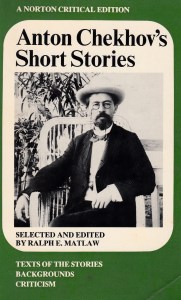
[Note: the story has appeared in English translation under a variety of titles; I know of at least three: “The Schoolmistress” (Constance Garnett trans.), “A Journey by Cart” (Marian Fell) and “In the Cart” (Avrahm Yarmolinsky, the translation discussed by George Saunders in his book, A Swim in a Pond in the Rain). My method, were I to be teaching this story in a course on Russian literature: I would read the original first, then compare translations, trying to pick the best one for my students to read. In quoting here from the story in English I use the Marian Fell translation, which appears in the Norton Critical Edition, Anton Chekhov’s Short Stories (edited by Ralph Matlaw). I have made slight changes in certain passages and have changed her title.]

The Structure of the Story, the Protagonist, the Venality, the “Slice of Life” Continue reading

The Feast of Love, by Charles Baxter

The Title, the Epigraph and the Prelude

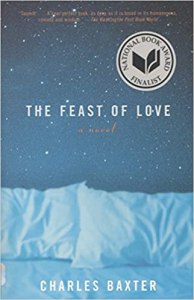
Somebody gave me a copy of this book (Charles Baxter, The Feast of Love, Random House, 2000. Vintage paperback edition, 2001, 308 pp.). It lay about my house for a long time, the bright blues of the cover occasionally calling out to me, “Read me.” I resisted, probably because the title put me off. “The Feast of Love” promises a light read, maybe a melodrama, nothing serious. The book, however, turns out to be a wonderful piece of literary fiction.

Here’s the epigraph, from Samuel Beckett’s Molloy: “Yes, there were times when I forgot not only who I was, but that I was, forgot to be.” Is the novel that follows about forgetting to be? Not really. This book as a whole is about being, and all the messiness of being human in flesh. That epigraph misleads the reader into thinking he’s in for something resembling Kafka, and the “Preludes” part that comes next—first subheading under “Beginnings”—reinforces that expectation of the Kafkaesque. In the prelude the writer Charles Baxter—most people call him Charlie—wakes up in the middle of the night and “cannot remember or recognize myself . . . I can’t manage my way through this feeling because my mind isn’t working, and because it, the flesh in which I’m housed, hasn’t yet become me.” Continue reading