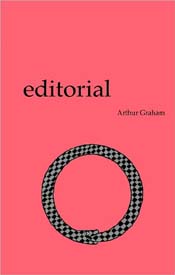
 At the onset, our protagonist in Editorial (CreateSpace, 140 pages) is sent to live with an aunt/uncle after the untimely death of his parents, and he finds the routine and familiarity therapeutic in a sado-masochistic sort of way, until the day comes when his aunt and uncle basically throw him out on his own with nothing possession-wise to speak of other than his porn mag collection. Well, at least our narrator handles it well: with wit, sarcasm, and what was probably a heat stroke induced delusion.
Category Archives: just literary fiction
The Death of Patsy McCoy by Levi Montgomery
 “His death began the moment we saw him. It just took a long time to consummate that death. We began to kill him when we first saw him…”
The Death of Patsy McCoy (Inflatable Rider Press, 147 KB) is a story about a murder, but long before that, it was a story about suicide. The suicide of a small town, the suicide of a new kid seeking acceptance, and the suicide of five young men who would never be able to push aside memories left behind in their childhood, memories that are nothing more than the strewn wreckage of innocence gone lost. Continue reading
Cities of the Red Night, The Place of Dead Roads, and The Western Lands by William S. Burroughs
 NOTHING IS TRUE. EVERYTHING IS PERMITTED
Undeniably the magnum opus of his later (some might say entire) career, the trilogy of novels produced by William S. Burroughs between 1981 and 1987 continues to cast its shadow as one of the most enduring pieces of experimental American literature ever written.
Whether readers find this “great work” to be great indeed or just greatly disappointing will largely depend on their opinion of Naked Lunch (1959) and his other novels from the 60s and 70s, because although the form and substance have matured quite a bit in the intervening decades, there is still much from these early cut-ups prefiguring the wild rides that are Cities of the Red Night (1981), The Place of Dead Roads (1983), and The Western Lands (1987). The lurid descriptions of sex, drugs, and violence are still very much present in Continue reading
Mefisto by John Banville
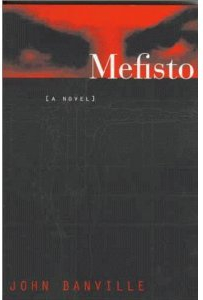 Gabriel Swan is the Faustian hero of Mefisto (Godine Press, pages 233). He is a savant mathematician, with talents that will make him out-of-place among uneducated poor Irish. With a desire to understand the truth of the universe, he believes that numbers will help him sense some “larger” pattern tying everything together. But as in Faust, what Swan does with his opportunities is disappointing. He hooks up with scam artists and junkies and, tragically, ends up being instrumental in his mentor’s efforts to prove there are no larger patterns. Continue reading
Love and Summer by William Trevor
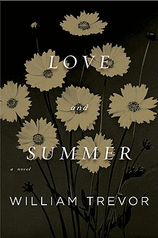 At the age of 81, William Trevor offered his 40th, or 44th book—something along those lines, depending on how you count the work, mainly fiction, novels, novellas and story collections, with some drama, nonfiction, a children’s book and editing interspersed. This latest novel, Love and Summer (Penguin, 2009, 211 pages), is not his best but it is good, in some respects excellent, even singular. Continue reading
Daddy’s by Lindsay Hunter
 Lindsay Hunter’s Daddy’s (Featherproof, 210 pages) is a fairly disturbing look at life in a southern rural area, though I think the book probably is meant to depict many rural areas. What the work is able to do, however, is entertain on more than one level through her craftsmanship in voice. The cold, matter-of-factness with which she writes is met in a simultaneous observational sentimentality, which works to then give us an inner clock-working machine we can hear clicking. Have you ever known a girl who has a deadpan sense of humor and this sort of distant manner yet simultaneously is obviously deep in existential thought? That’s what we’re working with here. Continue reading
Vestments by John Reimringer
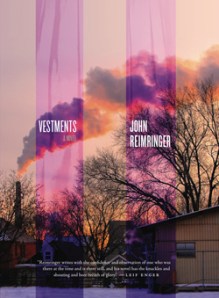 One of the pleasures of literary fiction is its fluidity, how it engages both the physical world and mental states, moving back and forth in a manner that not only reproduces the experience of being alive, but adds to it. The book in hand is less a mirror than an additional, highly sensitive appendage of the self.
John Reimringer’s Vestments (Milkweed, 407 pages) highlights the process by staking out two sharply contrasting worlds: the earthy, often violent family of James Dressler, a young man growing up in blue-collar Saint Paul, and James’ calling as a Roman Catholic priest, Continue reading
How to Survive a Natural Disaster by Margaret Hawkins
 It’s unfortunate that “adult entertainment” has become synonymous with porn, because there’s a shortage of the real thing. By that, I mean books and films for grown-ups. Not only about sex, but about the multitude of other concerns that mature people care about. These people know that there is more to life than celebrities, shopping and getting skinny. Or having to choose between zombies and vampires.
Margaret Hawkins’ How To Survive a Natural Disaster (Permanent Press, 199 pages) confidently embraces this fact and offers a literary novel that is both Continue reading
Look at the Harlequins! by Vladimir Nabokov
 Beginning with a list of the author’s “other” books, which don’t exist outside the distorted mirror world of what Nabokov calls “LATH” (as he acronymically pegs Look At The Harlequins! [Vintage, 272 pages] within that book’s own text) is a wildly inventive metafiction in the bilingually verbose hyper-alliterative Nabokovian mold. We get splendid sentences here on the jeweled gift of selfhood giving reason to resist suicide from whatever facet, cranky meditations on the author’s pederastic proclivities and ego, and, most brilliantly, strange slips down the semiotic slope into madness. In two or three places in this book we find ourselves in a meticulously rendered literary reality and then, through a process of what one might call Continue reading
Bob the Gambler by Frederick Barthelme
 The night after I finished this book I found myself before a slot machine in a small casino. I had a feeling and put a quarter in. I won and won again. I stuffed the quarters in my pockets but there were no buckets available. When I lost two quarters in a row I left. Unfortunately this was a dream and I awoke empty handed. Bob the Gambler (Mariner Books, 224) is a beautifully observed, enviably perfect novel by a master who doesn’t seem flashy because he stays within his means. It is also a surprisingly, even surreally loving story. The novel centers around the fissioned nuclear family of down-on-his luck Biloxi architect Ray Kaiser, a plump transplant moved by the Mississippi coastal decay before it was invaded by “gussied-up Motel 6 hotel Continue reading
 Dactyl Review