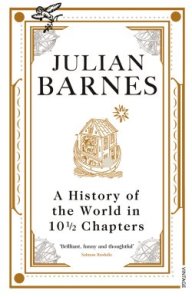
A History of the World in 10 1/2 Chapters by Julian Barnes

God’s all-time bestseller, The Book, might be described (I wish to offend no one) as metafiction; it was written, divinely, by its main character, Who appears in various forms, at crucial cliff-hanger moments, as Himself. Unfortunately, so the story goes, God’s sixth-day creation, us — or more accurately our ancestors — made a muddle of His work, so God recruited Noah & Sons to cruise.

Mr. Julian Barnes launches A History of the World in 10½ Chapters (Knopf, 307 pages) with his own mock-knowing version of history, as reported by a wiseacre, truth-telling woodworm (baby termite?) stowaway, one of several who survived the trip. Why the need to sneak? Woodworms were not one of God’s chosen species, which leads Continue reading
Alien Autopsy: Stories by Pedro Ponce

Pedro Ponce offers eighteen very short stories in this slender volume (Cow Heavy Books, 55 pages). Within the brief space Ponce delegates for himself not much can happen, but these vignettes do manage to develop vigorous fabula-like themes. In each short piece, a subject is opened, then skillfully closed. Continue reading
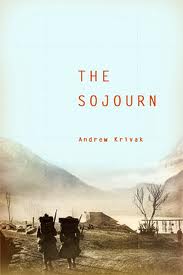
The Sojourn by Andrew Krivak

There will, unfortunately, always be a need for books about war, and this need takes many forms. In The Sojourn (Bellevue Literary Press, 191 pages), Andrew Krivak successfully defends the parish of the novel. Although the harsh imperatives of history require much sifting of facts, places and victims—synthesis and hindsight are essential, as part of our troubled species’ perverse CV—the novel, with its relentless subjectivity and its bloody-minded insistence on the plight of individuals, brings its own kind of necessary testimony. Continue reading

The Beach Beneath the Pavement by Roland Denning

Bernard Hawkes is a cynical, disillusioned journalist who finds himself in a spot of trouble when someone starts enacting the theoretical terrorist plots described in his satirical newspaper column. So begins this sardonic tale of conspiracies within conspiracies set in modern-day London.

With the sinister Tranquility Foundation (a New Age conglomerate promising “serenity with security”) on one side and the Primitive Front (a group bent on shaking people out of such complacency) on the other, Bernard’s previously humdrum existence suddenly becomes quite interesting as he is drawn ever deeper into the intrigue behind the bombings. Adding to his problems are Inspector Pitmarsh, the paradoxically chummy yet menacing police detective, a vivacious young revolutionary calling herself Animal, and Dillwyn, his alternatively rational and paranoid neighbor. Continue reading

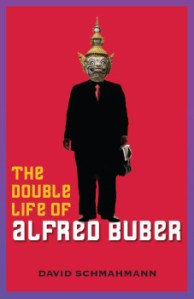
The Double Life of Alfred Buber by David Schmahmann

(Permanent, 197 pages) Who is Alfred Buber? In starkest terms, he is a respected Boston lawyer who falls in love with a Thai sex worker named Nok. Not surprisingly, they do not live happily ever after. This is not a book of neat resolutions.

But it is a story full of interesting ruminations, which are often amusing, sometimes provocative, and consistently engrossing. Narrated in the first person, the novel moves deftly between past and present and provides a nuanced portrait of loneliness. Continue reading

Dr. Jesus and Mr. Dead by Cooper Renner

Spanish poetry translator, publisher of elimae press, and celebrated indie writer, Cooper Renner has written a debut novel Dr. Jesus and Mr. Dead (Ggantijia, 215 pages). The work is an amalgamation of historical fiction, and ebbs and flows across hundreds of years and multiple psyches. Disturbing, entirely entertaining, and expertly written prose which drawls in slow, southern sweeps, Dr. Jesus and Mr. Dead is dripping with beautiful language, harsh imagery and heady inquiry. Continue reading

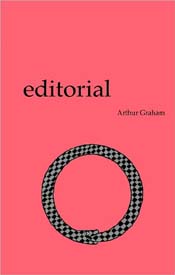
Editorial by Arthur Graham

At the onset, our protagonist in Editorial (CreateSpace, 140 pages) is sent to live with an aunt/uncle after the untimely death of his parents, and he finds the routine and familiarity therapeutic in a sado-masochistic sort of way, until the day comes when his aunt and uncle basically throw him out on his own with nothing possession-wise to speak of other than his porn mag collection. Well, at least our narrator handles it well: with wit, sarcasm, and what was probably a heat stroke induced delusion.

Continue reading

The Death of Patsy McCoy by Levi Montgomery

“His death began the moment we saw him. It just took a long time to consummate that death. We began to kill him when we first saw him…”

The Death of Patsy McCoy (Inflatable Rider Press, 147 KB) is a story about a murder, but long before that, it was a story about suicide. The suicide of a small town, the suicide of a new kid seeking acceptance, and the suicide of five young men who would never be able to push aside memories left behind in their childhood, memories that are nothing more than the strewn wreckage of innocence gone lost. Continue reading

Randolph’s One Bedroom by Andrew Oberg

Randolph’s One Bedroom (CreateSpace, 156 pages), for me, wasn’t so much about Randolph as it was his state of mind, specifically how he dealt with the everyday oddities of his world. The truth is stranger than fiction, and where Randolph lives, pretty much everything is strange. What I think I loved most about this story collection was that none of the characters were all that out of the ordinary. We are surrounded by the bizarre every single day, and we, like Randolph, have become unaffected by the goings on around us. If we didn’t insulate ourselves in this way, we would all be mental by now. When I see some of the things my own neighbours do, I swear my husband and I are the only normal people on the block. That’s a stretch, all things considered, but then we think, hey, they probably think we are weird, and they wouldn’t be that far off base. That’s really the whole point of the book I think: it’s an abstract look at society’s various psychological tics. Randolph’s cursing pet parrot is really the only thing predictable in his entire world, well, that and he never gets any mail. Continue reading

Cities of the Red Night, The Place of Dead Roads, and The Western Lands by William S. Burroughs

NOTHING IS TRUE. EVERYTHING IS PERMITTED

Undeniably the magnum opus of his later (some might say entire) career, the trilogy of novels produced by William S. Burroughs between 1981 and 1987 continues to cast its shadow as one of the most enduring pieces of experimental American literature ever written.

Whether readers find this “great work” to be great indeed or just greatly disappointing will largely depend on their opinion of Naked Lunch (1959) and his other novels from the 60s and 70s, because although the form and substance have matured quite a bit in the intervening decades, there is still much from these early cut-ups prefiguring the wild rides that are Cities of the Red Night (1981), The Place of Dead Roads (1983), and The Western Lands (1987). The lurid descriptions of sex, drugs, and violence are still very much present in Continue reading