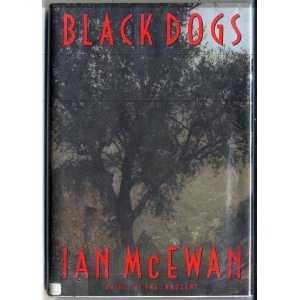
 Rarely does it seem that a great writer is recognized in his time, but Ian McEwan is an exception. Using the trope of two black mastiffs left behind by the Gestapo but still menacing the beautiful French countryside, in Black Dogs (Nan A. Talese, 149 pages) McEwan tells the tale of an older couple June and Bernard Tremaine, living in different countries but still in love. The clever narrator, their son-in-law whose own parents died when he was eight, pieces together the interlacing of the private lives and world events of his adoptive parents from deathbed interviews with once-stunningly beautiful June and her big-chinned rational Marxist politician husband. The action toggles in space and Continue reading
Chinese Checkers: Three Fictions by Mario Bellatin. Translated by Cooper Renner.
 Chinese Checkers: Three Fictions (Ravenna Press, 139 pages). In “Hero Dogs: A Look at the Future of Latin America Envisioned as an Immobile Man and His 30 Belgian Malinois Shepherds” (2000), the collection’s second fiction, Bellatin reduces the theme of atrophied human nature and skewed relationships, explored in “Chinese Checkers,” to absurdity. In a nearly affectless prose unrelieved by symbol, metaphor, or ornament, the third-person narrator details the life of a paralytic recluse, a Beckettian protagonist of indeterminate age, whose single purpose is the care and training of thirty dogs “able to kill anyone with a single bite to the jugular.” Despite his immobility, the unnamed Continue reading
The Proud Beggars by Albert Cossery. Translated by Thomas W. Cushing.
 I often wonder about sentences – about their impact, their purity, their necessity of being. I wonder about wasted words, wasted pages, and wasted stories. I wonder every time I read.
Yet, whenever I reach for The Proud Beggars (Black Sparrow Press, 190 pages), I find myself in awe, mesmerized, a captive to Cossery’s mastery of language, his scenes, his characters, and his ideology. If there ever was the perfect literary book, for me, it is this one. Continue reading
The Secret Goldfish: Stories by David Means
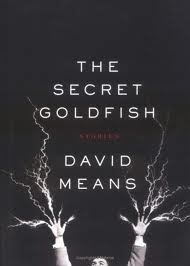 This inventive collection of stories, The Secret Goldfish (Fourth Estate, 224 pages), revolves around the off-kilter — either something happens that cannot be explained or the characters are bewildered about how they came to be where they are. In the title story, a goldfish survives for nine years despite the odds in a murky, nearly airless tank while a marriage disintegrates. “Blown From the Bridge” tells of the last moments a young man shares with his lover before she and her car are blown off the Mackinac bridge, her fate sealed by a mysterious dedication to her father. The main character of “Lightning Man” cannot escape a lifetime of lightning strikes, but he continues anyway through his ruined and Continue reading
The Deadwood Beetle by Mylene Dressler
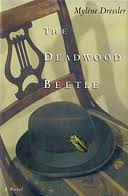 This wise and gorgeously wrought novel The Deadwood Beetle (Blue Hen Trade, 256 pages) had me by the heart from its first sentence. Tristan Martens, a retired entomologist in his seventies, has discovered by accident the blackened pine sewing table once owned by his mother in the Nazi occupied Netherlands. As he recognizes it in the New York antique shop – “this ghost, this small, lost thing, floating like a piece of impossible wreckage toward me” – he knows he must possess it to keep its secret from the world. The owner Cora Lowenstein, who has misinterpreted the childlike scrawl on the table’s underside, stands in his way. The table Continue reading
The Names by Don DeLillo
 DeLillo surely kept a journal while living in Athens and visiting various places in the Middle East and India. He noted scenes, described the climate and vegetation, philosophized on the locals then published his journal as the novel, The Names
 discovered that the narrator, who has been described as a Continue reading
Death with Interruptions by Jose Saramago
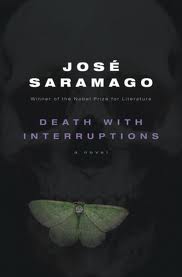 As a reviewer, there are two things you’ll want to know about me before bothering to read further. I only like literary fiction, and I only like literary fiction that’s a bit “difficult,” in one way or another, style or theme, preferably both.
A good theme for me might include controversial social issues, human paradoxes, ethical puzzles– problems to which there are no easy solutions. The concerns of unmarried 32-year-old woman and the plight of a middle-aged man whose affair is petering out are not real “problems,” in my view, nor is the temporary loss of faith in God or humanity. Continue reading
Willful Creatures: Stories by Aimee Bender
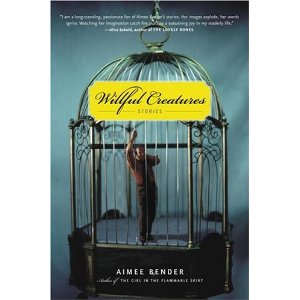 Aimee Bender’s stories are the contemporary descendants of those of the Brothers Grimm, with their surrealism laid on top of human desire and need. In both her previous collection, The Girl in the Flammable Skirt, and this newest one, Willful Creatures (Doubleday, 224 pages), her fiction adopts the tone of fairytales through the straightforward storytelling of the bizarre. Instead of a sausage growing on the end of a nose, Bender gives us potato children and a captive miniature man. Instead of a wicked stepmother, she conjures a collective group of predatory teenage girls. The “willful creatures” of the Continue reading
Garner by Kirstin Allio
 In the opening pages of Kirstin Allio’s debut novel, Garner (Coffee House Press, 232 pages ), young Frances Giddens is found by the town’s postman drowned in Blood Brook. It is 1925, and the town of Garner, New Hampshire is struggling financially. The postman, Willard Heald, is obviously troubled by Frances’s death even as he labors over his handwritten history of the town. His wife watches him with suspicion, for she suspects him of having harbored a crush on the spirited teenager. The summer boarders staying at the Giddens family’s house remain silent, as do those who lift her body out of the stream. No one dares utter the questions lurking in the reader’s mind: Did Frances kill herself or was she murdered? And why? Continue reading
My Dream of You by Nuala O’Faolain
 Nuala O’Faolain’s My Dream of You (Penguin, 464 pages) is a coming-of-middle-age tale about Irish women across decades looking for “something to love.” While the novel is overtly about passion, it also explores the meaning of coming home and leaving it, of familial ties, of friendship, and, most poignantly, of growing older. Fiftyish Kathleen de Burca finds herself bereft and alone when her best friend Jimmy dies, and she begins to question the choices she has made. A persistent memory of a former lover and his “gift” to her of court documents prompt her to quit her job as a travel writer and to research the scandalous affair between a Continue reading
 Dactyl Review