Don’t Look at Me, by Charles Holdefer

Go big or go home. In his new novel Don’t Look at Me (Sagging Meniscus Press, 282 Pages), author Charles Holdefer chooses to go big.

At the center of Don’t Look at Me is a young woman sidelined from a promising college basketball career by a nasty leg injury. Her name is Holly Winegarten, and she is six-foot-nine inches tall. Holly is never described as a giant and doesn’t suffer from the deadly ills immense size brings. Still, her height makes her unusual, painfully so.

After casting around for a personal direction post-accident, Holly discovers solace in an unexpected place, literature. Great language offers the self-conscious woman a much-longed-for way to diminish the isolation that accompanies her physical stature. Continue reading
The Berserkers by Vic Peterson

Prominent on the lists of popular commercial fiction and television today is a category called “Scandi-Noir” or “Nordic Noir,” characterized by a police point of view, plain language, bleak landscapes, a dark and morally complex mood, and murder, of course. As I began Vic Peterson’s novel The Berserkers (Hawkwood Books, 240 pages), I was anticipating exactly that sort of genre experience. The first chapter, depicting a crime scene investigation on a frozen lake, did not begin to alter my expectations until its final two paragraphs:

“A pale tangle lay beside the hole the girl had been sunk in. It then dawned on me that the pale tangle was the girl. Her body lay sprawled on top of the ice, displaced by the minor tsunami of the sinking car, and ejected from the ice like the cork from a champagne bottle. Her clothes spread about her in wet snarls lurid under the dim sun, a cape and corset and stockings.

The girl’s pallor was blue and ruinous. My jaw slackened. I tried to utter some words, any words, whether of shock, wisdom, or warning. No sound emanated from my lips. For a pair of large wings had begun unfolding around the corpse, beautiful, wispy, shivering with each gust like the pinfeathers of a hatchling drying in the dying light.”

Continue reading

Three Days by the Sea by Helen E. Mundler

My initial response when I started to read Helen Mundler’s Three Days by the Sea (Holland House Books, 300 pages) was “Yes, we need more of this.” In addition to the interest of the story, the book serves as a reminder of the strengths of literary realism, at a time when for many readers, journalism and nonfiction have replaced the novel as a chronicle of lived experience.

This situation is the product of a changing culture but it’s also, I think, the fault of many novelists, who too often settle for what I’ve come to think of as “weather report realism.” In these novels, Plot X or Y occurs against a backdrop of dutiful descriptions of everyday life, a supposedly reliable accounting of facial expressions, brand names and what the weather was like that day.

Of course life is full of facial expressions and brand names and weather, but verisimilitude is not an end in itself. Saying as much is nothing new. Surely it’s what Willa Cather had in mind when she defended the novel démeublé. As a masterful realistic writer, she knew the risks of her chosen mode. An artist can faithfully render how life appears while neglecting how it feels. “How wonderful,” Cather observed, “it would be if we could throw all the furniture out of the window.” Continue reading

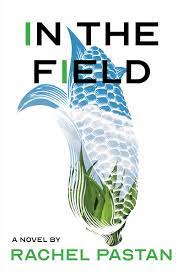
In the Field by Rachel Pastan

Literary fiction about science remains an exception. When C.P. Snow voiced concern in 1959 about “Two Cultures” in reference to the growing gap between science and the arts, it created a stir. Nowadays, no one would debate the notion. It has hardened into fact.

Often, when literary fiction tries to engage with science, it tends toward speculative writing. For instance, Kazuo Ishiguro’s Never Let Me Go or Ian McEwan’s Solar or any of a number of Richard Powers’ novels. They show a hypothetical present or future and ask: “What if?Continue reading

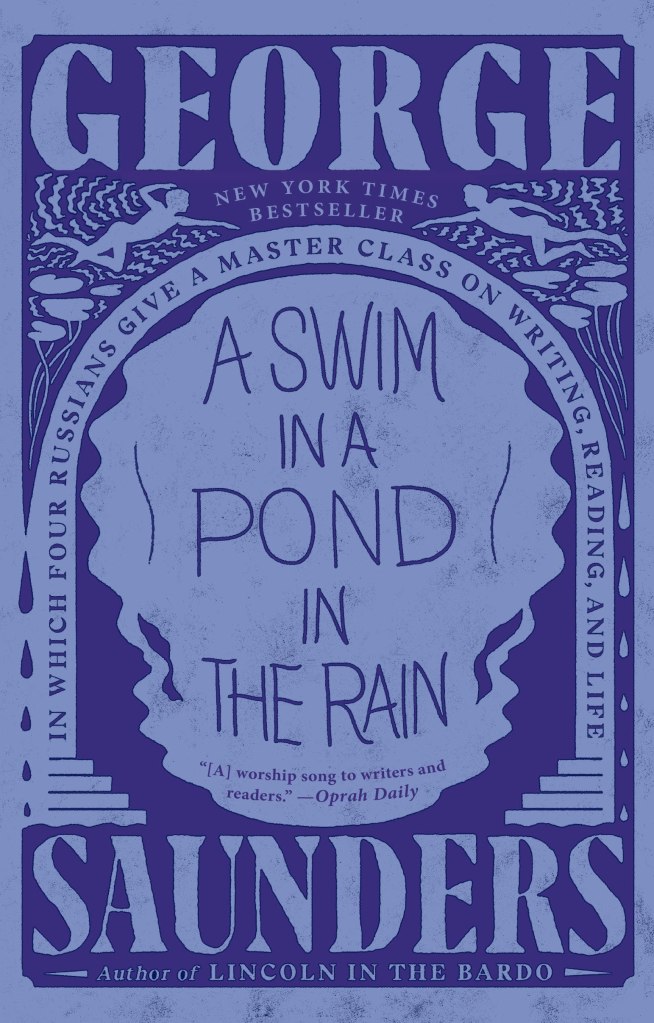
Commentary on Analysis by George Saunders of Story by Anton Chekhov


“In the Cart” (Yarmolinsy Translation)

From the book by George Saunders, A Swim in a Pond in the Rain

Note: I taught Russian literature in a university for thirty years. Naturally, I was intrigued when the short-story writer George Saunders published a book detailing how he teaches Russian stories in his creative writing classes at Syracuse University. Among those stories are two by Anton Chekhov that I once taught (“The Darling” and “Gooseberries”) and one by Nikolai Gogol (“The Nose”).

I decided that before looking at the Saunders commentary I would publish my own critical remarks on each story. The result would be an interesting contrast: material as presented by a teacher of Russian literature versus material as presented by a teacher of creative writing. The first story treated by Saunders is Anton Chekhov’s “In the Cart.” I have already posted my critical analysis of that story on my blog, “U.R. Bowie on Russian Literature” and on Dactyl Review. What follows below is my commentary on how George Saunders approaches the story.

Continue reading

“In the Wagon” (“На подводе”), by Anton Chekhov


 Telega (Wagon, Cart) With Wounded Soldiers

[Note: the story has appeared in English translation under a variety of titles; I know of at least three: “The Schoolmistress” (Constance Garnett trans.), “A Journey by Cart” (Marian Fell) and “In the Cart” (Avrahm Yarmolinsky, the translation discussed by George Saunders in his book, A Swim in a Pond in the Rain). My method, were I to be teaching this story in a course on Russian literature: I would read the original first, then compare translations, trying to pick the best one for my students to read. In quoting here from the story in English I use the Marian Fell translation, which appears in the Norton Critical Edition, Anton Chekhov’s Short Stories (edited by Ralph Matlaw). I have made slight changes in certain passages and have changed her title.]

The Structure of the Story, the Protagonist, the Venality, the “Slice of Life” Continue reading

Renato! by Eugene Mirabelli

Renato! (McPherson & Co, 577 pages) is a vast, rambling, delightful tale about the life and loves of Renato Stillamare, a once noted painter who mourns the decades-long dwindling of his reputation. He is also struck to the core by the loss of his wife, his near life-long love, and his complicated muse. The story is three previous novels merged through adroit craft into one. The first section offers the fantastic family origins in Renato’s mythic grandfather, a man half human and half horse. The second section is set a century later, covering the life of Renato, an aging painter wishing to reclaim his prominence in the art world. The third section follows Renato as he tries to revive his reputation and endure the scorching misery of widowerhood. Continue reading

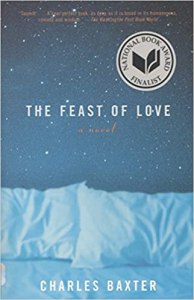
The Feast of Love, by Charles Baxter

The Title, the Epigraph and the Prelude

Somebody gave me a copy of this book (Charles Baxter, The Feast of Love, Random House, 2000. Vintage paperback edition, 2001, 308 pp.). It lay about my house for a long time, the bright blues of the cover occasionally calling out to me, “Read me.” I resisted, probably because the title put me off. “The Feast of Love” promises a light read, maybe a melodrama, nothing serious. The book, however, turns out to be a wonderful piece of literary fiction.

Here’s the epigraph, from Samuel Beckett’s Molloy: “Yes, there were times when I forgot not only who I was, but that I was, forgot to be.” Is the novel that follows about forgetting to be? Not really. This book as a whole is about being, and all the messiness of being human in flesh. That epigraph misleads the reader into thinking he’s in for something resembling Kafka, and the “Preludes” part that comes next—first subheading under “Beginnings”—reinforces that expectation of the Kafkaesque. In the prelude the writer Charles Baxter—most people call him Charlie—wakes up in the middle of the night and “cannot remember or recognize myself . . . I can’t manage my way through this feeling because my mind isn’t working, and because it, the flesh in which I’m housed, hasn’t yet become me.” Continue reading

The Deep Translucent Pond, by James Shelley

In James Shelley’s The Deep Translucent Pond (Adelaide Books, 192 pages), the Black Magus, “Cleveland’s greatest poet since Hart Crane,” is getting on in years and mentors his last two aspiring poets in an esoteric fellowship program known as the Triangulum. The Black Magus explains,

“The Triangulum Galaxy is the most distant light we can see with the naked eye. It contains a nebula, NGC 604. Radiation from new stars blows holes in the nebula, providing a view into its black interior. A star-birthing factory…The Tenth Triangulum’s first order of business is to understand holes.”

With references to Da Vinci’s Last Supper and triangles as the most stable shape, the novel opens with elements that are reminiscent of The Da Vinci Code. Jerome Konigsberg, one of the poets who has won the fellowship on the basis, in part, of a poem titled “The Regaining,” presents the poem in an introductory session:

I am realistic enough to know
If I stumble upon The Grail
It won’t be a chalice, haloed in
radial spokes of blinding white
I only hope
like the sighting of a rare bird
I recognize it before it slips away
long enough
to help keep my head above water

Scanning the horizon for rescue:
the next shimmer of light.

Continue reading

2021 Dactyl Foundation Award goes to Petri Harbouri

In his review of Petri Harbouri’s novel, The Brothers Carburi, U. R. Bowie, writes:

What do I like best about this book? I like a lot of things about it, but I like best the way the author loves words. Here is a description of what [Giovanni Battista Carburi], or any good physician, should be doing: “wrestling with obdurate diseases and overpowering them with an armamentarium—a good word, this—of powerful medicines.” The author loves words. Is there a better reason for writing creative literary fiction than a love for words? No. There is no better reason.

Apologies for the delay in announcing the award. It took a while to make contact with the author!

Petri Harbouri’s latest novel is Our Lady of the Serpents from Recital Publishing.