Herscht 07769 by László Krasznahorkai, translated by Ottilie Mulzet

[October 9, 2025, it was announced that László Krasznahorkai was awarded the Nobel Prize in Literature.] Here is a pertinent citation from Dennis Overbye (NY Times, 12/22/2024): “Everything that scientists have learned tells us that the universe is dynamic, and so is our knowledge of it. Nothing lasts forever, not even forever itself. Stars are born and they die, their ashes congeal in new generations of flash and crash. And so the show goes, until the last, biggest black hole gasps its last puff of subatomic vapor into the void.

“We don’t know what wonders await discovery back in the first nanosecond of time or in the yawning eons yet ahead. We don’t know why there is something instead of nothing at all. Or why God plays dice, as Einstein put it as he mulled the randomness implicit in quantum mechanics, the house rules of the subatomic realm.”

Continue reading

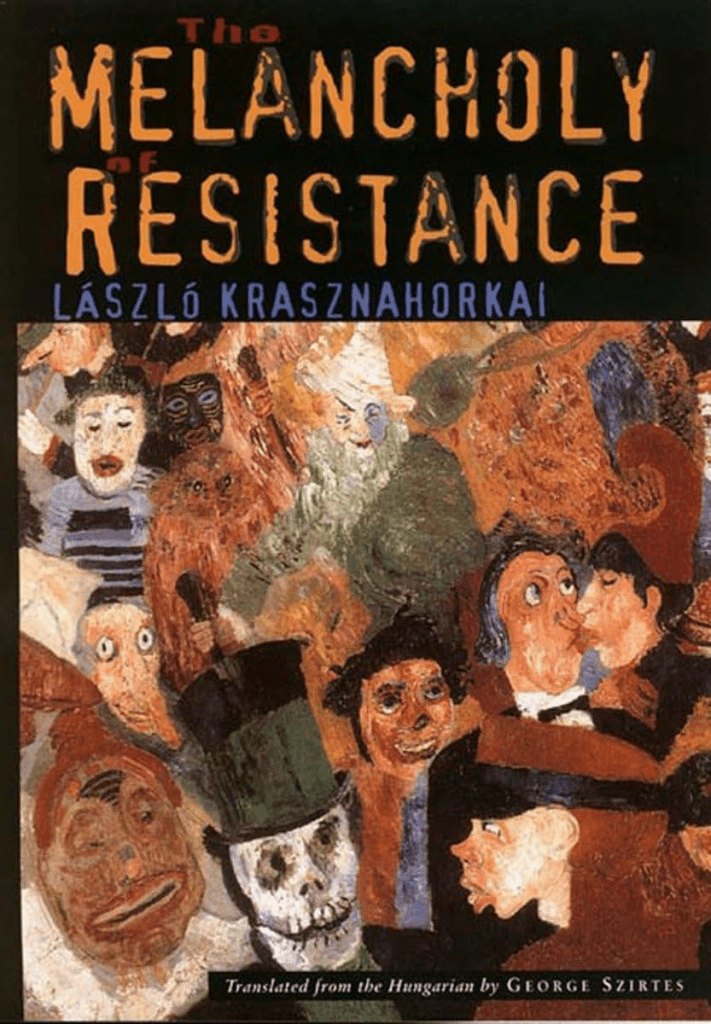
The Melancholy of Resistance, by László Krasznahorkai (translated by George Szirtes)

Part One: “An Emergency: Introduction”

The Malaise

[Note: the part in quotes above is Krasznahorkai’s. These brief titles for various sections of the book are all he gives the reader to go on. I see this as a kind of perversity on the part of the storyteller, a middle finger stuck up in the face of the reader. Figure it out for yourself, sucker. Therefore, in my review—in aide of the reader—I sometimes provide chapter numbers and titles, the things the writer himself should have provided. A few breaks for paragraphs would have been a nice thing too. The words are crammed together in huge glomps on every page, so as to squeeze the tender brains of any reader. Dialogue is not set off in separate paragraphs, but placed in quotation marks in amidst the glomps.]

Continue reading

Son of the Morning, by Joyce Carol Oates

A man attempting to escape time and being in flesh, a man who does not wish to be, which is, for the most part, what all earthly creatures wish for most fervently: to be. In flesh. But for the most fanatic of religious believers, flesh is a problem. Time is a problem as well, and the most perfervid of believers seek timelessness and fleshlessness. Which is to be found where, other than in Death? One view: such a believer is beloved of the Lord, in that he is willing to renounce all earthly existence in flesh and being to embrace godliness. Another view: a person who refuses to accept the precious gift that God has given him—life in flesh with being in consciousness—is the worst of heretics. Is possibly even in the camp of Satan.

We begin on the first page with a direct address to the Deity by an unknown speaker; we begin with a man in flesh with time on his hands—someone crying out in the wilderness to the Lord. “You have promised that there shall be time no longer. Yet there is nothing but time in the desolation of my soul . . . I don’t want mankind, nor do I want the happiness of the individual without mankind. I want only You . . . There shall be time no longer, yet we are deep in time, and of it; and it courses through us like the secret bright unfathomable blood through our bodies, bearing us along despite our childlike ignorance of its power . . . Save me, O God, by thy name, and judge me by Thy strength and not by my weakness . . . I think of my mother’s broken body and of my father’s swarthy beauty and of my own soul, which drains away in time, minute after minute, even as I compose my desperate prayer to You.” Continue reading

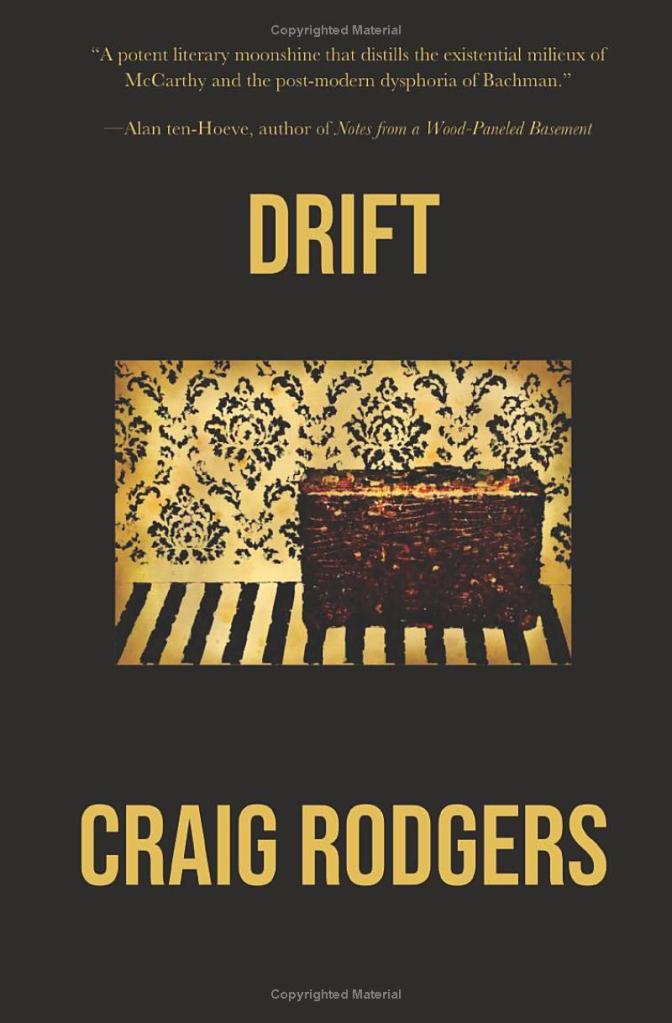
Drift by Craig Rodgers

Sometimes a novel’s originality is less a matter of affirmation than an act of refusal. Refusal to go along with received ideas of how to tell a story or create verisimilitude or even how words signify. Saying no opens up new space, or at least points towards what has been neglected by complacence.

Craig Rodgers’ Drift (Death of Print, 156 pages) is such a novel. A dystopian tale of a bible salesman named Charlie, it will defy the ingrained expectations of many readers. Plotwise, Charlie has no trouble making a sale: everyone seems to want his product. He has no idea why. Women like Charlie—no struggles there, either. Other characters include a clown on a rampage and a mysterious goon in a dented bowler hat who seems to be following Charlie. There’s a bearded lady, with whom Charlie has sex, and a young boy afflicted by plague who becomes his travel companion. Then the boy steals Charlie’s car. Continue reading

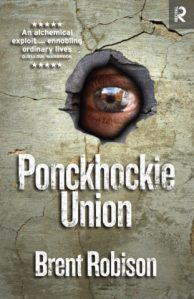
Ponckhockie Union by Brent Robison

Ponckhockie Union (Recital Publishing, 208 pages) is a novel for the connoisseur of the uncanny. The story is about Ben Rose, a documentary filmmaker, who stumbles into a vortex of metaphysical uncertainties when trying to make a film about a Revolutionary War historical site. He is estranged from his wife, doubtful about his future prospects, and vulnerable to having his bedrock assumptions upended. The more Ben grasps, the less stable his life is. The tipping point in the narrative comes when Ben encounters – or encounters again – a lying sociopath who may or may not be an assassin and may or may not get murdered. Ben is held hostage in a cellar for two weeks before escaping, realizing only too late that the way out had been available all along.

I don’t want to let the cat out of the bag with too much detail, but the narrative seesawing is on par with Kafka or Borges. Once certainty is asserted, it is as quickly diminished. Add to that a dollop of paranoia a la Philip K. Dick, and you get the drift. If there is a cat to be let out of the bag, it is Schroedinger’s.

The overall atmosphere is of a thriller. An intense thriller. The notes of ominous transformations are quietly sounded in the introduction of the sociopath calling himself Les Spanda:

He gave me a wide grin and reached out a broad meaty hand. As I shook it, a vague sensation began to dawn in me that I had met this man before. I couldn’t grasp any specific memory, so I just thanked him, and walked back to my car.

Later, we learn that “spanda” is a Sanskrit word meaning divine vibration or pulse inseparable from being, a cosmic expansion, and contraction. Breathe in. Breathe out. Now hold your breath, and keep holding, holding, holding. That’s the mood Robison seems to be after. Continue reading

The Feast of Love, by Charles Baxter

The Title, the Epigraph and the Prelude

Somebody gave me a copy of this book (Charles Baxter, The Feast of Love, Random House, 2000. Vintage paperback edition, 2001, 308 pp.). It lay about my house for a long time, the bright blues of the cover occasionally calling out to me, “Read me.” I resisted, probably because the title put me off. “The Feast of Love” promises a light read, maybe a melodrama, nothing serious. The book, however, turns out to be a wonderful piece of literary fiction.

Here’s the epigraph, from Samuel Beckett’s Molloy: “Yes, there were times when I forgot not only who I was, but that I was, forgot to be.” Is the novel that follows about forgetting to be? Not really. This book as a whole is about being, and all the messiness of being human in flesh. That epigraph misleads the reader into thinking he’s in for something resembling Kafka, and the “Preludes” part that comes next—first subheading under “Beginnings”—reinforces that expectation of the Kafkaesque. In the prelude the writer Charles Baxter—most people call him Charlie—wakes up in the middle of the night and “cannot remember or recognize myself . . . I can’t manage my way through this feeling because my mind isn’t working, and because it, the flesh in which I’m housed, hasn’t yet become me.” Continue reading

The Songs and Laments of Loömos, by René de Saint-Denis

With his Loömos book (Laocoön Press, 2021, 128 pp.), the author attempts a presentation of art as an integrated whole. As the subtitle tells us, “Text, drawings, paintings, music and sculpture” are included here. We read the words of the book, but, simultaneously, we interact with everything else. We, of course, do not interact directly with the sculptures by Saint-Denis—here we must be content with their visual representations. Nor do we hear the actual music, as this is not an audiobook. But the final section, “Songs and Laments,”—four separate pieces comprising a total of fourteen pages—consists entirely of musical notations.

Therefore, in order to “hear” the music of the final section you have to be a musician yourself, able to read the notes provided on paper. The author may have considered publishing an audiobook, or including a CD of the final section with this paperback. But then again, given certain unique and avant-garde features of Loömos, he may have deliberately intended the final section not to be played. So as to achieve something like what the composer John Cage created when he wrote his famous composition consisting of silence. All the musicians sit in stillness on the proscenium, holding their instruments, while the conductor stills his baton and all his gesticulations. The “music” consists of isolated coughs and throat-clearings from the audience, plus a few car horns blowing and ambulance sirens from the outside world.

Continue reading

Milligan and Murphy by Jim Murdoch

I’ve always been fascinated by stories of doubles, twins, doppelgangers, minds and actions mirrored (perhaps as a reaction against the profound truth that each of us is utterly unique, and therefore alone). Jim Murdoch’s short novel, Milligan and Murphy (Fandango Virtual, 180 pages), is not really one of those stories, but it toys with the trope of twins who together make a single person. The half-brothers Milligan and Murphy (both named John!) are not twins but are enough alike that their non-twinness is just a technicality. Murphy, the firstborn, may be a shade more introspective, and Milligan a trifle more action-oriented, but essentially they are one mind, and the fact that they inhabit separate bodies is primarily a storytelling device. Without it, the extensive dialogues exploring their limited reality would become claustrophobic solipsism. Such is the reason for the respectable literary history of twins, brothers/sisters, bosom buddies, even the hero/sidekick construct: it works. Continue reading

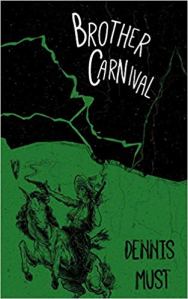
Brother Carnival by Dennis Must

In Brother Carnival (Red Hen Press, 209 pages), a fiercely engaging literary work, Dennis Must plays with time and character, leading the reader into a special world of space and time, almost a quantum universe, where characters can be in two places at the same time–or can they? Laced with an intense investigation into the nature of divinity and deities, Brother Carnival weaves an impressive litany of human weakness into the warp-quest for the divine. These lines point to the nature of Our Problem: Continue reading

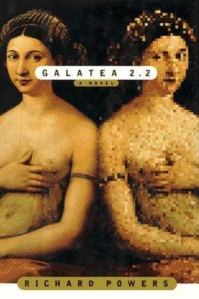
Galatea 2.2 by Richard Powers

I happen to be contemplating these days how Artificial Intelligence (AI) differs from Biological Intelligence (BI), and so I finally took down Galatea 2.2  (FS&G, 329 pages) from my bookshelf where it has stood waiting for me for about fifteen years. I may have belatedly cracked the spine, but the pleasure of reading good science fiction only improves as its predictions either come to pass or not.

The main plot turns on a Turing Test. Can scientists train a neural network to pass a comprehensive literature exam? Continue reading