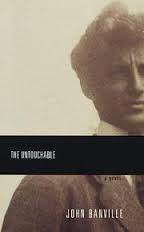
 When Banville is writing at his best, he tends to reminisce about people and places rather than tell a story. In The Untouchable (Knopf, 668 pages), Victor Maskell, an Irishman living in England, becomes a spy for the Soviets during World War II. The book begins when the elderly Sir Maskell’s secret past has been revealed in the press. A young biographer, Serena Vandeleur, comes to interview him, and he takes the opportunity to look back over his life. Banville’s most artful writing is to be found in the plotless parts of the narrative, where he is working on characterization by relating memories of his childhood and young adulthood. Continue reading
Author Archives: VN Alexander
Alien Autopsy: Stories by Pedro Ponce
 Pedro Ponce offers eighteen very short stories in this slender volume (Cow Heavy Books, 55 pages). Within the brief space Ponce delegates for himself not much can happen, but these vignettes do manage to develop vigorous fabula-like themes. In each short piece, a subject is opened, then skillfully closed. Continue reading
Shadowplay by Norman Lock
 Shadowplay (Ellipsis Press, 137 pages) by Norman Lock, is the 2010 Dactyl Foundation Literary Fiction Award recipient. Lock’s novella is a dense fable, mixing magic realism with self-reflexivity. The entire story is given to us in miniature at the beginning, such that the novella itself is really a constant retelling–a folding and refolding–rather than an unfolding. A shadow puppet master named Guntur falls in love with Candra, who comes into his theater one day to buy puppets. When she dies of typhoid fever six days later, he falls into despair for many years, until finally he understands how to enter the world of the dead, Continue reading
Mefisto by John Banville
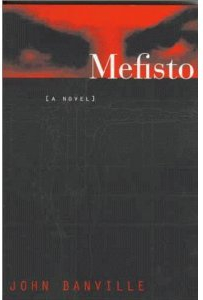 Gabriel Swan is the Faustian hero of Mefisto (Godine Press, pages 233). He is a savant mathematician, with talents that will make him out-of-place among uneducated poor Irish. With a desire to understand the truth of the universe, he believes that numbers will help him sense some “larger” pattern tying everything together. But as in Faust, what Swan does with his opportunities is disappointing. He hooks up with scam artists and junkies and, tragically, ends up being instrumental in his mentor’s efforts to prove there are no larger patterns. Continue reading
The Suburban Swindle by Jackie Corley
 With The Suburban Swindle (So New Books, 99 pages) Jackie Corley delivers a collection of memoir-like stories about drunk, pissed-off, reckless, late-teen and twenty-something Jersey suburbanites fucking up relationships and getting the shit beat out of them. The narrative voice, sensibly consistent throughout the collection and rising to a kind of tortured literariness, wedges a space between author-narrator (who is destined to get the hell out of there) and subjects (who aren’t going anywhere). The narrator is an outsider-in-the-making, not quite not-one-of-them yet, but well on her way. Throughout this collection, the language is kicking violently against the box it finds itself in, rebelling like a young suburbanite, trying to find its meaning. It’s angry and frustrated: Continue reading
The Names by Don DeLillo
 DeLillo surely kept a journal while living in Athens and visiting various places in the Middle East and India. He noted scenes, described the climate and vegetation, philosophized on the locals then published his journal as the novel, The Names
 discovered that the narrator, who has been described as a Continue reading
Death with Interruptions by Jose Saramago
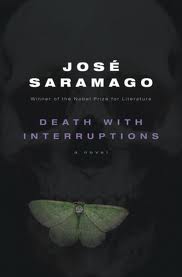 As a reviewer, there are two things you’ll want to know about me before bothering to read further. I only like literary fiction, and I only like literary fiction that’s a bit “difficult,” in one way or another, style or theme, preferably both.
A good theme for me might include controversial social issues, human paradoxes, ethical puzzles– problems to which there are no easy solutions. The concerns of unmarried 32-year-old woman and the plight of a middle-aged man whose affair is petering out are not real “problems,” in my view, nor is the temporary loss of faith in God or humanity. Continue reading
Salvation and Other Disasters by Josip Novakovich
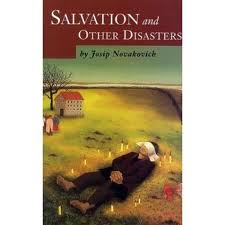 [Review adapted from an author introduction read at Dactyl Foundation October 2002 ] Despite the fact that Novakovich may write about what he knows — immigrant life or life in Croatia — these stories not the so-called “slice of life fiction” that is considered the epitome of realism these days. They are concerned with an artfulness in a way that much of contemporary fiction is not. They may remind you of myths. I want to make a comparison to one myth in particular, Oedipus Rex, not in terms of content but in terms of plot structure.
It has to do with the way he uses chance and coincidence. It’s something he does in many stories in his new collection, Salvation and Other Disasters, (Graywolf Press, 204 pages), Continue reading
Blood Meridian by Cormac McCarthy
 With all books, there is a difference between author and narrator. Sometimes the difference is slight, sometimes great. Omniscient narrators tend to reflect the author’s stance about the story more than, say, first-person narrators, which often strike poses very unlike the authors’, excepting the case of confessional “fiction” (which is not actually fictional). At first I thought the narrator of Blood Meridian: Or the Evening Redness in the West (Modern Library, 384 pages) spoke without irony, without distance being injected between his voice and the author’s feelings about the story. As I read on, I felt more and more an ironic distance between McCarthy and the narrator. I felt as if McCarthy were telling me to resist this narrative for its excesses, its hyperbole and its superstition and fatalism. Continue reading
Yellow Dog by Martin Amis
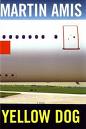 “Male violence did it.” Martin Amis has a bit of a reputation for making sweeping, declarative statements like this one that ends the first paragraph of Yellow Dog (Mirimax, 339 pages). I’ve read all of Amis’ books except Pregnant Widow and Koba the Dread (on my list, next) and I’m very familiar with the Amis conception of gender. I can make sweeping generalizations about his Men and his Women. Continue reading
 Dactyl Review