The Best American Short Stories, 2017

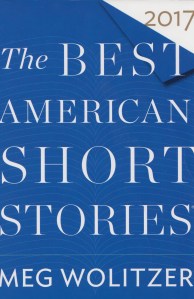
The Best American Short Stories, 2017 (Selected from U.S. and Canadian Magazines by Meg Wolitzer with Heidi Pitlor), Houghton Mifflin Harcourt, 2017, 303 pp.

Ten years ago the writer Elif Batuman wrote an article on two anthologies titled Best American Short Stories, for the years 2004 and 2005. Her amazing conclusion, well-reasoned and argued, was that many of the “best stories” in these collections were not very good stories. As she puts it, “Contemporary short stories contain virtually no reference to any interesting work being done in the field over the past twenty, fifty, or hundred years; instead, middle-class women keep struggling with kleptomania, deviant siblings keep going in and out of institutions, people continue to be upset by power outages and natural disasters, and rueful writerly types go on hesitating about things.” Domestic realism. Urggh. Continue reading

On Literary Translation

These remarks are based, largely, on Emily Wilson’s book review of Mark Polizzotti, Sympathy for the Traitor: A Translation Manifesto (MIT Press, 2018). The review appears in the New York Review of Books, May 24, 2018, p. 46-47.

Assuming that most of us are not bilingual or trilingual, without literary translation we cannot read novels, stories, poems written in foreign languages. But practically no one seems to agree on what makes for a good literary translation. The crucial question always seems to be how much leeway the translator is given. Must he/she (1) remain very close to the original, producing a literal translation that may not read well in the target language? (2) diverge from the original to produce a kind of imitation? (3) push the imitation so far that it amounts to a traducing of the original (even though it may read well and be a work of creative art in the target language)? Continue reading

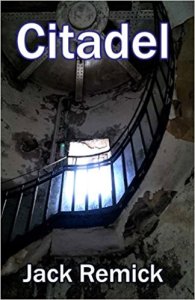
Citadel by Jack Remick

Citadel (Global, 372 pages) is a much needed, unforgiving and unapologetic evisceration of the idea of female inferiority we have so primitively accepted today and throughout history. Remick shows tremendous skill in the way he attacks such a heated and complicated subject. He never shies away from the atrocious acts of violence against women, but neither does he lose the magic of his whirlwind storytelling in favor of lecture. Citadel is an honest, sometimes savage look at the relationship between men and women, and what the world could be like if women were in control.

Trisha de Tours is an editor at Pinnacle Books and has been directed by her boss to find a bestseller. When she finds out the new resident in her condos, Daiva Izokaitis, has a manuscript called Citadel, she agrees to read it. Trisha soon finds out Daiva is a literary rebel, refusing to adhere to the fundamentals of writing and later refusing to participate in the editing process, yet she has created a revolutionary novel that overcomes Trisha so completely we see her drown in the story, and reemerging a different woman. Continue reading

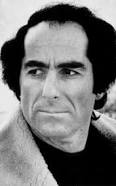
On Writing Fiction: The Case of Philip Roth (1933-2018)

“We must read only the kind of books that wound and stab us. If the book we are reading does not wake us up with a blow to the head, then what are we reading it for? A book must be the axe for the frozen sea inside us.”  …Franz Kafka

Some of the best writers in world literature—Kafka in German, say, Isaac Babel in Russian, Philip Roth in English—are the kind of writers who love to inflict blows to the head of the reader. In so doing they must, however, be ever aware that someone smacked upside the head will yell, and yell loudly.

Nathaniel Rich discusses this issue in regard to Roth (NYRB, March 8, 2018).

Philip Roth had “to defend himself and to explain himself to the paranoid assimilationists of his father’s generation who berated him for ‘informing the goyim that some Jews might not be paragons of virtue and might even possess human qualities.’” Roth told his detractors, “Fiction is not written to affirm the principles and beliefs that everybody seems to hold.” This was in response to the reaction to his story, “Defender of the Faith,” published in The New Yorker in 1959. Continue reading

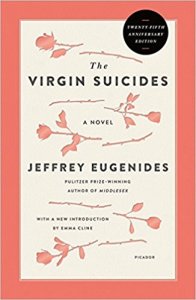
The Virgin Suicides by Jeffery Eugenides


Given that the twenty-fifth anniversary edition of “The Virgin Suicides” (Warner Books, 1993, 249 pages) is about to appear in print, now is a good time for another look at a novel that has become a modern classic in American literature.

Set in Wayne County, Michigan, in and around Grosse Point, a suburb of Detroit, “The Virgin Suicides” is steeped in gloom. Since it is narrated, however, with verve and humor, you don’t quite comprehend how sad it is until you’ve read the final pages. You put the book down and that’s when the melancholy grabs you by the soul. Continue reading

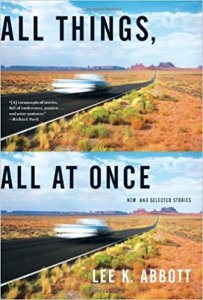
All Things All At Once, by Lee K. Abbott

Recently I’ve decided to read and review what are generally accepted as the best short story collections by living American writers. With publication of All Things All at Once (Norton, 365 pages), Lee K. Abbott, widely acknowledged as a “writers’ writer,” has seven collections of stories in print. His work has appeared in some of the most highly regarded literary journals. In addition, his stories have been featured in Best American Short Stories and have won O. Henry awards. This most recent collection features new stories, plus several previously published.
Continue reading

U. R. Bowie joins Dactyl Review as Contributing Editor

I am happy to announce that U. R. Bowie (pictured left) will be joining Dactyl Review as Contributing Editor. Bowie is the 2017 recipient of the Dactyl Review literary fiction award for his novel The Tale of the Bastard Feverfew. At DR we believe literary fiction writers make the best literary fiction reviewers. And vice versa. Bowie’s work offers substantial support for that premise.

Bowie has been contributing reviews regularly since the spring of 2016. As a professor of Russian literature, he brings special insight to novels that are touched by the Russian soul. His reviews of The Sympathizer by Viet Thanh Nguyen, The Betrayers by David Bezmozgis (both dealing with Russian themes) and his most recent review of The Trick of It by Michael Frayn (a novel about novel writing) stand out as the kind of reviews literary fiction authors want and need. (Read his reviews now, if you haven’t yet.) Unlike a lot of hack reviewers working for pocket change for the prepub make-it-or-break-it publications such as Publishers Weekly and Kirkus Reviews, Bowie, working for the love of it alone, has actually read the books he reviews, not just skimmed them. We can tell because he analyzes the actual language used by the author and does not make comments about the characters as if they were real people not literary constructs. Continue reading

Dactyl Foundation 2017 Literary Fiction Award

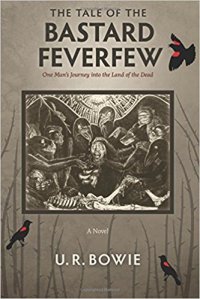
U.R. Bowie’s The Tale of the Bastard Feverfew: One Man’s Journey into the Land of the Dead wins Dactyl Foundation’s annual award for literary fiction.

Bastard Feverfew is about an insurrection at a maximum security prison. Mike Miller (author of Worthy of this Great City) reviewed this year’s winner, noting that “The book succeeds in that it leaves the reader with a sense of a journey taken. We’ve experienced a reality we’d prefer to deny, we’ve endured and survived but will never completely forget. That’s an accomplishment for both author and reader.”

In addition to publishing six novels/short story collections over the past four years (Gogol’s Head, Hard Mother, GoogleGogol, Disambiguations, Own: The Sad and Like-wike Weepy Tale of Wittle Elkie Selph, and Anyway, Anyways ), Bowie has been a prolific contributor to Dactyl Review in 2017.

Congratulations U. R. Bowie and many thanks to Mike Miller for submitting the review. Bowie and Miller each agreed to a review exchange this year, and we hope other reviewer/writers will be encouraged to support each others’ work.

VN Alexander, Editor

Support Dactyl Review, created by and for the literary fiction community.

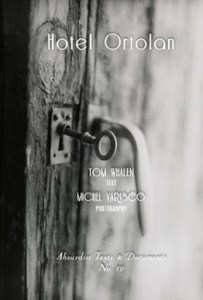
Hotel Ortolan by Tom Whalen

If you choose to read this book, to visit this Hotel, you will find it to be finely crafted by photographer Michel Varisco and writer Tom Whalen into a labyrinth of stairways and passageways of uncertainty, mystery, and intrigue, along which there are scattered bread crumbs, enticements, clues and innuendo that will take you down corridors that you hope will lead to your room. Henry Green described good prose as a “gathering web of insinuations.” Once you check in, whatever past you may have had will become a forgotten dream and then time itself will become inverted, then finally cease to have any meaning at all. Continue reading

The Heritage of Smoke by Josip Novakovich

In The Heritage of Smoke (Dzanc, 240 pages), a collection of short stories set mainly in 20th century war-wrecked Croatia or Ex-Yugoslavia, Josip Novakovich makes American-born writers, whose plots inevitably turn on sexuality and identity, seem merely whiny and self-obsessed. This masterful storyteller follows ordinary lives in the relatively small, recently-renamed Eastern European country, of which Americans are only vaguely aware, whose diverse cultures and old animosities persist through regime change. Caught between the whims and wars of super power nations and petty dictators, the characters revealed here endure, curse, and try to have fun. Novakovich’s characters tend to be listless, jaded, and stubborn, but they also have a kind of a dignified persistence, like old trees growing in the cracks of mountaintop stone . Continue reading