On Literary Fiction: Flannery O’Connor

Wise Blood

Fifty years after its publication Flannery O’Connor’s Wise Blood is still quite the bizarre little book. “Its parts seem not to fit together. For a book about the defiance of God it is strangely sportive, at once seedy and shiny bright.”

Paul Elie, The Life You Save May Be Your Own: An American Pilgrimage

That “strangely sportive” can be applied to nearly all of Flannery O’Connor’s fiction. It lends to her stories their special little gleam.

“Good Country People”

O’Connor wrote one of her most famous and memorable tales, “Good Country People,” in only four days. The story practically wrote itself. A quote from O’Connor: “I didn’t know he [the bible salesman Manley Pointer] was going to steal that wooden leg until ten or twelve lines before he did it, but when I found out that this was what was going to happen, I realized that it was inevitable.”

O’Connor read Nikolai Gogol while she was a grad student in Iowa and admits to being influenced by him. You wonder how aware or unaware she was of the similarity between Manley Pointer, her gatherer of human dead souls, and Pavel Chichikov, wholesale buyer of dead souls in Gogol’s novel Dead Souls. Both characters are traveling rogues, in the employ of Satan. Manley is Chichikov’s little brother.

U.R. Bowie
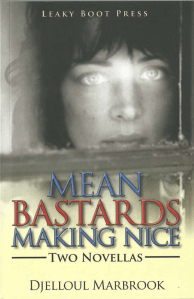


Mean Bastards Making Nice by Djelloul Marbrook

Mean Bastards Making Nice (Leaky Boot Press, 168 pages) is a slim volume from small UK publisher Leaky Boot Press. It contains two novellas related by theme and setting. It’s a thoroughly New York book, but that doesn’t mean stock Big Apple accents or tired tropes from TV. It means both city streets and upstate forests are simply there: as integral as the air the characters breathe.

To gloss the surface: “Book One: The Pain of Wearing Our Faces” introduces a painter, a composer, their shared alcoholism, and a mysterious woman who is a muse for both of them, but a dangerous one. “Book Two: Grace” follows a girl on the run from country to city, her discovery of her own warrior strength on the streets, and her profound impact on a few of the city’s art-world glitterati. Continue reading

Florida, by Lauren Groff

For the past couple of years I’ve been reading lots of short story collections by living American writers, looking for something that sparks with creativity, not often finding much. Lauren Groff is generally accepted as one of the prime divas of the MFA world of writing. The stories in this new collection, “Florida” (Riverhead Books, 2018), have been previously published in some of the premier venues in the U.S.: The New Yorker, American Short Fiction, Granta, Tin House, among others. They have been featured as well in three different anthologies of Best American Short Stories. Does that mean they are good? Alas, owing to the stranglehold that the standard MFA racket in fiction holds on these once-august publications, I’ve learned not to get my expectations up too high. Continue reading

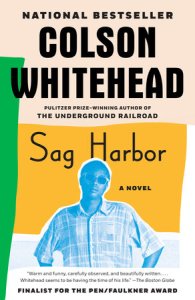
Sag Harbor by Colson Whitehead

Though I spent a not inconsequential portion of my early-twenties leisure time at Bay Street in Sag Harbor, where such reggae luminaries as Steel Pulse, Black Uhuru, Burning Spear, and Lucky Dube frequently performed, I did not know that not far from the concert venue was a neighborhood that had been built by African-American families after World War II. That neighborhood, made up of Azurest, Sag Harbor Hills, and Nineveh, is geographically and existentially at the center of Colson Whitehead’s  Sag Harbor  (Penguin/Random House, 352 pages).

Early in the novel, the now grown-up narrator Benji recalls his fifteen-year-old self settling into Sag Harbor for the summer of 1985 and contemplates the mythical aura that surrounded some of the people who came before him:

“What I did know about DuBois was that he fell into the category of Famous Black Folk—there was a way people said certain names so that they had an emanation or halo. The respectful way my mother pronounced DuBois told me that the man had uplifted the race.”
Continue reading

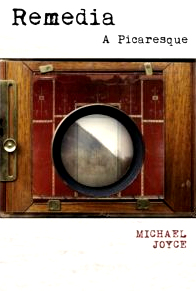
Remedia: A Picaresque by Michael Joyce

Three Explorations of Michael Joyce’s Novel Remedia, A Picaresque (Steerage Press 306 pages).

This review takes the form of three colloquies between two readers who seek to understand the multiple meanings of this enormously rich novel.

I. Scenes and Adventures

You finished Remedia.

Terrific novel—characters, places, drama, linguistic acrobatics, mystery. But I would’ve read it just to get to that great ending.

Very elegiac. The whole book resonates in it. Made me think of those last minutes of Mahler’s Ninth.

I need to talk about this book. Continue reading

Apothegms on Literary Fiction: Rebecca West

“Only part of us is sane: only part of us loves pleasure and the longer day of happiness, wants to live to our nineties [she did] and die in peace, in a house that we built, that shall shelter those who come after us. The other half of us is nearly mad. It prefers the disagreeable to the agreeable, loves pain and its darker night despair, and wants to die in a catastrophe that will set back life to its beginnings and leave nothing of our house save its blackened foundations. Our bright natures fight in us with this yeasty darkness, and neither part is commonly quite victorious, for we are divided against ourselves.”
Rebecca West, Black Lamb and Grey Falcon

U.R. Bowie


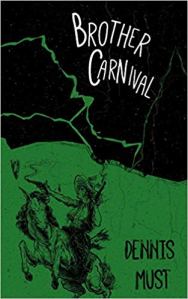
Brother Carnival by Dennis Must

In Brother Carnival (Red Hen Press, 209 pages), a fiercely engaging literary work, Dennis Must plays with time and character, leading the reader into a special world of space and time, almost a quantum universe, where characters can be in two places at the same time–or can they? Laced with an intense investigation into the nature of divinity and deities, Brother Carnival weaves an impressive litany of human weakness into the warp-quest for the divine. These lines point to the nature of Our Problem: Continue reading