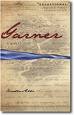
 In the opening pages of Kirstin Allio’s debut novel, Garner (Coffee House Press, 232 pages ), young Frances Giddens is found by the town’s postman drowned in Blood Brook. It is 1925, and the town of Garner, New Hampshire is struggling financially. The postman, Willard Heald, is obviously troubled by Frances’s death even as he labors over his handwritten history of the town. His wife watches him with suspicion, for she suspects him of having harbored a crush on the spirited teenager. The summer boarders staying at the Giddens family’s house remain silent, as do those who lift her body out of the stream. No one dares utter the questions lurking in the reader’s mind: Did Frances kill herself or was she murdered? And why? Continue reading
My Dream of You by Nuala O’Faolain
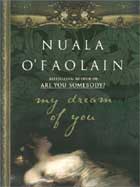 Nuala O’Faolain’s My Dream of You (Penguin, 464 pages) is a coming-of-middle-age tale about Irish women across decades looking for “something to love.” While the novel is overtly about passion, it also explores the meaning of coming home and leaving it, of familial ties, of friendship, and, most poignantly, of growing older. Fiftyish Kathleen de Burca finds herself bereft and alone when her best friend Jimmy dies, and she begins to question the choices she has made. A persistent memory of a former lover and his “gift” to her of court documents prompt her to quit her job as a travel writer and to research the scandalous affair between a Continue reading
The History of Love by Nicole Krauss
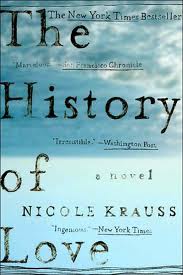 Nicole Krauss’s astonishing novel The History of Love (W. W. Norton & Company 252 pages), about a manuscript that survives the Holocaust, a flood, broken friendships, a plagiarist, misunderstanding, and obscurity has all the heart and intelligence of the best fiction being published today. Elderly Leo Gursky is afraid of dying unnoticed, and he plans his days so that people will see him and remember him. Among other schemes, he makes a scene in Starbucks and poses nude for a drawing class. Leo wasn’t always this lonely. Decades before, in a small town that was then part of Poland, he fell in love with a girl named Alma. He wrote a book Continue reading
Salvation and Other Disasters by Josip Novakovich
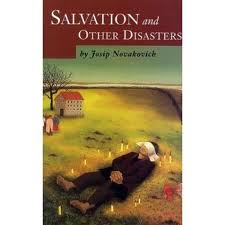 [Review adapted from an author introduction read at Dactyl Foundation October 2002 ] Despite the fact that Novakovich may write about what he knows — immigrant life or life in Croatia — these stories not the so-called “slice of life fiction” that is considered the epitome of realism these days. They are concerned with an artfulness in a way that much of contemporary fiction is not. They may remind you of myths. I want to make a comparison to one myth in particular, Oedipus Rex, not in terms of content but in terms of plot structure.
It has to do with the way he uses chance and coincidence. It’s something he does in many stories in his new collection, Salvation and Other Disasters, (Graywolf Press, 204 pages), Continue reading
Blood Meridian by Cormac McCarthy
 With all books, there is a difference between author and narrator. Sometimes the difference is slight, sometimes great. Omniscient narrators tend to reflect the author’s stance about the story more than, say, first-person narrators, which often strike poses very unlike the authors’, excepting the case of confessional “fiction” (which is not actually fictional). At first I thought the narrator of Blood Meridian: Or the Evening Redness in the West (Modern Library, 384 pages) spoke without irony, without distance being injected between his voice and the author’s feelings about the story. As I read on, I felt more and more an ironic distance between McCarthy and the narrator. I felt as if McCarthy were telling me to resist this narrative for its excesses, its hyperbole and its superstition and fatalism. Continue reading
The Thin Wall by Cheryl Anne Gardner
 This is probably the hardest review I have had to do yet. Prior to The Thin Wall (Twisted Knickers, 124 pages), I had read two previous books by Cheryl Anne Gardner, The Splendor of Antiquity, and Logos, and The Thin Wall is a radical departure from Gardner’s romantic roots into the realms of darker, subconscious psychology and individual philosophies she masterfully delves into in this work.
One word to describe this book for me? Drastic. Continue reading
Yellow Dog by Martin Amis
 “Male violence did it.” Martin Amis has a bit of a reputation for making sweeping, declarative statements like this one that ends the first paragraph of Yellow Dog (Mirimax, 339 pages). I’ve read all of Amis’ books except Pregnant Widow and Koba the Dread (on my list, next) and I’m very familiar with the Amis conception of gender. I can make sweeping generalizations about his Men and his Women. Continue reading
Oryx and Crake by Margaret Atwood
 Margaret Atwood’s Oryx and Crake (Nan A. Talese, 383 pages) presents the reader with a significant but rewarding challenge. Though as an author she rejects any association with the term “science fiction”, that basically is the genre in which this novel lives. And it really does come to life, though exactly which life-form might be open to debate.
Oryx and Crake are nicknames. Both are animal species and both are extinct. Oryx is female and Crake is male. They are both acquaintances of Snowman, who is really Jimmy. Continue reading
The Mysterious Secret of the Valuable Treasure by Jack Pendarvis
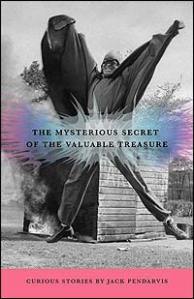 In The Mysterious Secret of the Valuable Treasure (MacAdam/Cage Publishing, 183 pages), Jack Pendarvis has the kind of wit that ambushes you – and then bludgeons you until you can no longer suppress the laughter. This collection of nine stories and a novella mocks bad writing and moronic thought through a complete submersion in each, with protagonists believing in absurd premises (like the dead-beat husband who imagines himself as a famous historian and the unemployed drinking buddies who want to be writers without doing the work.) The subtitle – “Curious stories” – Continue reading
Burr: a novel by Gore Vidal
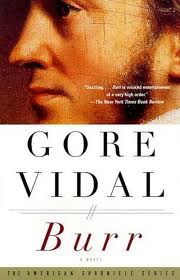 The passage of time edits history. The roughness and corners of detail wear away under the constant erosion of recall and interpretation. Eventually, unless events or people are sufficiently insignificant so they can be merely forgotten, the process rounds off what remains to form mere icons, summaries that become anodyne cartoons of once complex events and motives.
I can recall the celebrations that surrounded the bi-centennial of the American Revolution. At the time, I thought I knew something about the history. Names such as Washington, Jefferson and Adams became commonplace for a while. A couple of years before, Gore Vidal had published his novel Burr (Vintage, 448 pages), which I had not read. Having just finished it, nearly forty years Continue reading
 Dactyl Review