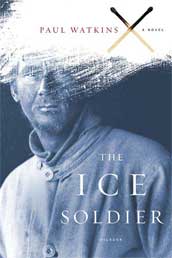
 At the beginning of Paul Watkins’s outstanding new novel The Ice Soldier (Henry Holt, 352 pages), narrator William Bromley embraces his quiet life. Just six years before, he served as a British soldier during World War II, and he now teaches English at a small boys’ school. To pass the time, he plays cards with two colleagues, avoids the woman he has a crush on, and meets for a weekly wine binge with his old friend Stanley. When the appearance of a former comrade Sugden triggers intense flashbacks to a failed mission in the Italian Alps, Bromley knows he is in trouble. His best friend Stanley does not understand his crisis, and instead presses him to meet the new Continue reading
An Unfinished Season: A Novel by Ward Just
 Ward Just’s novel about the loss of innocence is the type of novel that can sneak up on a reader with its unassuming style and emotional power. Told in the steady voice of narrator Wils Ravan, An Unfinished Season (Houghton Mifflin Harcourt, 251 pages) is set mostly in and around Chicago during the 1950’s. Wils, who will soon enter the University of Chicago, spends his summer divided between working for a tabloid newspaper and attending the obligatory debutante balls: seersucker jacket by day, tux by night. These Continue reading
Cotton by Christopher Wilson
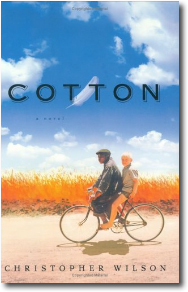 The title character of Christopher Wilson’s second novel, Cotton (Little, Brown, 320 pages) begins life as a blonde, white, blue-eyed boy born of a black mother. Lee Cotton’s problems are compounded by another oddity, his ability to hear the thoughts of both the living and the dead. If that were not enough, Lee discovers that his life holds surprising, even shocking, turns that ensure he will never fit in anywhere. First he survives a brutal, racially motivated assault that leaves him a John Doe, assumed to be white, in a neurological ward, and then, through a series of events, he undergoes major transformations that always Continue reading
Black Dogs, by Ian McEwan
 Black Dogs: A Novel
The Sea by John Banville

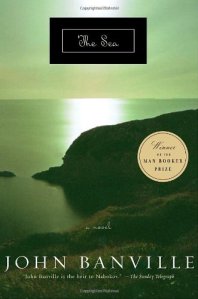 The Sea (Knopf, 208 pages) Spoiler alert. I don’t care for surprise endings, so I’m going to give this one away. If you’re at all like me, you may find it preferable to know more than what the jacket cover reveals about the story, that there was a death in the narrator’s childhood that he revisits in memory as an old man. It isn’t until the end of the book that we finally learn who dies, twin children with whom he had shared a memorable summer. They intentionally drown themselves. And although all suicides may seem shocking and unnecessary, these two especially so. The narrator also conceals Continue reading
The House of Meetings by Martin Amis
The House of Meetings (Knopf, 256 pages) is a narrative delivered as a long letter from an unnamed narrator, an 86-year-old Russian man, to his step-daughter Venus, living in Chicago. He is in the midst of traveling back home after many years in the U.S. The point of his journey is to revisit a work camp in the Artic where he had been held prisoner and slave laborer in the 40s and 50s. Particularly, he wants to visit the “house of meetings,” where, late in the labor camp era, the Soviets had begun allowing some prisoners to meet briefly with their wives. The narrator’s brother, Lev,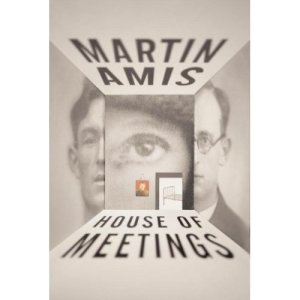 Continue reading
Walk On, Bright Boy by Charles Davis
 Set in Medieval Spain, Walk On, Bright Boy (The Permanent Press, 144 pages), a story of a boy’s first confrontation with political and religious corruption, strives less for historical accuracy than for universal applicability. Written with lovely economy and sensitivity, it is reminiscent of a fable or of a young adult coming-of-age tale. At the same time, however, it is also complex in its exploration of human foibles and conflicting philosophies.
Continue reading
 (The Permanent Press, 144 pages), a story of a boy’s first confrontation with political and religious corruption, strives less for historical accuracy than for universal applicability. Written with lovely economy and sensitivity, it is reminiscent of a fable or of a young adult coming-of-age tale. At the same time, however, it is also complex in its exploration of human foibles and conflicting philosophies.
 Dactyl Review