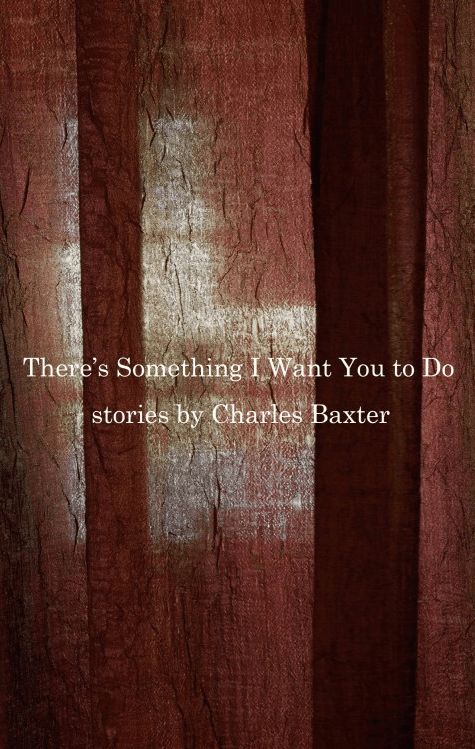
There’s Something I Want You to Do, by Charles Baxter

The Short-Story Novel

There is probably a better term for this, but I don’t know what it is. I refer to a book of short stories, so put together as to feature similar themes and recurrent appearances of the same characters: Charles Baxter, There’s Something I Want You To Do, Penguin Random House, 2015, Vintage paperback, 2016, 221 pp. The result being, if not a novel, at least something resembling a novel. All of the stories in this collection have titles featuring one aspect or another of human character, positive or negative. Part One: bravery, loyalty, chastity, charity, forbearance; Part Two: lust, sloth, avarice, gluttony, vanity. The stories are presented so that—with one exception—each story in Part One has a companion story (same characters) in Part Two.

America in the Twenty-First Century: Full of Somethings Somebody Wants

Quotations from various stories in the collection: “something has happened, I need to say something to you, something was about to happen, something is out there, we’re going somewhere [or nowhere?], something will happen to me, something wants something from me, there’s a thing that’s come up.” And, of course, the line that provides the title of the book: “There’s something I want you to do.” That line appears five times in various contexts. Continue reading

Machines Like Me by Ian McEwan

Machines Like Me (Nan A. Talese, 352 pages) by Ian McEwan is set in the possible world of the 1980s if Alan Turing had not died in 1954, Kennedy had not been shot in Dallas, and Britain had not won the war in the Falklands. In the story, Open Source information has allowed technological progress to sprint ahead, and the automatization of work is leading, first to high unemployment and then, presumably, to the creation of a universally idle population supported by the labor of machines. The hero, Charlie Friend, has recently purchased a life-like robot named Adam and he and his new love interest Miranda Blacke will together train and condition Adam to develop a personality and consciousness. Continue reading
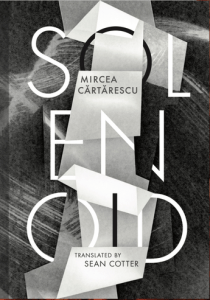
Solenoid by Mircea Cartarescu, translated by Sean Cotter

In “he Garden of Forking Paths,” Jorge Louis Borges’s postulates a novel so complex it would become “a labyrinth in which all men would become lost.” Left unfinished by its fictional author, the novel is a legacy emblematic of the innumerable possibilities of existence. For Borges, multitude makes the case for universal elusiveness—a sublimity in extremis.

With celebrated Romanian writer Mircea Cartarescu’s massive novel Solenoid, we are deep into Borges territory. Solenoid (Deep Vellum Press, 672 pages) is a chronicle told by an unnamed high school teacher whose Kafkaesque days are spent at public School 86 in Bucharest, “the saddest city in the world.” At night, the unnamed protagonist surrenders himself to the phantasmagoric spell of a “solenoid” buried beneath his house; the solenoid is a strange electromagnetic coil with dimension-bending properties. The solenoid causes the narrator to float above his bed. We learn how the mysterious contraption is built from concepts of Nicholas Tesla and the notion of the hypercube. Later, the solenoid is revealed to be one among an array of solenoids buried throughout the city. Ultimately, the narrator meets a woman with whom he falls deeply in love. In a finale that owes as much to science fiction as James Joyce, the couple, and the entire city of Bucharest, are launched spaceship-like from the surface of the earth, trailing a cone of infrastructure and debris. Continue reading

Young Pushkin, by Yury Tynyanov

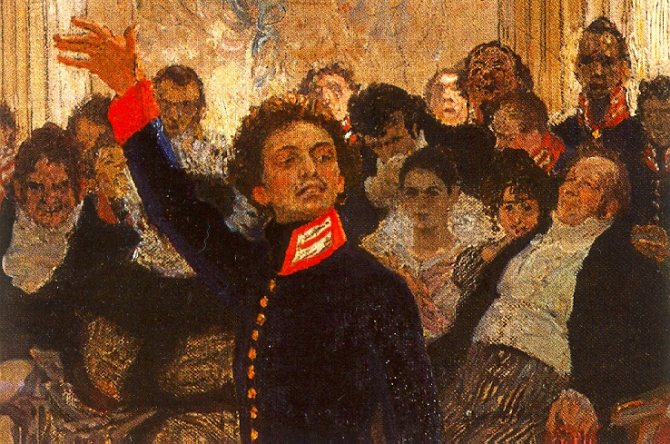
Yury Tynyanov, Young Pushkin: A Novel

(translated by Anna Kurkina Rush and Christopher Rush (New York: Overlook/Rookery) 2008, 515 pp.

[the Russian original: Юрий Тынянов, Пушкин (М: Издательство «Правда»), 1981]

Introduction

This is a historical novel, treating the life of Russia’s greatest poet from the year of his birth, 1799, to shortly after he graduated from the Lycée school in Tsarskoe Selo in 1817. Tynyanov’s original plan was to cover all of Aleksandr Pushkin’s life, until his death in a duel in 1837, but the author’s health failed. Beginning in 1935, the novel was serialized, but by 1943 Tynyanov was terminally ill with multiple sclerosis; at the end of that year he died at the age of forty-nine, leaving Part One (“Childhood”) and Part Two (“The Lycée”) completed to his exacting standards. What is Part Three as published here (“Youth”) is clearly in rough draft form, lacking the literary polish of the first two parts (more on this later). Even worse, what would be, say, Parts Four and Five—in which we would meet the mature poet, plus his mature literary works—remained a chimera. Continue reading

Drift by Craig Rodgers

Sometimes a novel’s originality is less a matter of affirmation than an act of refusal. Refusal to go along with received ideas of how to tell a story or create verisimilitude or even how words signify. Saying no opens up new space, or at least points towards what has been neglected by complacence.

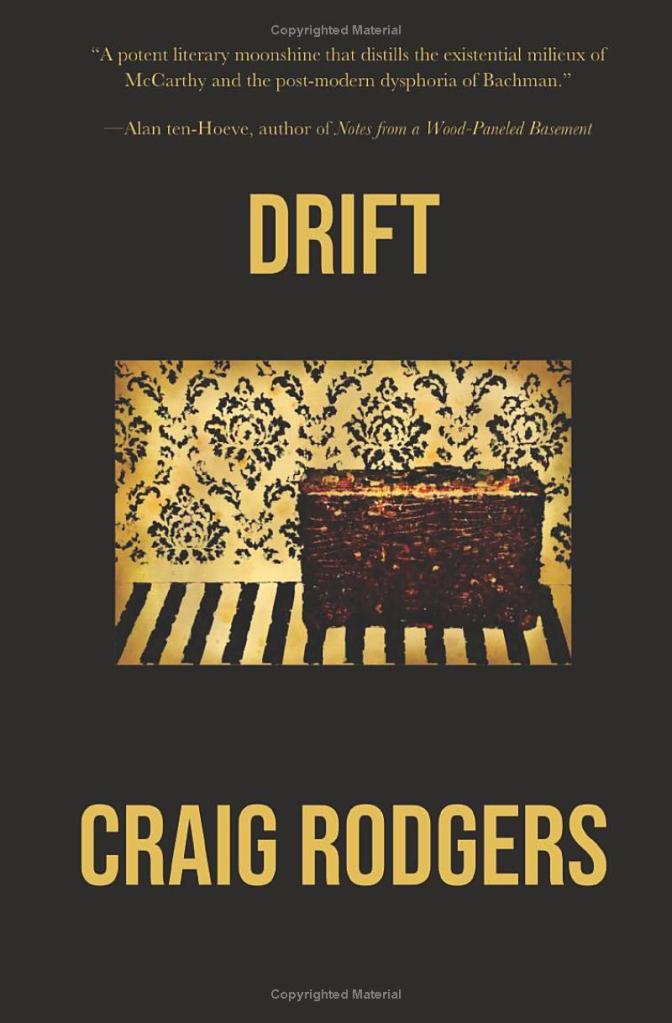
Craig Rodgers’ Drift (Death of Print, 156 pages) is such a novel. A dystopian tale of a bible salesman named Charlie, it will defy the ingrained expectations of many readers. Plotwise, Charlie has no trouble making a sale: everyone seems to want his product. He has no idea why. Women like Charlie—no struggles there, either. Other characters include a clown on a rampage and a mysterious goon in a dented bowler hat who seems to be following Charlie. There’s a bearded lady, with whom Charlie has sex, and a young boy afflicted by plague who becomes his travel companion. Then the boy steals Charlie’s car. Continue reading

Forgotten Night by Rebecca Goodman

In Rebecca Goodman’s novel Forgotten Night (Spuyten Duyvil, 296 pages) the unnamed narrator–we will call her N hereafter–is searching desperately but determinedly for a Madame Brissac. The reader is immediately enlisted in the search and will never leave N’s side, not even after putting the novel down. The night of the title may be forgotten, but this novel will remain forever in memory, a touchstone whenever World War I or the Holocaust is recalled.

N is one of those people you are irresistibly drawn to but are wary of. You are afraid for her. She knows that she’s looking for Madame Brissac, a name that has come to her from her grandfather Joseph’s tattered diary of WWI. But N is not an adept seeker, inquiring here and there, assailed by distractions, often in the form of artists of dubious motives. Nor is it clear in the beginning exactly what she hopes to learn from Madame Brissac. Who is Madame Brissac anyway? She would be a descendant of a fellow youth N’s grandfather encountered in 1907 in flight from Romania, where a peasant uprising focused its hatred on Jews. Does N find Madame Brissac? That is for each reader to decide, because Madame Brissac is not merely a person. She is the bearer of N’s hope that out of the senseless carnage of WWI and the unspeakable horrors of the Holocaust some meaning will emerge.

Continue reading

Dead Souls by Sam Riviere

Believe the Blurbers

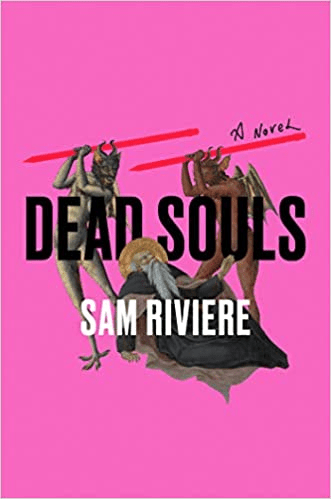
Dead Souls (A Novel by Sam Riviere, NY: Catapult, 2021, 289 pp.) is a rare example of a book containing believable blurbs. This wild gallimaufry of a novel, which runs a monologue through almost three hundred pages of text, without pauses for paragraphs or new chapters, is a tour de force of literary mania. Reviewers have pointed to possible influences: Roberto Bolaño, Georges Perec, Thomas Bernhard, Italo Calvino. One blurber, Nicolette Polek, describes the novel as “a rare and brilliant pleasure, a coiling, searing fugue of a book that takes our deranged culture and pulls forth from it a box of stars.” She’s right. Or, to put it in the fully neutered style in which the book is written, they are right.

There are chapters of sorts, but you have to figure them out yourself. In the front matter the author provides a kind of contents page—not labeled as such—listing names of characters as names of chapters, along with the pages where they start. Begin with an introductory chapter (not listed in these “contents”), then go, first, to “Zariyah Zhadan,” p. 32: this is, presumably, Chapter One. Proceed from there, filling in the chapter numbers beside the given name and page number. Chapter Six comprises two named characters. We end up with “The Scholastici,” p. 253, which is the last of twelve chapters. Continue reading

Hiking Underground by Amy Smiley

In Hiking Underground (Atmosphere Press, 203 pages), three urban naturalists explore the relationship between art and reality in episodic reveries about nature. Although the narratives ostensibly take place mostly in parks in Manhattan and Maine, the real action is in the minds of the characters as they explore the great outdoors and grow as artists and as individuals.

It worked, thematically, for me to think of the three main characters, Adam, Alice and Emma, as the same person at different stages of development. In the story, Adam is Emma’s six-year-old son; Alice is Emma’s student and Adam’s babysitter; Emma is a professional artist and a teacher. The book is divided into sections dedicated to each one of them in turn, although the focal point does visit different perspectives within each section. Adam’s sections are a portrait of the artist as a young child; Alice’s are of the artist as a student, whose emotional memories need resurrecting; Emma’s are of the consummate artist who is satisfied with her creations and begins the body of work that unites her past with her future. Continue reading

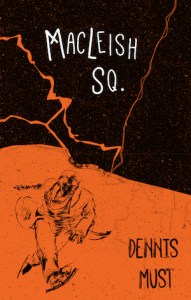
MacLeish Sq. by Dennis Must

Edward Said, writing about Beethoven’s late style, defined late style as that time wherein the artist freed from the expected cultural and historical restraints of form and content unleashes a newness that both confounds and instructs. Dennis Must has achieved that hour of newness in MacLeish Sq (Red Hen Press, 209 pages). With its visual complexities coupled to broad-ranging literary interconnections, Must’s writing raises the text to a “beyond” state where the readers have to let go of what they know. The readers must accept that their own hidden stories have been eclipsed and take this writing on its own without any pre-conceived notions of what “a novel” is or should be. Roland Barthes, now out of fashion to the post-post modern mind, wrote in his essays–Degrée zéro de l’écriture–that there are two kinds of writers which he called “l’écrivain and l’écrivant.” Must, in MacLeish Sq., brings us a third iteration of writer as his work approaches mythic status in which time, character, past, present, alive, dead—just a few of the literary polarities inhabiting this writing—interact at a level no reader can accept without relinquishing his/her own sense of person and being. Interweaving Dante, Melville, Hawthorne, Pirandello into a single narrative that seizes the essence of each, isn’t a style most readers will be comfortable with. Here, however, Must puts them together with such skill that the author lives on par with the masters. It will take an honest reader to admit–I have never read anything like this.

Continue reading

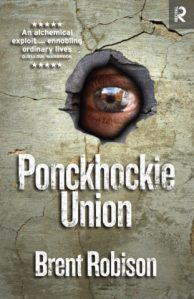
Ponckhockie Union by Brent Robison

Ponckhockie Union (Recital Publishing, 208 pages) is a novel for the connoisseur of the uncanny. The story is about Ben Rose, a documentary filmmaker, who stumbles into a vortex of metaphysical uncertainties when trying to make a film about a Revolutionary War historical site. He is estranged from his wife, doubtful about his future prospects, and vulnerable to having his bedrock assumptions upended. The more Ben grasps, the less stable his life is. The tipping point in the narrative comes when Ben encounters – or encounters again – a lying sociopath who may or may not be an assassin and may or may not get murdered. Ben is held hostage in a cellar for two weeks before escaping, realizing only too late that the way out had been available all along.

I don’t want to let the cat out of the bag with too much detail, but the narrative seesawing is on par with Kafka or Borges. Once certainty is asserted, it is as quickly diminished. Add to that a dollop of paranoia a la Philip K. Dick, and you get the drift. If there is a cat to be let out of the bag, it is Schroedinger’s.

The overall atmosphere is of a thriller. An intense thriller. The notes of ominous transformations are quietly sounded in the introduction of the sociopath calling himself Les Spanda:

He gave me a wide grin and reached out a broad meaty hand. As I shook it, a vague sensation began to dawn in me that I had met this man before. I couldn’t grasp any specific memory, so I just thanked him, and walked back to my car.

Later, we learn that “spanda” is a Sanskrit word meaning divine vibration or pulse inseparable from being, a cosmic expansion, and contraction. Breathe in. Breathe out. Now hold your breath, and keep holding, holding, holding. That’s the mood Robison seems to be after. Continue reading